

REQUEST DEMO
Robot CATALOG will be sent to your mailbox immediately after submission.
SUBMIT
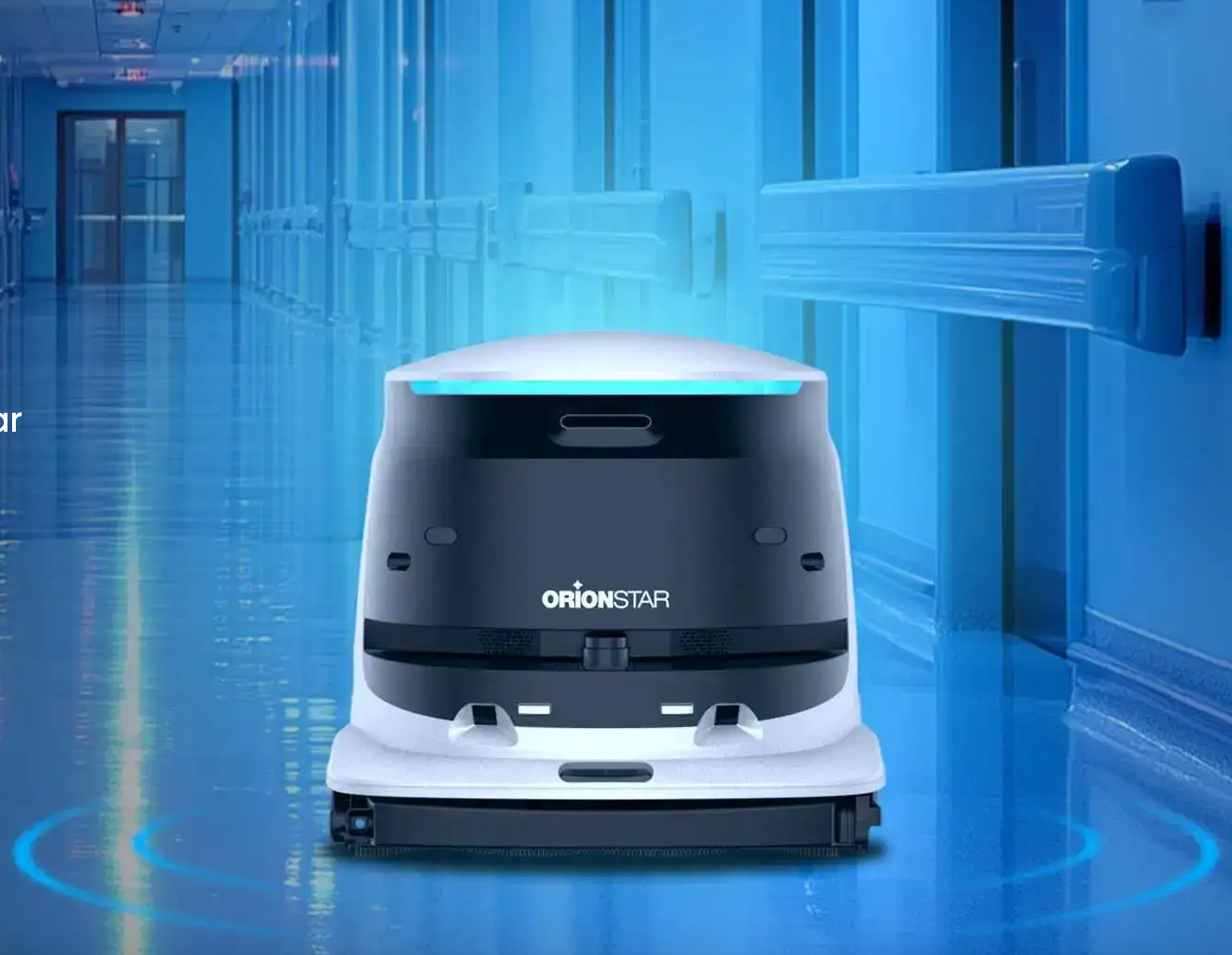
Healthcare facilities carry the highest stakes of any sector when it comes to floor maintenance. Hospital floors function as bioburden reservoirs where pathogens like MRSA and C. diff can settle in dust and potentially re-aerosolize into patient care areas. While clinical guidelines dictate that high-touch surfaces require the most rigorous disinfection, the floor remains a constant infection vector driven by staff footwear, wheelchair tires, and equipment wheels.
Simultaneously, Environmental Services (EVS) departments face structural understaffing. Annual EVS turnover in U.S. hospitals routinely runs between 40 and 80 percent. When a night-shift floor technician calls in sick or leaves for a less physically demanding industry, hospital operations teams must choose between approving expensive overtime, pulling staff away from other critical areas, or accepting a documentation gap—a severe risk during Joint Commission (JCAHO) accreditation surveys. To bridge this gap, healthcare facility managers are increasingly evaluating the hospital automatic floor scrubber category to standardize cleaning outcomes and stabilize daily operations.
Manual mop-and-bucket cleaning in expansive hospital spaces is slow, physically demanding, and subject to operator variability. An autonomous floor scrubber acts as a force multiplier for the EVS department. By automating the repetitive task of scrubbing miles of corridors, a hospital floor cleaning robot allows human technicians to focus on higher-value, detail-oriented tasks that require critical thinking, such as patient room turnover, terminal cleaning, and sanitizing public restrooms.
Consistency is a primary driver for this shift. An automated platform follows the exact same path, speed, and chemical flow rate during every session. This eliminates the variability caused by operator fatigue or shortcut behaviors, ensuring that long stretches of flooring receive a documented, uniform clean.
The OrionStar CleaniBot S55 Pro is engineered to handle large indoor commercial environments, combining sweeping, scrubbing, vacuuming, and mopping into a single platform. For EVS directors assessing its fit for healthcare environments, several specific capabilities align directly with hospital operational pain points.
Hospital corridors must remain navigable for crash carts, IV poles, and patient transport equipment. Oversized industrial scrubbers often create bottlenecks in these environments. The CleaniBot S55 Pro features a compact physical footprint (650 × 580 × 550 mm) and requires a minimum passing width of just 700 mm, according to manufacturer data.
This narrow clearance profile allows the unit to operate effectively in tight outpatient hallways and cluttered staff-only hallways without obstructing medical personnel. The robot utilizes a multi-sensor navigation system—including a LiDAR sensor, stereo camera, and ultrasonic sensors—to map areas up to 10,000 m² and detect sudden obstacles like moving stretchers or wandering visitors. Line lasers enable the machine to clean close to walls, minimizing the uncleaned edges that typically require manual follow-up.
A persistent challenge for EVS teams is completing intensive floor scrubbing during night shifts without disturbing resting patients. Industry benchmarks for hospital night cleaning target acoustic profiles under 65 dB. Under defined test conditions, the CleaniBot S55 Pro operates at 55 dB in standard scrubbing mode and drops to 45 dB in dust mopping mode. This quiet operation allows facility managers to schedule autonomous runs directly outside patient rooms or in nearby corridors during overnight hours.
Hospitals are not monolithic environments; they consist of mixed floor types and varying soil levels. Main lobbies and expansive reception areas may feature polished stone that requires daily dust mopping, while emergency department waiting rooms might need rigorous hard-floor scrubbing.
The CleaniBot S55 Pro supports zone-based mode switching. EVS managers can map the facility and program the robot to apply Power Scrubbing in high-traffic corridors, ECO Vacuuming in carpeted administrative areas, and quiet Dust Mopping in sensitive waiting rooms. Delivering a cleaning efficiency of up to 1,197 m²/h in scrubbing modes, the robot provides substantial coverage per shift. Its 25.6 V / 40 Ah battery supports up to 4.5 hours of continuous scrubbing, or up to 28 hours in dust mopping mode, before automatically returning to its charging dock.
If a robot requires complex daily maintenance, it negates the labor savings it was meant to generate. The CleaniBot S55 Pro is designed with EVS workflows in mind. It features a 22 L clean water tank and a 15 L wastewater tank. The wastewater tank is entirely removable and features a washable strainer design that can be fully immersed in water, helping staff prevent the odor and bacterial buildup common in standard scrubber recovery tanks. Furthermore, cleaning tools are modular, allowing technicians to switch brushes or pads quickly without specialized tools.
It is worth noting that facility requirements vary widely based on square footage and layout. The OrionStar CleaniBot series includes multiple models to accommodate different architectural layouts, ensuring that hospital operations teams can deploy the appropriately sized unit for their specific footprint.
For healthcare facility managers, proving that a floor was cleaned is just as important as the physical cleaning itself. JCAHO and CMS surveyors expect uneditable, timestamped records of cleaning activities. Paper logs are increasingly viewed as insufficient.
The CleaniBot S55 Pro supports Wi-Fi and 4G connectivity, enabling remote operational reporting. Facility directors can access digital session logs that verify the start/end times and total area covered, providing immediate proof of compliance during environmental audits.
However, deploying connected equipment in clinical settings requires strict data governance. Because the CleaniBot S55 Pro uses a stereo camera and LiDAR for spatial navigation and obstacle avoidance, healthcare organizations must verify compliance with relevant privacy frameworks before deployment. In the United States, operations teams must ensure the deployment aligns with HIPAA regulations regarding Protected Health Information (PHI), confirming that no sensitive visual data is stored or transmitted improperly. Similarly, European hospital deployments must undergo a thorough assessment to ensure compliance with the General Data Protection Regulation (GDPR), focusing on data minimization, local processing safeguards, and strict vendor data processing agreements.
How does the robot respond to sudden changes in hospital corridors, such as a parked supply cart? The robot utilizes a combination of LiDAR, ultrasonic sensors, and a stereo camera to update its map in real time. If a supply cart or wheelchair is left in its path, the sensors detect the object, and the robot automatically calculates a safe path around it to continue its cleaning cycle without requiring human intervention.
Does the CleaniBot S55 Pro clean inside patient rooms? No. A hospital automatic floor scrubber is designed for broad, continuous public spaces like corridors, lobbies, and large reception areas. Cleaning inside patient rooms requires critical human judgment, specialized high-touch surface disinfection, and terminal cleaning protocols that automated scrubbers are not intended to perform.
What is required to keep the robot operational day-to-day? EVS staff must perform basic daily maintenance, which includes emptying and rinsing the 15 L wastewater tank, refilling the clean water tank, and occasionally checking the low-curvature piping and modular brushes for physical blockages or debris buildup. The robot handles its own recharging by returning to its docking station automatically.