

REQUEST DEMO
Robot CATALOG will be sent to your mailbox immediately after submission.
SUBMIT
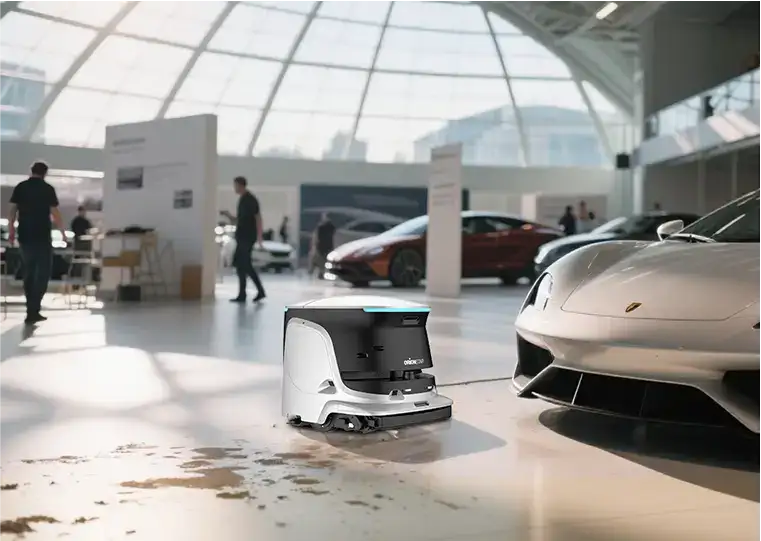
Facility managers face a distinct set of environmental pressures when selecting an automatic floor scrubber for airports. Aviation hubs combine vast open expanses, such as baggage claim areas and main departure halls, with dense bottlenecks, including security checkpoint lanes, retail corridors, and airline back-of-house service corridors. Because these facilities operate on continuous twenty-four-hour schedules, cleaning routines require equipment that can execute high-frequency maintenance across multiple shifts while safely sharing spaces with high volumes of passenger traffic. The operational environment also transitions rapidly between diverse floor surfaces, demanding machines that can shift seamlessly from scrubbing polished concrete and epoxy to mopping delicate marble and tile.
Navigating these spatial constraints requires evaluating equipment based on footprint, navigational agility, and cleaning modality. A machine must balance the need to cover wide-area concourses quickly against the necessity of weaving through tight seating arrangements at boarding gates. Autonomy and shift endurance represent another critical dimension, as the limited overnight windows for deep cleaning demand solutions with robust battery life, large fluid capacities, and automated docking routines that allow continuous operation without staff intervention. Finally, managing a deployment across immigration halls and public retail zones requires sophisticated fleet telemetry and strict adherence to data privacy regulations. Addressing these variables ensures that the selected floor care platform aligns with the complex realities of modern transit infrastructure.
The CleaniBot S55 Pro serves as a mid-size agile platform designed to navigate the highly variable zones of a modern airport, easily transitioning from open terminal environments to localized gate concourses. Its physical architecture is scaled to operate efficiently within high-traffic public spaces, utilizing a compact footprint capable of moving through a minimum passing width of up to seven hundred millimeters. This allows the machine to maintain wide departure halls while retaining the ability to slip through security checkpoint lanes and airline back-of-house service corridors. A primary emphasis of this platform is its low-noise operational profile, making it highly suitable for deployment near passenger-facing zones such as boarding gates or VIP lounges, where minimizing acoustic disruption is essential.
Equipped with a comprehensive suite of floor-care functions, the robot accommodates the rapid surface changes common in aviation hubs. Operators can cycle among six distinct cleaning modes, including scrubbing, power scrubbing, sweep and vacuum, ECO vacuum, dust mopping, and a combined sweep, vacuum, and mop function. This multi-mode capability is supported by impressive shift endurance, offering a multi-mode runtime of up to twenty-eight hours in dust-mopping configurations, according to manufacturer data. To ensure safe navigation alongside bustling passenger traffic, the system relies on a multi-sensor stack integrating LiDAR, stereo cameras, ultrasonic sensors, and line-laser technology. This array facilitates up to ten thousand square meters of mapping and enables the robot to detect obstacles, avoid stairs, and plan dynamic routes autonomously. Supported by an auto-recharging dock, the unit helps facility teams execute continuous multi-shift coverage during both busy daytime operations and short overnight cleaning windows.
Positioned as an enterprise-grade autonomous scrubbing platform, the Avidbots Neo 2W approaches airport maintenance through an industrial, wide-area architecture. This heavy-duty model is designed primarily for vast, unobstructed zones such as extensive arrival halls, empty baggage claim areas, and expansive apron-adjacent indoor walkways. While its substantial weight and sizable footprint make it less practical for tight retail aisles or narrow service corridors, its capability to deliver extended, continuous scrubbing addresses the rigorous demands of managing monumental square footage across long operating shifts. The platform is supported by a strong multi-site commercial deployment footprint, including public case studies detailing its utilization at aviation hubs such as CVG Airport.
The machine sustains lengthy cleaning operations by utilizing heavy industrial battery arrays and substantial onboard fluid tanks, resulting in runtimes of up to six hours under standard modes, according to manufacturer data. Navigational safety and route execution are driven by a sophisticated autonomy system featuring three-hundred-and-sixty-degree LiDAR and comprehensive three-dimensional sensing to maneuver around dynamic obstacles. Facility teams manage the fleet through the Avidbots Command Center, a cloud-based dashboard that provides real-time telemetry, sector coverage maps, and multilingual interface support. This extensive remote monitoring capability helps maintenance contractors track daily coverage metrics and rapidly adapt cleaning routes when airport layouts undergo temporary modifications.
The Gaussian Robotics Scrubber 50 operates as a versatile three-in-one floor care platform that emphasizes automated recovery and incident-driven maintenance. This machine targets the complex cleaning requirements of food-court concourses, ticketing areas, and immigration halls where spills are frequent but overall surface coverage remains critical. The platform’s approach relies heavily on specialized visual detection capabilities to optimize its resource consumption during continuous operations. It carries published deployment credentials from prominent transit environments, including London Heathrow Airport and Da Nang International Airport, demonstrating its viability within complex, high-traffic aviation sectors.
To manage localized soils efficiently, the unit employs an Auto Spot Cleaning mode powered by a combination of RGB cameras and artificial intelligence, allowing the machine to identify stains and apply targeted scrubbing only where necessary. When deployed alongside an optional workstation, the system manages its own fluid levels and battery reserves, autonomously docking to refill fresh water, empty wastewater, and recharge without requiring staff intervention. This capability is highly advantageous for continuous overnight windows, keeping the machine active across multiple shifts. According to manufacturer data, it achieves a cleaning efficiency of up to twelve hundred square meters per hour, supported by a diverse sensor stack designed to safely route the machine around constantly moving passengers and luggage carts.
The Kärcher KIRA CV 60/1 represents a specialized approach to airport floor care by operating exclusively as a professional autonomous vacuum rather than a wet scrubber. This machine addresses an adjacent but vital requirement within aviation facilities: managing the extensive carpeted environments found in premium airline lounges, administrative office suites, carpeted boarding ramps, and business-class gate areas. Because deploying a wet scrubber in these specific zones is structurally inappropriate, facility managers utilize this platform to extend autonomous maintenance into soft-floor areas while relying on a major European cleaning-equipment brand known for facility management at scale across transportation and commercial environments.
The unit incorporates a high-efficiency particulate air filtration system, which supports stringent indoor air-quality standards necessary in enclosed terminal piers and densely populated lounges. According to manufacturer data, the machine is driven by a cloud-connected artificial intelligence platform that processes real-time environmental data through onboard cameras and sensors to navigate safely around stationary seating and moving guests. The system is engineered to allow operators to quickly toggle between manual and autonomous modes via an integrated interface, providing essential flexibility when irregular airport shifts or unexpected layout changes demand immediate, human-directed vacuuming operations.
The ICE Co-Botics Cobi 18 relies on a highly compact cobotic architecture engineered specifically to navigate the dense, structural bottlenecks present throughout modern transit facilities. While wide-area scrubbers handle expansive departure halls, this unit targets the tight, restrictive zones that larger machines physically cannot enter. Its condensed footprint is optimized for weaving closely through security checkpoint lanes, navigating between seating clusters in localized food courts, and maintaining the narrow perimeters of busy retail concourses. The machine operates alongside human staff seamlessly, managing localized pocket zones with minimal supervision.
To ensure it does not disturb waiting passengers or active retail environments, the unit is engineered with a sub-seventy decibel operating profile, making it discreet enough for daytime deployment near busy immigration halls and boarding areas. According to manufacturer data, the machine provides a cleaning width of roughly forty-eight centimeters and operates for up to ninety to one hundred and twenty minutes per battery charge. Facility management teams can monitor the deployment through the i-SYNERGY fleet reporting system, maintaining oversight of daily route execution. The teach-and-repeat mapping method allows local cleaning crews to train the unit quickly on isolated routes, making it highly adaptable to fast-paced environments experiencing frequent foot-traffic changes.
When procuring an automatic floor scrubber for airports, facility managers must balance the scale of their concourses against the complexity of their architectural bottlenecks. Wide-area machines address the sweeping expanses of baggage claims but struggle in dense retail corridors, whereas compact cobotic scrubbers handle narrow security lanes efficiently but lack the capacity for monumental departure halls. Mid-size platforms often present the most pragmatic solution, blending sufficient shift endurance and tank capacity with the physical agility to navigate both open zones and constrained pathways. Ultimately, the successful deployment of these platforms relies on matching the equipment’s sensor capabilities, battery autonomy, and noise profile to the continuous, twenty-four-hour rhythm of the specific transit hub.
Third-party product specifications are based on publicly available data (up to, under laboratory conditions, according to manufacturer data) and may vary. Product names and trademarks are the property of their respective owners. If any product involves cameras, audio recording, mapping, or cloud-based data processing, operators must verify GDPR compliance prior to deployment.
Industry data points to a wide range depending on site characteristics. Mid-sized international airports typically model full capital payback within 26–36 months through labor savings, avoided equipment failures, and energy reductions, while daily-use commercial sites with 50,000+ sq ft of repeatable hard-floor coverage often see 9–18 months. Gausium publicly reports £124,174.99 in savings and a 64% ROI at London Heathrow Airport over its Scrubber 50 deployment. Airports with very low labor costs (under roughly $14/hr loaded), fragmented routes, or heavy weekend-only traffic stretch the payback to 4–6 years, so the model is most compelling where one robot can absorb 2–6 hours of repetitive scrubbing per day.
Total cost of ownership sits well above the purchase or RaaS fee and is usually the difference between a defensible business case and an embarrassing surprise. Buyers should plan for consumables (squeegee blades, brushes or pads, and filters running roughly $500–$1,000 per robot per year), an annual service contract at about 10–15% of the purchase price, and a battery refresh in the $2,000–$5,000 range if lithium-ion packs are not covered. Insurance, mapping re-surveys after terminal renovations, staff training, dedicated parking or docking space, and integration with airport BMS or CMMS platforms add further line items. Under a RaaS contract, most of these are bundled into the monthly fee — but it is worth confirming exactly which items are included before signing.
There is no single right answer; the choice depends on cash-flow appetite, in-house maintenance capability, and how long the deployment will run. Mid-size autonomous scrubbers like the Gausium Scrubber 50 typically list at roughly $30,000–$55,000 per unit under CapEx, while RaaS subscriptions for comparable machines run an estimated $600–$900 per month, often including the service contract, software, and consumables. Outright purchase makes sense when an airport has a maintenance team, plans to use the machine 5+ years, and wants to depreciate the asset. RaaS makes more sense when the buyer prefers predictable monthly billing, wants to avoid the risk of an out-of-warranty repair, or is running a pilot before scaling fleet-wide. Either way, the labour math is the anchor — a human cleaner loaded with benefits typically costs $3,500–$4,500 per month, against $600–$900 for a robot doing 50–100% of the same floor work.
For large concourses, the four numbers to anchor on are cleaning width, cleaning efficiency, tank capacity, and runtime, because they directly determine how many square meters one machine can clean per shift. The OrionStar CleaniBot S55 Pro, for example, pairs a 550 mm main brush with up to 1,197 m²/h in scrubbing and up to 1,368 m²/h in sweep/vacuum/ECO/dust-mop modes, supported by a 22 L clean water tank, a 15 L wastewater tank, and up to 4.5 h of runtime per charge. By comparison, the Gausium Scrubber 50 ships a wider 720 mm head at up to roughly 1,200–1,490 m²/h but with smaller autonomy per charge, while mid-size machines like the ICE Co-Botics Cobi 18 cap at about 800 m²/h and ~90 minutes per charge, suiting them to tighter zones rather than wide concourses. Navigation sensors — LiDAR plus stereo cameras and ultrasonic arrays — and the ability to auto-recharge and resume without staff intervention are the next pair of must-haves for overnight single-operator coverage.
Yes, in most cases, but the answer depends on which cleaning mode is running and how close the robot is to seating and retail zones. The OrionStar CleaniBot S55 Pro is rated at about 55 dB in scrubbing and 45 dB in dust mopping — well within typical office and lounge ambient levels and noticeably quieter than comparable machines such as the ICE Co-Botics Cobi 18, which is rated at 66–70 dB in ECO and MAX modes. For very quiet zones such as airline lounges or overnight gate areas, dust-mop and ECO-vacuum modes (with the S55 Pro capable of up to 28 h and 19.5 h of runtime respectively) offer the best balance of coverage and passenger comfort. Loud ride-on scrubbers in the 70+ dB range remain practical for back-of-house corridors and apron-adjacent indoor walkways where passenger sensitivity is lower.
Most modern units can, but the right answer for an airport is usually a small fleet of specialised machines rather than one do-it-all platform. The OrionStar CleaniBot S55 Pro covers polished terminal stone, marble, vinyl, and low-pile carpet through six modes — scrubbing, power scrubbing, sweep and vacuum, sweep/vacuum/mop, ECO vacuum, and dust mopping — and fits through a 700 mm minimum passing width, which is useful in security lanes and back-of-house corridors. For larger industrial-strength tanks and 4–6 h runtime, the Avidbots Neo 2W is a heavier, ride-on alternative (~152 × 76–94 cm, ~580–690 kg) suited to very large gate concourses but less practical in tight zones. For carpeted lounges, business-class gate areas, and back-of-house offices where a wet scrubber is unsuitable, a vacuum-class robot such as the Kärcher KIRA CV 60/1 covers an adjacent scenario. In practice, mixing an S55 Pro-class mid-size unit for concourses with a compact cobotic for narrow zones is the most common pattern in published airport case studies.