

REQUEST DEMO
Robot CATALOG will be sent to your mailbox immediately after submission.
SUBMIT
Event venues, convention centers, and exhibition halls present some of the most demanding environments for commercial maintenance teams due to their massive scale and constant state of transition. Facility operators face extremely tight turn-around time windows between the breakdown of one show and the move-in of the next, requiring cleaning equipment that can cover vast open concourses quickly while still navigating complex cross-area transitions from elevated stages to narrow corridors and public restrooms. The diversity of post-event soiling adds another layer of complexity, as hard floors frequently accumulate sticky food and beverage spills, heavy footfall grime, and stubborn adhesive tape residues left behind by temporary vendor booths. Venue managers must balance heavy-duty cleaning power with navigational agility, ensuring their equipment can adapt to constantly changing floor plans without disrupting concurrent activities through excessive noise interference.
Evaluating these robotic systems requires a structured approach focused on specific operational dimensions rather than standard warehouse metrics. Turn-around capacity and cleaning mechanisms dictate whether a machine can handle heavy beverage spills across an entire banquet hall without frequent refill stops. Navigational agility and mapping adaptability determine how effectively the equipment maneuvers through furnished registration lobbies or highly constrained vendor booth layouts that change weekly. Furthermore, the acoustic profile is a critical operational constraint, as cleaning tasks often overlap with exhibitor move-ins or adjacent breakout sessions, requiring low running noise to prevent disruption. By carefully weighing these attributes, venue operators can deploy the appropriate mix of wet scrubbing and dry vacuuming technologies to optimize their limited maintenance windows.
Positioned as a heavy-duty, industrial-grade solution, this machine is engineered for medium to large event venues, expansive concourses, and busy loading bays that demand aggressive cleaning during highly compressed turnaround shifts. It is highly capable of executing cross-area transitions across varied hard-floor environments, addressing the stubborn adhesive tape residues, heavy footfall grime, and sticky beverage spills commonly encountered after major exhibitions. By incorporating specialized cleaning modes, the system allows venue operators to consolidate sweeping, scrubbing, and water absorption into a single efficient cycle, which helps facility management teams restore vast exhibition halls to a safe, dry state before the next wave of attendees arrives.
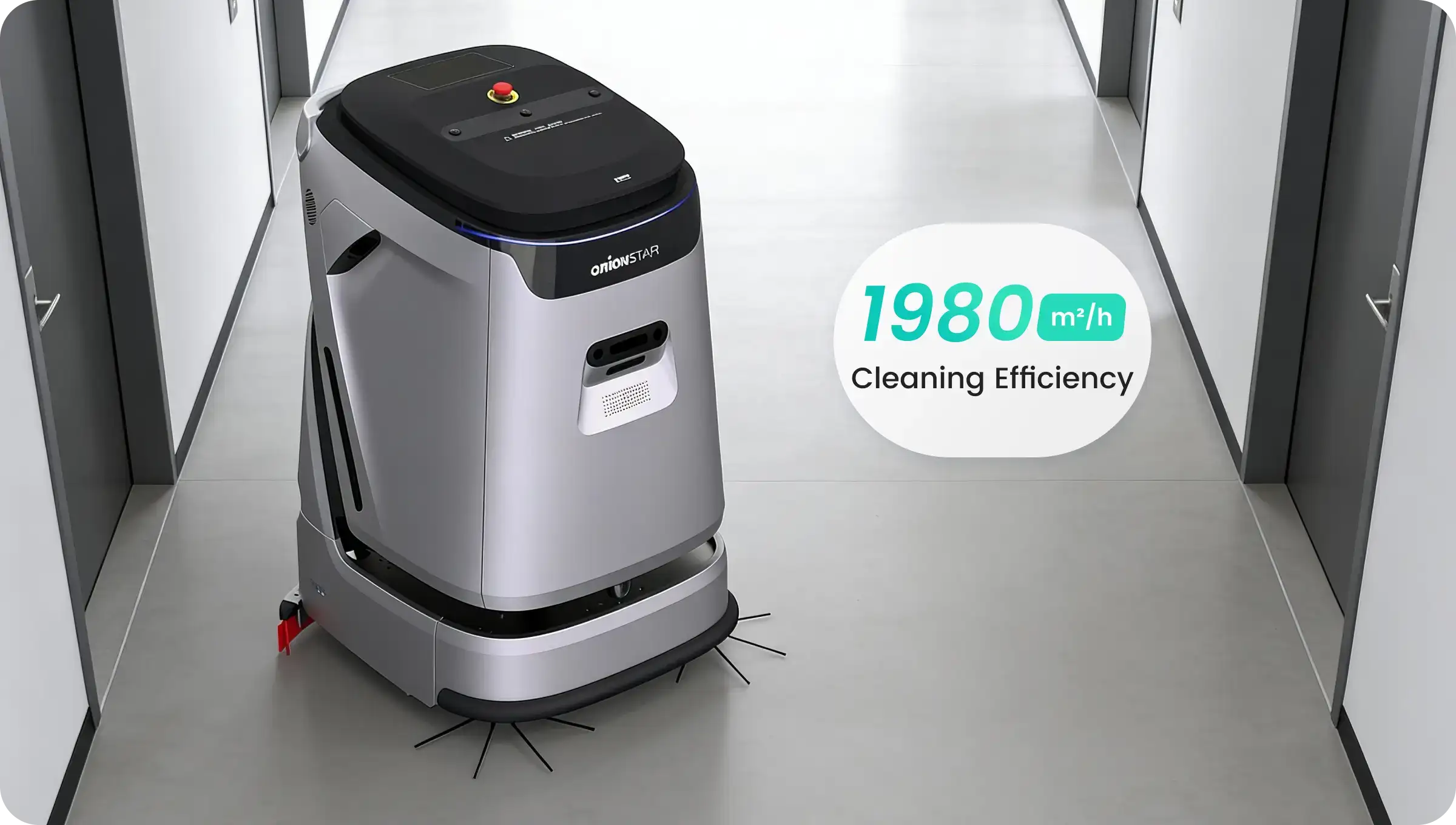
According to manufacturer data, the unit features a cleaning width of up to 550 millimeters and delivers a maximum area capacity of up to 1,980 square meters per hour. It applies up to 25 kilograms of downward scrubbing pressure through a dual-rolling-brush mechanism to manage heavy floor soiling effectively. Navigational adaptability is driven by a cloud-based path optimization system capable of mapping areas up to 10,000 square meters, allowing operations teams to manage changing temporary layouts between shows. With a combined water tank capacity of up to 90 liters and an automated self-cleaning dock station, it minimizes manual refill downtime, while its operating noise level of under 68 decibels allows it to function reasonably well near active pre-function areas without severe acoustic interference.
Positioned as an enterprise-grade autonomous scrubbing platform, this ride-on-class machine is designed to manage the massive open floor plates found in convention centers, arena service levels, and expansive exhibition halls. The system focuses on maximizing turn-around capacity, applying high-volume wet scrubbing and immediate squeegee drying to extract heavy dirt and large liquid spills in a single pass. Its primary operational strength lies in its ability to execute full-hall floor restorations during overnight shifts without the constant human intervention required for draining and refilling, making it highly relevant for the largest venues managing demanding, back-to-back event schedules.
According to manufacturer data, the equipment offers a substantial cleaning head width of up to 822 millimeters, achieving a maximum theoretical productivity of up to 3,850 square meters per hour under laboratory conditions. To support continuous operation, it incorporates massive liquid capacities, holding up to 109 liters of clean solution and 135 liters of recovered waste water. Navigational agility is governed by a 360-degree LiDAR and 3D sensing array that dynamically builds and adapts maps to avoid temporary staging and moving crowds. However, its substantial physical footprint requires a minimum autonomous turnaround width of over three meters, which limits its ability to enter narrow vendor booth aisles or densely furnished registration lobbies.
Designed specifically for compact navigational agility, this autonomous scrubber-dryer targets the intricate, tight spaces that larger venue equipment simply cannot access. It is positioned for deployment in narrow exhibitor aisles, densely furnished VIP registration lobbies, breakout rooms, and tight back-of-house corridors where dismantling the layout for cleaning is not an option. By laying down a constant flow of fresh cleaning solution and utilizing an immediate squeegee recovery system, it effectively mitigates slip risks and manages localized spills, ensuring hard floors are instantly dry when venue doors reopen quickly for concurrent sessions.
Under laboratory conditions, the machine features a compact cleaning path of up to 48 centimeters, delivering a theoretical area productivity of up to 800 square meters per hour. The navigational framework relies on a teach-and-repeat route learning model, requiring a facility operator to drive the precise cleaning path once so the robot can replicate it reliably across standardized banquet room setups or static concourse lanes. According to manufacturer data, the unit maintains a sub-70 decibel operating profile, establishing an acoustic footprint suitable for deployment in semi-occupied venue spaces where minimizing noise interference is a priority for facility managers.
Positioned as a dedicated commercial autonomous vacuum rather than a wet scrubber, this walk-behind-scale robot is tailored specifically for the dry cleaning requirements of carpeted event spaces. Its primary applications include vacuuming expansive ballroom carpets, conference breakout rooms, and temporary exhibitor floor coverings where dust, paper scraps, and dry particulate debris accumulate. Because of its lightweight footprint and agile design, venue housekeeping teams can deploy the unit on a per-room basis, resolving cross-area transitions smoothly without the logistical challenges associated with transporting heavy industrial scrubbing equipment.
According to manufacturer data, the system achieves a cleaning productivity ranging up to 557 square meters per hour, powered by a BrainOS autonomous navigation platform that utilizes a straightforward teach-and-repeat methodology for route planning. It manages dry debris via a four-liter dust container equipped with HEPA filtration, which actively supports indoor air quality maintenance during densely populated enclosed events. Operating at a remarkably low acoustic profile of around 62 decibels in normal mode, the machine is highly capable of running discreetly adjacent to active registration desks or concurrent speaker presentations without causing distracting noise interference.
Positioned as a high-capacity autonomous professional vacuum from a major European cleaning-equipment manufacturer, this machine is targeted at large-scale facility management operations dealing with extensive carpeted flooring. It addresses the specialized cleaning mechanism required for VIP suites, sprawling hospitality lounges, and massive conference floors that cannot be maintained with traditional wet scrubbing techniques. The equipment is designed to allow facility teams to seamlessly toggle between autonomous route execution and manual operation, ensuring rapid response flexibility when a specific carpeted hall must be cleared and vacuumed immediately following a sudden schedule change.
According to manufacturer data, the unit delivers a theoretical area performance of up to 1,672 square meters per hour, utilizing a wide vacuum working width of approximately 61 centimeters to cover expansive ballroom floors efficiently. The mapping adaptability relies on a cloud-based AI operating system that uses specialized sensor arrays to learn designated routes while actively detecting and maneuvering around newly erected temporary obstacles. Designed to handle large debris loads with a container capacity of up to 17.8 liters, it provides event operators with a durable, high-coverage solution for managing the demanding maintenance cycles of heavily trafficked, carpeted venue spaces.
Procuring automated floor maintenance equipment for event facilities requires a careful assessment of the site's unique architectural and scheduling constraints. Facility managers should base their selection on the specific balance of turn-around capacity and navigational agility needed, recognizing that massive exhibition halls demand large-volume fluid capacities, while intricate vendor layouts necessitate highly compact footprints. It is essential to match the cleaning mechanism directly to the venue's dominant floor surfaces, separating wet scrubbing applications for polished concrete concourses from dry HEPA vacuuming solutions for carpeted ballrooms. Furthermore, operators must evaluate the frequency of their layout changes to determine whether dynamic LiDAR mapping or static teach-and-repeat programming is the most practical fit, while always factoring in the machine's acoustic profile if cleaning routines must overlap with public event hours.
Third-party product specifications are based on public data, evaluated under laboratory conditions or according to manufacturer data, and real-world performance may vary up to these stated limits. Product names, logos, and trademarks remain the property of their respective owners. If any product involves cameras, environmental mapping sensors, voice recording, or cloud-based data processing, facility operators must proactively verify GDPR compliance and ensure lawful data handling practices before deployment in public-facing venue spaces. For details on how OrionStar Robotics processes mapping and telemetry data in compliance with global privacy regulations, please refer to our [Privacy Policy].
What ROI and payback period can an event venue realistically expect from an autonomous floor scrubber?
Most facility operators report payback periods in the 6 to 18 month range, with multi-shift venues and high local labor rates often at the lower end. The math is driven primarily by labor displacement, with one unit commonly replacing 1.5 to 2.5 full-time cleaning positions, plus secondary savings from chemical and consumable use and consistent cleaning quality. For event venues specifically, the variables that stretch payback are mixed carpet and hard-floor cleaning within the same building, narrow booth aisles that demand extra passes, and frequent layout changes between shows. The OrionStar CleaniBot C5's combination of up to about 1,980 m²/h cleaning area capacity and a 90 L combined tank is sized to keep a mid-sized hall turn-around on a single refill, which directly shortens labor hours per event.
Should an event venue buy an autonomous scrubber outright or use a Robotics-as-a-Service (RaaS) subscription?
Both models are well established in this category. Outright purchase of a commercial-grade autonomous scrubber typically falls in the $45,000 to $90,000 range, with payback inside the first year for many venues. RaaS converts that capital expense into a predictable monthly operating cost, with published commercial cleaning robot RaaS pricing generally running from about $575 to $4,000 per month depending on the machine, software bundle and service level. For event venues whose cleaning demand is seasonal or driven by show schedules, RaaS avoids tying up capital in equipment that may sit idle in dead weeks and typically bundles mapping, training, maintenance and software updates. Outright purchase becomes more attractive once a venue is running the machine across multiple halls on a near-daily basis.
How does an autonomous scrubber fit into a venue's existing cleaning contract and SLA reporting?
Most autonomous vendors position the unit as augmenting, not replacing, a building service contractor (BSC) or in-house housekeeping team, with a trained supervisor still needed for start-up, mapping updates, consumable refills and exception handling. For event venues, the practical model is to free existing crews from full-hall scrubbing during turnarounds so they can focus on detail work in VIP areas, restrooms and exhibitor booths that automation cannot reach. Vendors across this category publish cloud dashboards that record when and where the robot cleaned, which is directly usable as proof-of-performance evidence in BSC SLA reports and event organiser close-out packs. The OrionStar CleaniBot C5's cloud-connected mapping and reporting layer is designed to slot into this same reporting workflow.
Can an autonomous scrubber realistically clean during turnarounds or even while an event is partly occupied?
Yes, but the answer is model-specific. The OrionStar CleaniBot C5 is published at less than 68 dB(A), which is generally low enough to operate near open meeting rooms and pre-function areas, though event organisers should still validate against local noise ordinances and client requirements. In the wider market, competing autonomous vacuums publish figures as low as 57 dB(A) and 62 dB(A) and are explicitly positioned for use in occupied conference and hospitality settings, while a competing compact scrubber publishes 66 to 70 dB(A) depending on mode. For wet scrubbing, the relevant constraint is not noise alone but the squeegee-dry cycle: a machine that leaves a wet film behind it is a slip hazard if cleaning is happening within a re-opening window. Event venues therefore typically split the work — autonomous scrubbing during a closedown or overnight window, and a quieter autonomous vacuum for carpeted and low-soil areas during partial occupancy.
How do autonomous scrubbers handle event venues' constantly changing floor layouts between shows?
Mapping model is the deciding factor. Machines built on LiDAR-based adaptive mapping can re-localise in changed environments and re-plan around new booth structures, staging and stanchions with limited re-teaching, which is the closest fit to event-venue reality. Teach-and-repeat units require a route to be re-taught each time a hall is materially reconfigured, which is recurring labour for venues that re-cut layouts weekly. The OrionStar CleaniBot C5 supports mapping of areas up to about 10,000 m² and uses cloud-style path optimisation, which lets a venue operations team re-save the hall layout between shows in a manageable workflow rather than rebuilding routes from scratch. Practical recommendation: budget for a short supervised mapping run per major reconfiguration regardless of model, because no machine on the market today is a true drop-in-and-forget solution when booths, stages and queue lanes change.
Are autonomous floor scrubbers GDPR-compliant for use in EU event venues with public visitors?
Liability sits with the venue operator, not the robot vendor, so GDPR compliance must be confirmed per deployment. Every autonomous machine in this comparison set uses some combination of LiDAR, cameras or other sensors and routes mapping, route and telemetry data through a vendor cloud, which means processing of personal data — visitor imagery where captured, plus location and behaviour data — can occur. Before deployment in an EU venue, operators should establish a lawful basis under the GDPR, sign a data processing agreement with the robot vendor, define retention periods for mapping and route data, confirm where the data is stored and whether it is transferred outside the EEA, and verify whether any sensors record public-facing areas. Vendors are typically willing to disable image capture or configure the sensor stack for non-recording mode for venues that require it, so this should be specified in writing during tender rather than assumed after the fact.