

REQUEST DEMO
Robot CATALOG will be sent to your mailbox immediately after submission.
SUBMIT
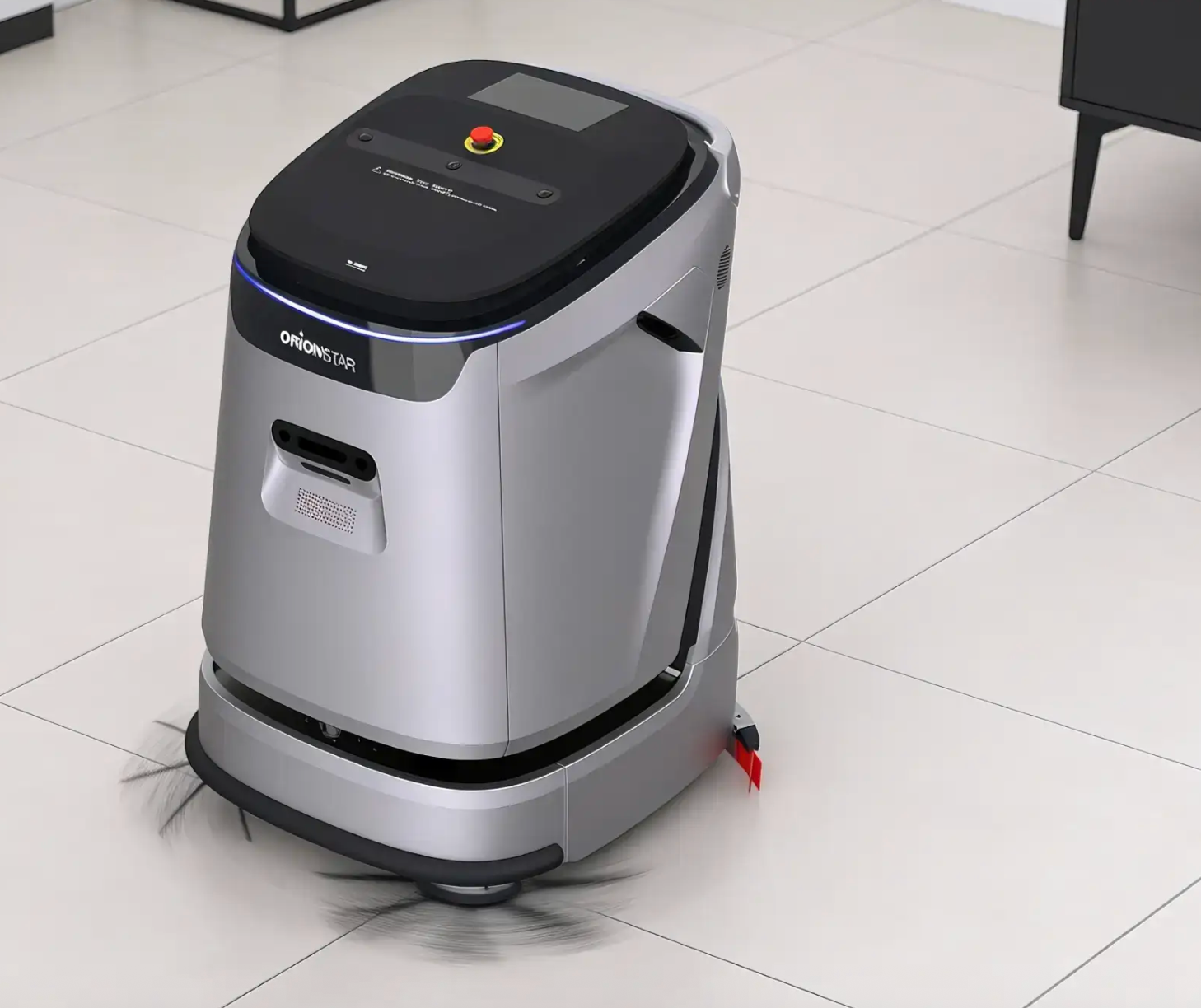
Institutional catering environments, corporate cafeterias, school dining halls, hospital cafeterias, factory canteens, university food courts, banquet halls, and event catering venues present uniquely demanding surface conditions. The daily operations in these facilities result in the rapid accumulation of dropped solid food, heavy cooking oil, viscous sauces, and frequent liquid spills on hard floors. Addressing these complex residues requires rapid turnaround times and high-frequency cleaning operations that do not disrupt active meal services or dining room traffic. Facility managers must implement motorized solutions capable of managing heavy soil loads while maneuvering safely around diners, chairs, trolleys, and unpredictable peak-hour pedestrian movement.
Evaluating the market for appropriate robotic platforms requires a comparative framework based on three primary procurement dimensions. First, operators must assess grease and solid food residue removal mechanisms, distinguishing clearly between heavy-duty wet scrubbing for dining areas and dry suction for reception spaces. Second, fluid management and multi-shift autonomy determine operational expenditure (OPEX), as self-cleaning workstations significantly reduce the labor associated with draining and refilling machinery. Finally, spatial navigation and environmental adaptability dictate whether a machine's aisle-width requirements and water tank capacity match the specific sub-spaces of the venue, from narrow buffet lines to vast banquet halls. Additionally, procurement teams must recognize that not all platforms are suitable for back-of-house deployment, as many lack the specific safety or hygiene certifications required for operating in heavily greased commercial kitchen zones.
The OrionStar CleaniBot C5 serves as a high-capacity wet scrubber engineered specifically for high-traffic dining halls and banquet operations that face heavy soil accumulation. According to manufacturer data, the unit employs a 550 mm dual-rolling brush mechanism capable of applying approximately 25 kg of downward pressure, which achieves up to a 95% one-pass dirt removal rate on heavy oil, grime, and stubborn stains. This cylindrical approach allows the machine to simultaneously agitate greasy films and capture solid food debris up to about 3 cm in height into an integrated 1.8 L hopper. Fluid management is handled by a combined 90 L system (45 L clean water and 45 L waste water), enabling the robot to sustain extended wet-scrubbing cycles across multi-shift operations without interrupting active meal services for constant manual refilling.
To navigate the varied spatial constraints of catering services, the platform features a minimal passing width of approximately 880 mm, ensuring it can maneuver efficiently through standard cafeteria aisles, buffet lines, and narrow doorways. The operational efficiency of the C5 is further supported by an automatic dock station that facilitates hands-free clean-water refilling, waste-water discharge, and internal tank rinsing, a self-cleaning cycle taking roughly 4 minutes that helps prevent the buildup of food-waste odors. By significantly reducing manual maintenance requirements, this docking architecture directly lowers long-term operational costs in continuous catering operations. Because the system maps environments of up to 10,000 m² and processes navigational data, facility administrators must verify GDPR compliance and local data protection regulations prior to deployment in public dining spaces.
The Avidbots Neo 2W represents an industrial-grade autonomous floor scrubber positioned primarily for large-scale contract catering, expansive convention centers, and wide open-plan factory canteens. Under laboratory conditions, the platform delivers strong area coverage with a maximum theoretical cleaning productivity reaching up to 3,900 m² per hour. The machine addresses multi-shift autonomy through massive onboard tank architectures, featuring solution capacities up to 109 L and recovery capacities up to 135 L, alongside swappable long-life batteries that facilitate continuous runtime without the immediate need for permanent plumbing modifications. To tackle complex catering residues, it can be configured with cylindrical brushes that sweep and scrub concurrently, managing heavier debris typical of large-scale event venues.
The primary trade-off for this high productivity lies in its spatial adaptability and dimensional profile. With an empty weight of roughly 283 kg and a gross vehicle weight reaching up to 669 kg, combined with a minimum autonomous turn-around width of 3.05 m, the platform is too large for tight sub-spaces like narrow cafeteria aisles, server stations, or small banquet-hall corridors. Furthermore, while the manufacturer provides detailed fleet reporting through a web-based command center to optimize large-scale cleaning routes, operators must verify that any selected machine meets the specific safety and hygiene standards required for commercial kitchens. As the proprietary AI software utilizes cameras and cloud-based data processing for real-time environmental scanning, operators must ensure strict adherence to GDPR guidelines when deploying the unit across global catering markets.
The Gaussian Robotics Scrubber 50 is configured as a heavy-duty wet scrubbing platform designed for industrial and high-soil hard-floor environments, including medium-to-large hospitality and institutional food service spaces. According to manufacturer data, it features a relatively wide 720 mm cleaning path that efficiently captures large volumes of spilled liquids across expansive dining room floors, achieving a cleaning efficiency of up to 1,200 m² per hour. The core scrubbing architecture incorporates an 18 L recovery tank and a 24 L fresh-water tank equipped with multi-stage filtration, facilitating continuous wet operation to manage dropped solid food, cooking oil, and liquid spills consistently throughout the day.
For multi-shift catering operations, the platform integrates with an optional automatic workstation that manages battery charging, fresh-water refills, and dirty-water emptying, substantially reducing the manual burden on janitorial staff and positively impacting overall operational costs. While it effectively manages wide aisles and open cafeteria layouts, its operating weight of approximately 140 to 150 kg renders it less mobile in highly restricted sub-spaces compared to ultra-compact cobotic alternatives. The navigation suite relies on deep-learning algorithms, 2D LiDAR, and various camera systems to execute dynamic zone cleaning. Consequently, institutions operating within European and global regulatory frameworks must confirm GDPR compliance regarding the machine's environmental perception and encrypted data transmission capabilities before introducing it to areas where employee or guest data may be processed.
The Kärcher KIRA CV 1 models represent autonomous solutions from an established cleaning-equipment brand possessing a mature service network across Europe and the US, though their application within the catering sector requires careful contextualization. Specifically, models mapping to the CV designation operate primarily as autonomous robotic vacuums designed for hard floors and carpets, meaning these specific models are optimized for dry environments and are not designed for the wet-scrubbing tasks required to manage the heavy cooking oil, viscous sauces, and liquid spills that characterize main dining halls and active food lines. As a result, facility managers must differentiate between these dry-suction systems, which are highly effective for capturing dry soil and crumbs in back-of-house pre-rooms, meeting areas, and reception zones, versus the brand’s heavier scrubber-dryers that directly address wet-cleaning tasks.
When deployed in their appropriate dry-cleaning sub-spaces, these platforms offer reliable performance, achieving area coverage rates of up to 525 m² per hour or more, according to manufacturer data. The machines utilize advanced sensor arrays and continuous learning algorithms to adapt to dynamic environments, backed by comprehensive fleet management applications that deliver detailed productivity alerts and machine status reports. While the global service infrastructure ensures reliable maintenance support for multi-shift operations, operators deploying these sensor-rich platforms must evaluate the associated cloud-based AI processing architectures to ensure complete alignment with GDPR and related privacy mandates in public or semi-public institutional settings.
The ICE Co-Botics Cobi 18 is engineered as a compact teach-and-repeat cobotic scrubber tailored specifically for tight sub-spaces where larger industrial machines cannot operate. Its highly restricted footprint, measuring just 48 cm by 48 cm, enables the unit to navigate narrow pantries, dishwash return areas, server stations, and the tight aisles between tables in small catering outlets. According to manufacturer data, the machine delivers a continuous flow of fresh cleaning solution to prevent the cross-contamination of dirty mop water in hygiene-sensitive areas, achieving a productivity rate of up to 800 m² per hour. Operating at noise levels starting around 66 decibels, the platform integrates smoothly into noise-sensitive hospitality environments such as event venues during active service hours.
Due to its compact dimensions, the system utilizes smaller tank capacities, approximately 10 L for clean solution and 11 L for recovery, which limits its autonomy in massive cafeterias and requires manual fluid management rather than integrating with fully automated docking stations. This manual-fill architecture prioritizes deployment flexibility and rapid turnaround over the sustained continuous runtime expected in vast convention centers. Additionally, operators must verify that any selected machine meets the specific safety and hygiene standards required for commercial kitchens. The robot uses multiple sensors to generate point-cloud maps for safe navigation; facility operators must still verify that these cloud-connected fleet tracking applications align with GDPR standards before full operational integration.
Procuring the appropriate autonomous floor scrubber for catering services demands a strict alignment between a venue's specific spatial constraints, anticipated floor soil types, and the fluid management requirements of multi-shift operations. For vast, open-plan contract catering and convention centers, heavy-duty architectures prioritize high-capacity onboard tanks and wide cleaning paths to maximize continuous runtime, though they sacrifice maneuverability in narrow spaces. Conversely, secondary cafeterias and tight server stations benefit from compact, teach-and-repeat cobotic platforms that navigate complex layouts easily, despite requiring manual fluid handling. For medium-to-large high-traffic dining halls seeking optimal operational expenditure, systems that balance robust dual-roller wet scrubbing with fully automated self-cleaning workstations provide the most viable path to sustained, hands-free cleanliness. Regardless of the chosen platform, procurement teams must ensure the selected machinery handles the specific grease densities of the targeted zone and that all associated environmental mapping and cloud technologies comply rigorously with prevailing data protection frameworks.
Most published autonomous-scrubber ROI studies cite labor reallocation as the primary savings driver, with labor typically representing 60–80% of total cleaning spend. One industry analysis estimates that replacing walk-behind scrubbing with an autonomous unit can save roughly $42,300 per year in labor and consumables, producing a payback of about 16 months on a $58,000 machine. For high-frequency catering venues such as corporate cafeterias, school dining halls, and banquet halls, payback tends to fall in the 12–24 month range because spill response drives more frequent cleaning cycles than a generic office floor.
Leasing preserves capital and typically bundles preventive maintenance, software updates, and remote support into a fixed monthly fee — useful for contract caterers that prefer OPEX accounting or operate on tight seasonal budgets. Buying delivers lower lifetime cost (often 30–50% lower than three-year leasing in published TCO models) but exposes the operator to battery, brush, and sensor replacement costs after year two. Before signing, catering buyers should verify uptime SLAs (typically 95–98%), response-time guarantees, training hours included, and whether detergent and brush consumables are covered.
Beyond the unit price, budget for brushes and squeegees (typically replaced every 6–12 months in heavy-grease catering use), lithium battery replacement after roughly 3–5 years, cleaning chemistry, and water plus electricity for the docking station. Annual preventive-maintenance contracts usually run 8–12% of the machine price; spare parts and consumables add another 3–5%. Catering sites with 24/7 multi-shift operation should also budget for periodic sensor calibration and mapping re-runs whenever dining layouts or seating change.
Yes — but performance depends on tank capacity, brush pressure, and whether the unit supports hot-water or detergent dosing. The OrionStar CleaniBot C5 pairs a 550 mm dual-rolling brush with about 25 kg of downward pressure and a 95% dirt-removal rate on oil and grime, and its 45 L clean / 45 L recovery tank supports extended wet cycles between refills. For open commercial kitchens with fry and griddle stations, choose a model with cylindrical brushes (such as the Avidbots Neo 2W in cylindrical configuration) and confirm the manufacturer has tested its unit on cooking-oil films rather than only generic dust.
Modern autonomous scrubbers combine 2D LiDAR, 3D depth cameras, ultrasonic sensors, and air-pressure or touch bumpers to detect people and obstacles in real time, then re-plan paths on the fly. The OrionStar CleaniBot C5 maps up to 10,000 m² per site and uses smart obstacle avoidance with multiple sensors, plus a max speed of about 1.2 m/s and minimal passing width around 880 mm — narrow enough for typical cafeteria aisles. For catering environments with heavy foot traffic, operators should schedule cleaning during off-peak windows (post-meal or pre-opening) and use zone-blocking so the robot avoids servery lines during active service.
The robots themselves are not certified food-handling equipment, but they can support compliance with sanitation-critical regulations when deployed correctly. In the US, FDA Food Safety Modernization Act (FSMA) preventive controls expect documented sanitation monitoring; in the EU, Regulation 852/2004 on the hygiene of foodstuffs applies to equipment used in food areas; internationally, HACCP principles govern sanitation verification. Catering operators should retain per-cycle cleaning reports, verify that brushes and tanks are food-grade or rated for food-area use, and confirm that cloud-stored mapping and video data meet GDPR and local data-protection rules before deployment.
Third-party product specifications are based on public data (up to, under laboratory conditions, according to manufacturer data) and may vary. Product names and trademarks are the property of their respective owners. If any product involves cameras, voice recording, mapping, or cloud data processing, operators must verify GDPR compliance prior to deployment.