

REQUEST DEMO
Robot CATALOG will be sent to your mailbox immediately after submission.
SUBMIT
Medical facilities require floor maintenance that goes beyond basic dirt removal to support strict hygiene standards across mixed surfaces, ranging from tiled outpatient corridors to carpeted waiting rooms. Facility managers face the dual challenge of maintaining infection-control sensitivity while managing operational efficiency across dynamic clinical spaces. Deploying autonomous robotics in these environments introduces distinct procurement considerations, specifically regarding physical footprint, acoustic impact on patient recovery, and the ability to adapt cleaning modalities to various zones without disrupting clinical workflows. The right equipment must operate safely around unpredictable pedestrian traffic, including patients, medical staff, wheelchairs, and stretchers, while supporting comprehensive floor-care routines.
Different autonomous systems address clinical requirements through distinct functional architectures and physical designs. Integrated multi-modal systems combine sweeping, vacuuming, and wet scrubbing into a single robotic platform, allowing facility teams to adapt the cleaning behavior on the fly across both hard clinical floors and carpeted administrative zones. Conversely, dedicated wet scrubbers prioritize intensive hard-floor washing and heavily focus on deep soil removal, serving as heavy-duty tools for critical healthcare environments. Specialized dry-vacuum sweepers utilize HEPA filtration to manage dust and dry debris across carpeted spaces and low-soil hard floors, providing highly efficient daily surface maintenance alongside separate automated or manual wet-cleaning protocols.
The physical size, weight, and turning radius of the machine dictate where it can safely operate and how it moves between different clinical zones. Compact platforms typically weigh under one hundred kilograms and feature narrow passing widths suited for tight outpatient clinics, allowing cleaning staff to easily transport them between different medical wards using standard passenger elevators. Mid-weight autonomous scrubbers generally offer larger solution and recovery tanks for extended runtimes in main corridors and large public lobbies. Heavy-duty industrial models frequently utilize ride-on or stand-on chassis designs to deliver massive area coverage, optimized for expansive hospital atriums where industrial freight elevators are available.
Acoustic output and navigation safety are equally critical in noise-sensitive healthcare environments. Ultra-low-noise configurations minimize acoustic disruption, allowing facility teams to schedule continuous cleaning shifts directly adjacent to occupied patient rooms and active consultation spaces. Higher-output models deliver maximum mechanical scrubbing power but are typically scheduled for unoccupied public spaces or after-hours shifts to align with facility noise policies. Furthermore, operating autonomously requires robust obstacle avoidance and adaptive mapping technologies, relying on combinations of LiDAR, cameras, and sensors. Because any system utilizing these technologies processes facility and environmental data, hospital operators must verify that the deployment complies with applicable data protection and privacy regulations prior to operation in patient-care zones.
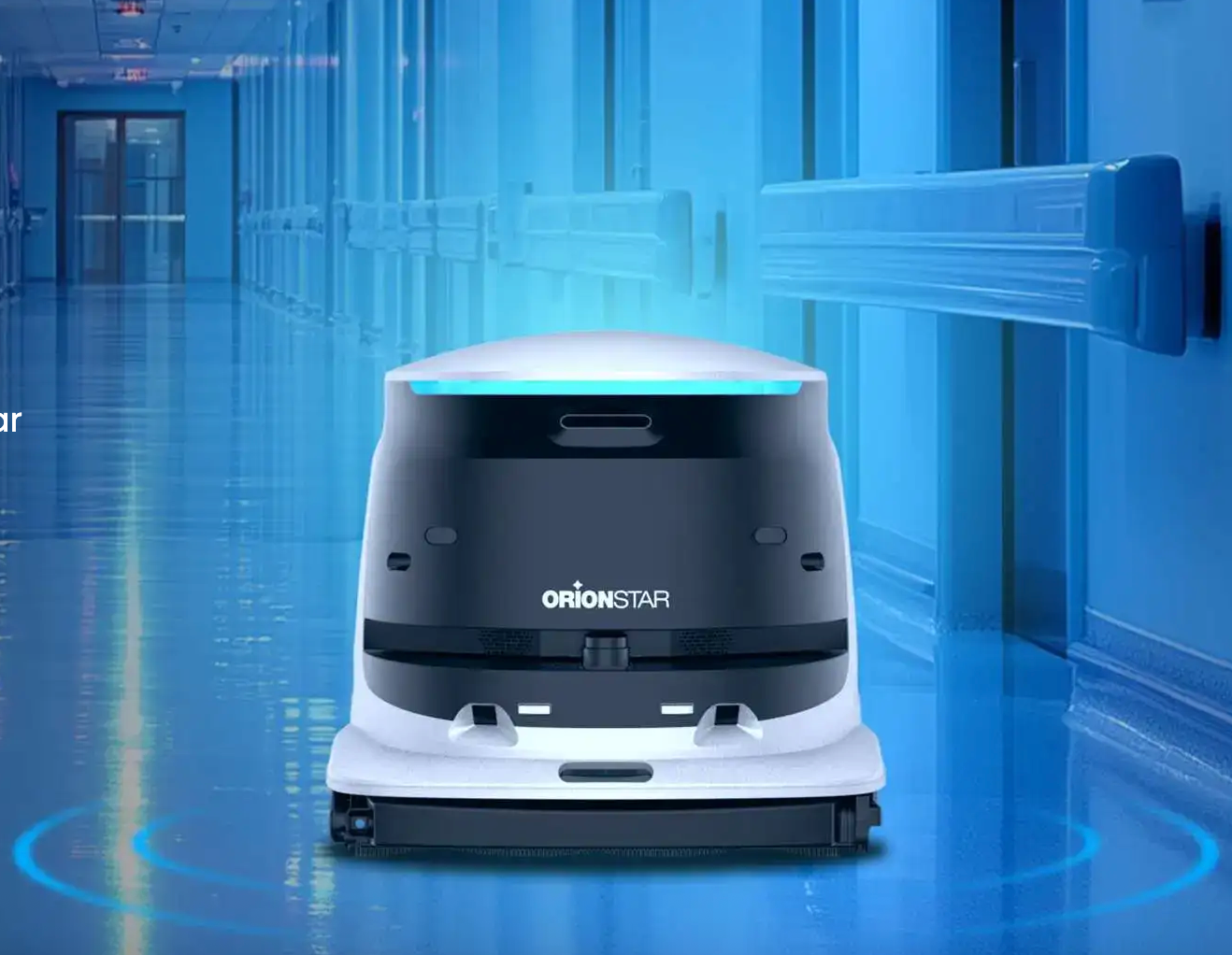
The OrionStar CleaniBot S55 Pro is positioned as a versatile, low-noise autonomous cleaning solution suitable for both patient-facing areas and back-of-house medical floors. Its design emphasizes multi-modal adaptability, allowing the system to transition among six distinct cleaning modes, including scrubbing, power scrubbing, sweep and vacuum, and dust mopping. This flexibility allows medical centres to deploy a single machine across mixed clinical surfaces, applying wet scrubbing workflows in tiled corridors and switching to quieter dust mopping or ECO vacuuming in administrative zones. By incorporating scrubbing and sweeping alongside conservative disinfection-related cleaning steps into its automated routine, the system supports infection-control workflows without relying on isolated single-function machines.
According to manufacturer data, the unit features a compact seventy-kilogram body and requires a minimum passing width of seven hundred millimetres, enabling it to navigate tight outpatient clinic layouts and standard passenger elevators. Acoustic performance is highly optimized for healthcare settings, operating at up to fifty-five decibels during scrubbing and up to forty-five decibels in dust mopping mode, which minimizes disruption in waiting areas and wards. Runtime stretches up to nineteen and a half hours in ECO vacuum mode and up to twenty-eight hours in dust mop mode under laboratory conditions, supporting extended overnight shifts. The machine utilizes a multi-sensor array combining LiDAR, stereo cameras, and ultrasonic sensors to navigate around patients and clinical equipment safely, while its Wi-Fi and 4G connectivity facilitate cloud-based fleet maintenance and task scheduling.
The Avidbots Neo 2 provides enterprise-grade wet scrubbing capabilities targeted at medium-to-large hospital concourses and expansive outpatient facilities. Supported by a dedicated healthcare vertical, this heavy-duty autonomous scrubber is designed to maintain consistent daily scrub cycles across high-traffic clinical environments. The platform allows facilities to choose between cylindrical or disc cleaning heads, accommodating mixed floor surfaces such as textured grouted tile in service corridors or smooth vinyl in patient wards. By utilizing its Active Cleaning technology, the machine dynamically adjusts to floor conditions, emphasizing deep soil removal and reliable wet cleaning for environments requiring rigorous hygiene maintenance.
Operating with a gross vehicle weight that can exceed six hundred kilograms and a width extending up to ninety-four centimetres depending on the head configuration, this model relies on significant physical down pressure and large-capacity tanks to achieve its cleaning goals. According to manufacturer data, the unit delivers a continuous runtime of up to six hours between battery charges, supporting long shifts in expansive hospital wings. The system utilizes advanced dynamic planning and real-time obstacle avoidance driven by the proprietary Avidbots Autonomy software, alongside an extensive sensor suite designed to maneuver safely around complex medical equipment. Through its Command Center cloud platform, facility managers gain granular reporting and map-based analytics, empowering them to monitor comprehensive cleaning shifts remotely.
The Kärcher KIRA B 50 functions as a practical mid-size autonomous scrubber for medical buildings that require thorough wet cleaning but lack the dedicated freight elevators necessary for industrial-grade ride-on machines. Positioned strongly for building service contractors operating in healthcare environments, this unit strikes a functional balance between area coverage and maneuverability. The machine deploys a five hundred and fifty-millimetre roller-brush scrub deck paired with a side brush, which facilitates close edge cleaning along hospital baseboards and corridor walls. This setup supports consistent daily sanitation routines across medium-sized clinical layouts, delivering reliable hard-floor maintenance where infection-control sensitivity remains a priority.
According to manufacturer data, the platform features an unladen weight of roughly two hundred and twenty-eight kilograms, rendering it substantially more transportable across multi-story medical facilities than heavier enterprise models. The sound pressure level sits at approximately sixty-nine decibels, which presents a moderate acoustic profile generally suited for daytime lobby maintenance or general corridor sweeps rather than immediate patient resting areas. Powered by a lithium-ion battery, it provides up to three and a half hours of runtime per charge, while an optional docking station supports fully autonomous operation encompassing fresh-water refills and dirty-water disposal. Its multi-sensor navigation system ensures the machine intelligently recalculates routes to avoid pedestrian traffic and temporary medical obstructions typical in active clinics.
The Nilfisk Liberty SC50, particularly in its UVGI variant, focuses on infection-control-oriented autonomous scrubbing specifically tailored for stringent healthcare facilities. The distinctive inclusion of an integrated UV-C module allows the machine to incorporate ultraviolet disinfection directly into the automated floor scrubbing workflow, addressing the elevated pathogen-reduction demands of medical centres. Furthermore, the unit holds compliance with the CSA/ANSI 336 standard, an OSHA-recognized autonomous floorcare safety certification, ensuring its operational safety architecture aligns with the rigorous compliance frameworks expected in modern clinical environments.
Built as a stand-on robotic scrubber-dryer with a twenty-inch cleaning path, the platform is structured to manage extensive outpatient clinic corridors and mid-sized hospital wards. According to manufacturer data, the lithium-ion variant achieves up to ten hours of continuous runtime, facilitating prolonged cleaning operations on a single charge. For navigation, the machine relies on dual teach modes, including a record-and-replay function and a perimeter-based autonomous coverage system, which allow non-technical clinical staff to define precise operational boundaries easily. Its stereo cameras and safety lasers capably detect obstacles as small as a tennis ball, ensuring safe passage around dynamic clinical hazards while performing comprehensive surface maintenance.
The SoftBank Robotics Whiz occupies a specialized role as a lightweight dry-debris maintenance solution designed for hospital corridors and outpatient waiting areas. Marketed explicitly through a dedicated healthcare vertical, this fully autonomous vacuum sweeper is intended to complement traditional wet scrubbing machines by handling the continuous removal of dust, hair, and particulate matter across carpeted zones and low-soil hard floors. By isolating dry vacuuming into a quiet, automated process, the unit allows clinical cleaning staff to reallocate their time toward critical terminal cleaning and manual wet-disinfection protocols required in patient-care spaces.
According to manufacturer data, the machine maintains an ultra-compact footprint, weighing only thirty kilograms with a width of approximately forty-seven centimetres, enabling effortless manual relocation between floors or tight clinic rooms. It generates a noise level of approximately sixty-two decibels, providing an unobtrusive acoustic profile suitable for daytime deployments near consultation spaces and lobbies. The platform operates on the BrainOS AI navigation software, utilizing a comprehensive sensor suite to maneuver intelligently around moving pedestrians and glass architectural features. Operating for up to three hours continuously, its integrated HEPA filtration system supports environmental air quality, though its dry-only configuration requires facility teams to rely on separate equipment for any liquid-based infection-control tasks.
Selecting the appropriate autonomous floor scrubber for a medical centre requires balancing physical footprint constraints, acoustic sensitivities, and specific infection-control demands. For expansive hospital concourses and multi-ward configurations where maximum wet-scrubbing coverage is the primary objective, heavy-duty dedicated scrubbers provide the necessary capacity and deep-cleaning pressure. Conversely, facilities facing structural limitations, such as older outpatient clinics lacking heavy freight elevators, benefit significantly from mid-weight platforms that offer continuous wet scrubbing within a manageable, transportable chassis.
In highly noise-sensitive environments where cleaning must occur adjacent to active patient wards or quiet waiting areas, prioritizing ultra-low-noise operation and multi-modal adaptability proves highly effective. Integrated systems that can seamlessly switch between hard-floor washing and nearly silent dust mopping allow facility managers to maintain constant floor care without violating hospital acoustic policies. For areas heavily prioritizing specialized pathogen reduction, deploying platforms that integrate supplementary disinfection technologies directly into the scrubbing workflow can streamline environmental services. Ultimately, medical facility operators must evaluate their unique combination of floor surfaces, shift schedules, and spatial layouts to determine which autonomous architecture best supports their clinical operations.
Third-party product specifications are based on publicly available data (up to, under laboratory conditions, according to manufacturer data) and may vary; product names and trademarks are the property of their respective owners; if any product involves cameras, voice recording, mapping, or cloud data processing, operators must verify GDPR / HIPAA compliance prior to deployment.
Most published case studies in healthcare settings reference labour-hour recovery rather than a single payback figure, because ROI depends on shift patterns, square footage, and current cleaning frequency. The SoftBank Robotics Whiz healthcare page, for example, documents about 25,000 ft² (≈2,300 m²) autonomously covered by one robot in under 6 hours, which translates into freeing several porter-hours per shift. Across the models reviewed, vendors position autonomous units as a way to reassign routine scrubbing labour to higher-value terminal cleaning and patient-area tasks rather than to eliminate headcount outright. Medical centres should size the business case around coverage m² per shift, not raw machine price, and validate it against their own floor plans before procurement.
Both models are active in healthcare, and the right choice depends on capital flexibility and how quickly the facility expects technology refresh. SoftBank Robotics Whiz is offered as a subscription commonly around $499 per month in the U.S., which lowers entry cost and bundles service. Outright purchase models from Avidbots, Kärcher, Tennant, and Nilfisk are typical when a facility wants full ownership of the asset and to integrate the machine into an existing multi-year capex plan. RaaS tends to suit smaller outpatient clinics with limited capital budgets, while larger hospitals with established cleaning fleets often prefer direct ownership once deployment is proven.
Every model reviewed — Whiz, Neo 2, Scrubber 75, KIRA B 50, T16AMR, and Liberty SC50 — relies on LiDAR, cameras, or 3D vision to map facility spaces, and most transmit mapping data to vendor cloud platforms for route playback, reporting, and software updates. Before deploying in patient-care areas, European operators should verify GDPR compliance including lawful basis, data-residency controls, and signage, while U.S. operators should confirm HIPAA alignment for any mapping data that could incidentally capture patient or staff information. It is also worth confirming the vendor's data-retention period and whether on-prem or local-only mapping is an option. Procurement teams should request the vendor's data-processing agreement (DPA) and security questionnaire as part of the contract.
Narrow-corridor fit depends on minimum pass width and turn-around radius, which vary significantly across the models reviewed. Compact units such as SoftBank Whiz (≈47 cm width) and OrionStar CleaniBot S55 Pro (≈58 cm width, 700 mm min. passing width) are well suited to clinical hallways and smaller waiting rooms. Mid-size scrubbers like the Kärcher KIRA B 50 require about 0.9 m of clearance and around 1.5 m for autonomous U-turns, which fits most hospital corridors but tightens layout planning. Larger ride-on units such as the Tennant T16AMR (42 in / 1,070 mm squeegee width, 1.4 m turn-around) and the Avidbots Neo 2 (76–94 cm width, 600+ kg) are practical mainly for atriums, concourses, and very wide central corridors rather than tight clinical spaces.
Several models support wet cleaning workflows that pair with healthcare-grade detergents, but the level of integration varies. The Nilfisk Liberty SC50 is offered in a UVGI variant that integrates UV-C into the scrubbing workflow, and it is the only model reviewed certified to the CSA/ANSI 336 OSHA-recognized autonomous floorcare safety standard, which makes it a closer match to infection-control-sensitive environments. Scrubber-style units such as Avidbots Neo 2, Kärcher KIRA B 50, and OrionStar CleaniBot S55 Pro all carry separate solution and recovery tanks that can be filled with facility-approved disinfectants, provided the chemical is compatible with the machine's tank and seal materials. Vacuum-oriented units focus entirely on dry debris management, requiring facility teams to maintain separate protocols for liquid-based sanitization.
Noise level is one of the clearer differentiators among the models reviewed and matters more in medical centres than in most other commercial settings. SoftBank Whiz runs at about 62 dB and the OrionStar CleaniBot S55 Pro is rated at 55 dB in scrubbing mode and 45 dB in dust mopping, which is generally acceptable in waiting areas and corridors during daytime operations. The Kärcher KIRA B 50 is around 69 dB(A) and the Tennant T16AMR is about 71 dBA, which makes them better suited to off-shift or low-traffic periods rather than direct patient-facing use. For facilities that need to clean during operating hours, the practical answer is to schedule quieter modes in patient areas and reserve louder, more aggressive scrubbing for nights or low-occupancy windows.