

REQUEST DEMO
Robot CATALOG will be sent to your mailbox immediately after submission.
SUBMIT
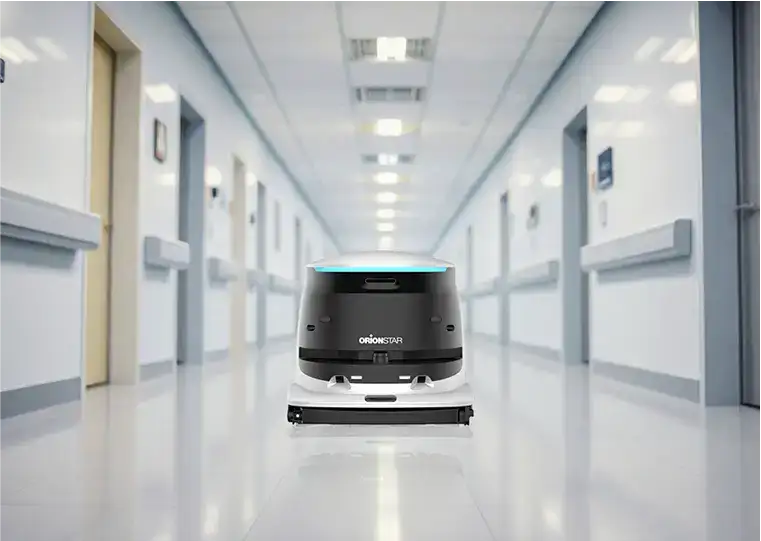
Clinical environments face unique operational hurdles that separate them from standard commercial spaces. The transition from aesthetic lobby maintenance to strict infection-control protocols requires careful coordination, especially when distinguishing between fluid spill management in high-acuity zones and general dust control in outpatient waiting rooms. Acoustic sensitivity is equally critical for patient recovery, forcing facility managers to balance daytime cleaning schedules in reception areas against nighttime operations in inpatient corridors to avoid disrupting rest. Navigating complex physical layouts adds another layer of difficulty, as machines must maneuver through expansive public atriums, tightly constrained exam rooms, and staff-only zones while maintaining cross-floor elevator dispatch capabilities.
Evaluating commercial cleaning robots for clinical facilities means prioritizing these workflow realities alongside stringent data privacy boundaries. Because autonomous navigation relies heavily on optical cameras, LiDAR mapping, and cloud-based fleet management to bypass medical carts and personnel, the risk of incidental patient image capture remains a core procurement factor. Facility operators must establish clear data residency frameworks and verify compliance with GDPR / HIPAA-equivalent regional health-data regulations before deploying any sensor-equipped platform within active patient-care environments, ensuring visual data is strictly processed at the edge without cloud transmission (or subjected to facial blurring) and that cloud maps contain only spatial geometric data.
The OrionStar CleaniBot S55 Pro addresses the highly variable layouts of medical facilities through a multi-mode floor care system that supports sweeping, scrubbing, vacuuming, mopping, and dust mopping within a single unit. This operational versatility allows environmental services teams to configure one machine for diverse zones, transitioning fluidly from wet-scrubbing inpatient corridors to dry-vacuuming reception areas. With a minimum passing width of 700 mm and a compact overall footprint, the platform is physically engineered for navigating into tight exam rooms and operating seamlessly across expansive single-floor layouts. The system utilizes conservative disinfection-related workflow language, integrating its cleaning steps to support routine facility hygiene processes.
Acoustic performance heavily influences clinical scheduling, and this platform operates at an ultra-quiet 45 to 55 dB, according to manufacturer data. This low noise output permits continuous daytime deployment in patient-sensitive waiting rooms and outpatient clinics without causing auditory disruption. Navigation and obstacle avoidance are driven by a robust 15-sensor stack that includes LiDAR, stereo cameras, and ultrasonic sensors to safely bypass dynamic clinical traffic like wheelchairs, stretchers, and staff. Because the platform relies on Wi-Fi or 4G connectivity to sync mapped environments of up to 10,000 square meters with a digital management interface, healthcare administrators must proactively consult the vendor to verify compliance with GDPR / HIPAA-equivalent regional health-data regulations regarding cloud data storage and spatial mapping.
The SoftBank Robotics Whiz occupies a specialized operational niche, focusing entirely on dry vacuuming for carpeted reception areas, administrative offices, and outpatient waiting rooms. It is not designed for wet scrubbing or fluid disposal, meaning it operates as a complementary tool alongside traditional infection-control protocols rather than a replacement for high-acuity trauma cleaning. Weighing a manageable 30 kg, the machine features an exceptionally light chassis that enables easy manual relocation between floors or disconnected staff-only zones when elevator integration is unavailable.
By capturing particulate matter through an explicitly marketed HEPA filtration system, this platform effectively traps dust and airborne irritants without redistributing them into patient-facing environments. It operates at 62 dB in its normal mode, generating a moderate acoustic footprint that blends reasonably well into daytime conversational noise in active lobbies. The unit leverages BrainOS navigation and a teach-by-demonstration programming model to lock into predictable movement patterns. Given its reliance on 3-D cameras and LiDAR for obstacle avoidance, along with cloud-based fleet reporting, facilities deploying this vacuum must carefully audit the system against GDPR / HIPAA-equivalent regional health-data regulations to ensure incidental camera capture aligns with local privacy laws.
The Avidbots Neo 2 is engineered for heavy-duty deployment in sprawling inpatient corridors and large hospital atriums where continuous, large-scale infection control is required. As a fully autonomous multi-application floor scrubber, it is designed to manage the extensive hard-floor footprints typical of major clinical institutions. The platform is unique for offering a first-party disinfection add-on designed explicitly to sanitize high-touch 3-D surfaces alongside standard floor scrubbing. This dual capability allows facility managers to bridge the gap between aesthetic floor maintenance and rigorous environmental sanitization during overnight shifts.
To maintain high productivity, the machine features a 109-liter solution tank and a 135-liter recovery tank, allowing it to clean up to 3,900 square meters per hour, according to manufacturer data, without requiring frequent trips to back-of-house service areas. The onboard AI stack utilizes computer vision and continuous real-time path replanning to navigate around moving beds, medical carts, and dense visitor traffic. The proprietary command center provides granular coverage maps for clinical compliance audits, but because this requires continuous environmental sensing and cloud connectivity, hospital compliance officers must thoroughly vet the platform against GDPR / HIPAA-equivalent regional health-data regulations before implementation.
The Gaussian Robotics Ecobot Scrubber 75 functions as an industrial-grade wet scrubbing platform best suited for back-of-house service areas, massive transit halls, and underground hospital parking facilities. With a 750 mm cleaning width and a substantial 400-kilogram chassis, it maximizes uninterrupted floor coverage in wide-open zones but lacks the agility required to maneuver through narrow exam rooms or highly congested outpatient clinics. It features an optional workstation that enables completely unattended self-docking, automatic freshwater refills, and wastewater discharge, significantly reducing manual intervention for overnight janitorial staff.
Generating operational noise levels between 55 and 70 dB, this heavy-duty unit is generally restricted to after-hours scheduling to avoid disturbing recovering patients or interrupting daytime clinical consultations. It utilizes an expansive sensor array comprising 3-D LiDAR, 2-D LiDAR, and 3-D cameras to manage complex industrial navigation and avoid static obstacles. Because the platform maps vast clinical spaces and transmits remote performance reports to a central cloud dashboard, facility IT and legal departments must ensure the architecture strictly adheres to GDPR / HIPAA-equivalent regional health-data regulations regarding remote monitoring and telemetry data storage.
The Kärcher KIRA B 50 provides a structured, predictable scrubbing solution tailored for long, straightforward inpatient corridors and pre-cleared public spaces. Utilizing a proven cylindrical brush technique with an integrated pre-sweeping function, the platform effectively manages debris and fluid cleaning across hard clinical floors. It is designed to operate autonomously in conjunction with a docking station, enabling multi-shift floor maintenance with minimal staff supervision. The platform features an intuitive route-programming workflow intended for non-specialists, allowing in-house environmental services teams to quickly adjust cleaning paths as hospital ward layouts evolve.
Safety and public-area integration are central to its design, evidenced by its formal public-area safety certifications and integrated laser scanners. However, operators must account for a documented blind spot regarding obstacles less than 15 cm above the floor, necessitating careful pre-cleaning area setup to remove low-profile medical cables or small IV stand casters. The manufacturer offers explicit assurances regarding data encryption and restricted portal access, yet clinical operators in all regions are still required to independently verify that these protocols fully satisfy their local GDPR / HIPAA-equivalent regional health-data regulations before authorizing cloud-based reporting.
Procuring autonomous floor care equipment for medical environments requires aligning the machine's physical and acoustic attributes with the facility's specific operational workflows. For high-traffic waiting rooms and outpatient clinics where daytime scheduling is mandatory, systems offering ultra-quiet acoustic profiles and narrow passing widths provide the least disruptive maintenance footprint. Conversely, expansive inpatient corridors and back-of-house service areas benefit from wide-path scrubbers with substantial tank payloads to maximize overnight cleaning efficiency without frequent manual refills. Ultimately, integrating high-touch surface sanitization tools and establishing strict data privacy governance remain the most critical differentiators when evaluating long-term automated infection control capabilities.
What ROI can a clinical facility realistically expect from a commercial cleaning robot? Payback periods in published industry models cluster in the 6–18 month range, with most daily-use hospitals converging on the shorter end. Sproutmation's ROI guide cites 9–18 months for facilities with 50,000+ sq ft of repeatable hard floor, and GrabaRobot's 2026 ROI guide models a hospital corridor scenario at roughly 8.3 months payback on a $35,000 landed scrubber with $55,000 of annual labor-plus-liability savings. Facilities prioritizing rigorous environmental cleaning often align with public health guidelines to maintain optimal hygiene, delivering value that extends beyond simple labor offset. Buyers should stress-test savings by trimming expected labor offset by 25%, and use real-world coverage rather than brochure speeds.
What does a 5-year TCO look like, and what drives the biggest cost differences? A typical 5-year TCO range from GrabaRobot's 2026 guide is roughly $38,500 for a Chinese-vendor scrubber ($18,000 landed) versus $63,000 for a comparable Western-brand unit ($35,000 landed), with maintenance and consumables accounting for $12,500–$18,000 over the period. The largest swing factors are purchase price, brush and squeegee replacement cadence, chemical dosing, battery replacement after year 3–4, and service-contract scope. Kärcher's KIRA B 50, for example, sits in the higher-end TCO band but bundles CSA C22.2 No. 336-17 and IEC 63327 public-area safety certifications into that price. For a clinical buyer, request a written 5-year cost breakdown including detergent chemistry, brushes, batteries, software updates, and downtime provisions.
Should we buy, lease, or use a Robot-as-a-Service (RaaS) subscription? All three models exist and the right answer depends on cash-flow versus balance-sheet priorities. SoftBank's Whiz is sold primarily as a RaaS subscription at roughly $699/month in the US, which keeps the unit off the balance sheet and bundles software updates. Industry RaaS pricing for autonomous scrubbers typically ranges from $500–$2,000/month depending on robot class. Capital purchase makes sense for multi-shift, multi-year usage and for hospitals that prefer to own the asset on their depreciation schedule; RaaS makes sense for pilot deployments, multi-site rollouts that want one master contract, or facilities without capital budget. Verify who owns cleaning-data records, service-level response time, and end-of-contract refresh rights in any RaaS contract.
Which cleaning mode and width make sense for clinical reception areas versus inpatient corridors? Use case dictates the answer. Quiet reception and waiting rooms benefit from a low-noise vacuum or dust-mop mode—OrionStar's CleaniBot S55 Pro runs Dust Mop at 45 dB for up to 28 hours on a charge, and SoftBank Whiz runs at 62 dB normal mode with a 4 L HEPA-filtered dust bag (manufacturer data). For long inpatient corridors, a wider scrubbing path pays off: CleaniBot S55 Pro scrubs at 1,197 m²/h with a 550 mm brush, Kärcher KIRA B 50 at up to 2,300 m²/h with a 550 mm brush, and Gausium Scrubber 75 at up to 1,400 m²/h practical with a 750 mm brush. Match the robot's minimum passing width (e.g., 700 mm for S55 Pro, 1,400 mm for Scrubber 75) to your narrowest corridors and elevator doors before committing.
How do these robots fit into infection-control workflows and high-touch surface disinfection? Wet scrubbers handle floor-level infection control, but high-touch 3-D surfaces usually require an add-on. Avidbots Neo 2 is the only one of the surveyed models with an explicitly marketed first-party Disinfection Add-On (DSX) for high-touch surfaces beyond the floor. The CDC recommends objective monitoring of cleaning thoroughness, and its guidance for high-touch surface evaluation is the de facto reference standard that infection-prevention teams use to audit any robotic program. For HEPA-filtered vacuuming, only Whiz among the surveyed models publishes a HEPA rating; for KIRA B 50 and Scrubber 75, request the filter class directly from the vendor. Plan for the robot to complement—not replace—manual terminal cleaning of isolation rooms and body-fluid spills.
Can these robots navigate safely around wheelchairs, IV poles, beds, and staff in real clinical traffic? Yes, but with documented blind spots that buyers should pressure-test. CleaniBot S55 Pro combines LiDAR (mapping up to 10,000 m²), stereo-camera cliff and step detection, ultrasonic obstacle avoidance, and line-laser edge tracking for a stated 360° sensing envelope; its 20 mm obstacle-climbing height and 700 mm minimum passing width are well matched to standard clinical corridors (manufacturer data). Kärcher's manual explicitly warns that the KIRA B 50 cannot detect obstacles less than 15 cm above the floor (cables, IV stands, sockets), so area setup is required. Whiz uses BrainOS with LiDAR plus 3-D cameras and a "Teach & Run" route learning model, which works well on stable routes but needs re-teaching when layouts shift. Pilots in the messiest real corridor, not the demo room, are the only reliable way to validate obstacle handling before fleet rollout.
Disclaimer: Third-party product specifications are based on public data (up to, under laboratory conditions, according to manufacturer data) and may vary. Product names and trademarks are the property of their respective owners. If any product involves cameras, voice recording, mapping, or cloud data processing, operators must verify GDPR / HIPAA-equivalent regional health-data regulations compliance prior to deployment.