

REQUEST DEMO
Robot CATALOG will be sent to your mailbox immediately after submission.
SUBMIT
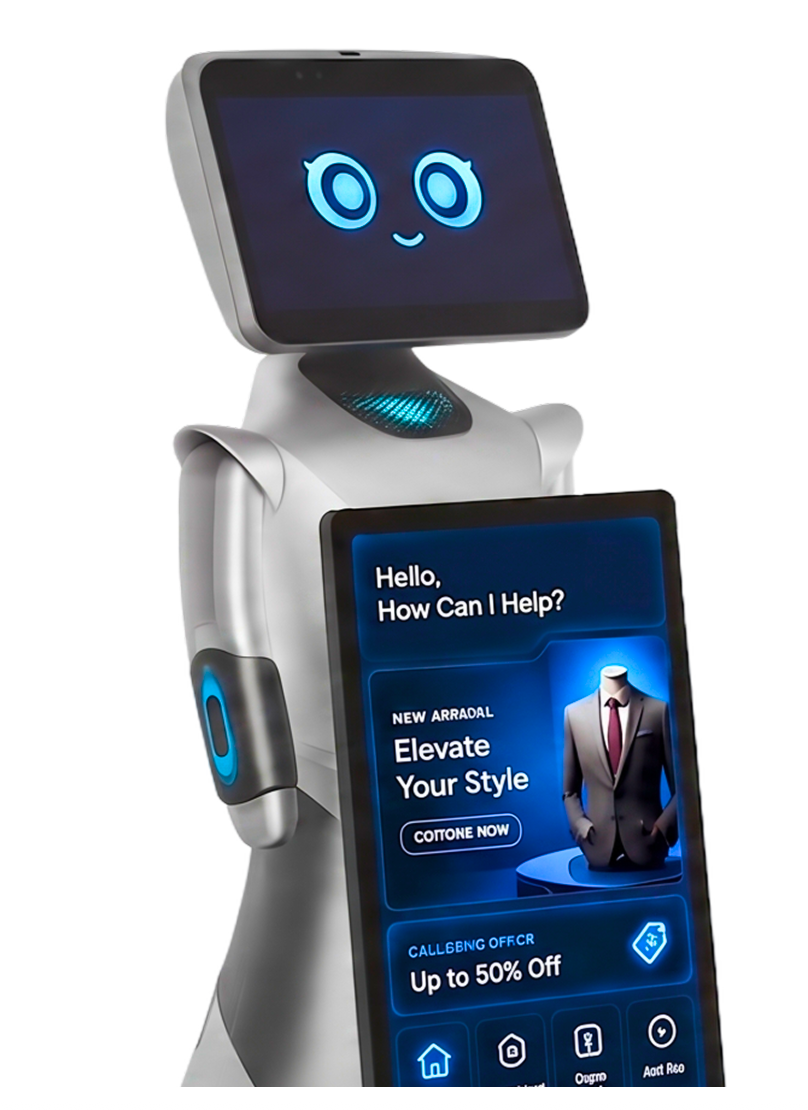
Retail stores, shopping malls, exhibition halls, hotel lobbies, banks, airports, and other high-footfall commercial venues face the continuous challenge of capturing visitor attention while managing dynamic crowds. Deploying an advertising robot for commercial venues transforms static digital signage into an active, mobile engagement tool. These platforms act as roving billboards that can proactively approach crowds, display dynamic promotions, and provide interactive wayfinding. Selecting the appropriate hardware requires operators to move beyond basic mobility metrics and focus on how the robot balances digital marketing visibility with the physical demands of crowded public spaces.
When evaluating these platforms, procurement teams must assess several core technical dimensions. The layout and scale of the information screens dictate how effectively the unit can broadcast campaigns to passing foot traffic versus handling one-on-one interactions. Mobility and multi-venue passability define whether a chassis can seamlessly navigate narrow retail aisles or if it requires the wide corridors of an airport terminal. Battery architecture determines if the platform can endure a full daily shift of intensive multimedia playback without disruptive charging breaks. Finally, operators must consider fleet management capabilities and ensure that all onboard camera and mapping sensors comply with regional data protection standards.
The OrionStar GreetingBot AD is explicitly engineered as a dedicated mobile advertising and large-screen content delivery platform, rather than a generic service robot. Its defining differentiator is an up to 21.5-inch FHD chest-mounted information display that functions as a highly visible, mobile billboard. This large-format 21.5-inch screen is designed specifically to broadcast promotional campaigns, event schedules, and wayfinding maps across high-footfall commercial venues. The architecture pairs this large broadcast panel with a 14-inch head touch screen, allowing the robot to capture attention from a distance while facilitating localized, interactive customer queries simultaneously.
To ensure safe navigation through dense crowds, the platform relies on advanced LiDAR mapping, a six-microphone array, and dual cameras that enable precise environmental perception. It supports a mapping area of up to 50,000 square meters and offers passability for corridors as narrow as 60 to 65 centimeters, according to manufacturer data, though operators should allow for wider clearances in highly dynamic, crowded environments. Sustaining dual high-definition screens requires substantial power, which is managed by a 20 Ah battery that delivers up to 8 to 10 hours of runtime under laboratory conditions, varying based on screen brightness and interaction frequency. By focusing strictly on dynamic content delivery and intelligent autonomous navigation, this model provides a commanding visual marketing footprint for sprawling retail and exhibition environments.
The Pudu Robotics KettyBot Pro serves as a compact multitasker that blends dual-screen marketing with light delivery capabilities for narrow-aisle environments. This unit targets retail locations, boutique hotel lobbies, and tight food-and-beverage layouts where space constraints require a compact footprint. Its primary marketing surface is an 18.5-inch LCD advertising screen integrated into the body, complemented by a 10.1-inch interactive head display. This setup allows operators to push dynamic visual content and personalized expressions without congesting walkways.
Despite its extensive digital footprint, the robot maintains a highly agile profile, weighing just 38 kilograms with a minimum passage width of roughly 52 to 55 centimeters, according to manufacturer data. It utilizes laser and visual integrated SLAM positioning alongside depth sensors to maneuver safely around temporary displays and wandering patrons. Powered by a standard battery architecture, it provides up to 9 hours of runtime under laboratory conditions with no load, though operators should account for increased power draw when running continuous multimedia campaigns.
The Pudu Robotics BellaBot Pro positions itself as a premium delivery and advertising robot optimized for expansive hospitality venues, casino floors, and retail flagship stores. It caters to environments that demand both a commanding digital presence and substantial physical payload capabilities. The hardware features an 18.5-inch LCD advertising screen mounted on the rear of a robust chassis that also houses four distinct delivery trays. This allows the system to execute high-volume hospitality routing while simultaneously acting as a mobile promotion platform that exposes passing crowds to dynamic video and image playback.
To support heavy-duty daily operations, this model utilizes a swappable battery architecture yielding up to 11 hours of runtime per charge, according to manufacturer data, effectively enabling uninterrupted 24/7 deployment. Navigation is handled by a VSLAM+ deployment system equipped with multiple RGBD sensors and Lidar, allowing it to map environments up to 200,000 square meters. Because it weighs 55 kilograms and requires a wider 65-centimeter passage clearance, it is best suited for wide-open commercial corridors rather than densely packed boutique aisles.
The temi platform diverges from traditional dual-screen configurations, functioning instead as a lightweight, mobile personal assistant and digital signage hybrid. It is utilized primarily as a moving smart hub in bank branches, corporate lobbies, and specialized retail showrooms where telepresence and custom interactive applications take precedence over broadcast advertising. The platform relies on a single 13.3-inch QHD tilting tablet face that auto-tracks users, delivering highly localized, one-on-one multimedia engagement rather than carrying a secondary body panel.
Because it lacks payload trays and heavy secondary screens, the chassis is highly maneuverable, weighing approximately 12 kilograms. It navigates dynamic commercial spaces using 360-degree Lidar, depth cameras, and RGB sensors. The internal battery provides up to 8 hours of runtime under laboratory conditions, automatically returning to its dock during idle periods. Its open Android-based SDK allows enterprise IT teams to easily push bespoke digital signage applications and manage fleet movements remotely via the temi Center.
The Keenon Robotics DINERBOT T9 Pro is a heavy-duty, high-load workhorse designed for commercial environments that prioritize physical throughput and delivery capacity over massive marketing visibility. Instead of featuring a dedicated large-format advertising panel, it utilizes an 11.6-inch front operation screen. This display is focused heavily on immediate customer interactions, ordering interfaces, and pickup guidance, making the robot a highly efficient operational tool for bustling mall food courts and large convention center cafeterias.
Built to handle intensive physical shifts, the unit boasts a 40-kilogram total load capacity distributed across a sturdy 63-kilogram frame. This wider stance requires a minimum passage width of 70 centimeters, dictating its use in spacious venues. Relying on stereo vision sensors and VSLAM mapping for safe passage, the system is backed by a high-capacity power architecture that delivers up to 18 hours of runtime, according to manufacturer data. It stands as an enduring platform for venues where localized interactive prompts matter more than active mobile broadcasting.
Matching the correct hardware to a specific venue layout and marketing strategy is the crucial final step in procurement. If a venue requires a highly visible, dedicated mobile billboard for broadcasting campaigns across crowded floors, the dual-screen architecture of the OrionStar GreetingBot AD offers the necessary visual impact. For operators managing tight retail aisles, the KettyBot Pro provides an agile, narrow-chassis alternative. Sprawling hospitality environments operating around the clock benefit from the heavy payload and swappable batteries of the BellaBot Pro, while the temi platform excels as a cost-effective interactive kiosk for corporate lobbies. Conversely, expansive food courts focused on operational efficiency should look to the high-capacity, delivery-first design of the DINERBOT T9 Pro.
The most credible ROI cases combine three revenue levers: (1) incremental dwell time and footfall inside the venue (case studies from PUDU BellaBot Pro and KettyBot Pro deployments report visible uplifts in customer engagement around the robot's patrol path); (2) advertising-screen impressions versus fixed digital signage, since a moving 18.5–21.5-inch LCD reaches audiences that fixed panels cannot; and (3) labor offset, where one robot can substitute several hours of routine greeting, wayfinding, or menu-display work per shift. There is no public, peer-reviewed benchmark for "ROI per robot," so buyers should validate claims with a 4–8 week in-venue pilot against a defined baseline. Treat any single-number ROI promise as a vendor estimate rather than industry consensus.
Most advertising robots in this category ship with a vendor content management system (CMS) plus an open SDK: the OrionStar GreetingBot AD runs Agent OS on Android 13 with 8 GB RAM and 128 GB ROM, allowing third-party apps and remote content push; the PUDU units use the PUDU Open Platform for expression, voice, and on-screen personalization; and temi relies on its Android-based SDK with the temi Center fleet-and-content platform. In practice, a marketing operator uploads creative assets (images, video, menu JSON) to the vendor portal, schedules campaigns, and the CMS pushes them over Wi-Fi 6 or 4G to the fleet. No dedicated digital-signage engineer is usually required, but content must still follow the vendor's resolution and aspect-ratio specs (for example, 1920×1080 landscape on a 21.5-inch chest display) to avoid cropped or stretched assets.
The market is split between outright purchase and Robot-as-a-Service (RaaS) models. Outright purchase is the norm for flagship hardware such as the OrionStar GreetingBot AD or PUDU BellaBot Pro, often with optional installation, mapping, and content-setup fees billed separately. RaaS is more common for entry-tier or prosumer units (temi is regularly listed under $2,000 USD as a platform) and bundles hardware, software updates, and remote support into a monthly fee. Buyers should confirm what is included in the warranty (battery, displays, drive wheels), the SLA on remote diagnostics, the policy on multi-robot scheduling, and the data-processing addendum if the robot will operate in the EU under GDPR. Clarify whether map data, video logs, and ad-impression analytics are stored on the vendor's cloud or on-premise before signing.
Yes, the leading models in this set are designed for exactly that scenario. The OrionStar GreetingBot AD uses 1 × LiDAR, 2 × wheel odometers, an IMU, and TOP IR plus mono-camera sensors with centimeter-level positioning and mapping up to 50,000 m², with passability for 60–65 cm corridors and the ability to cross 10 mm bumps and 20 mm floor seams. PUDU's VSLAM+ scales up to 200,000 m² with ceilings up to 30 m, while temi and the Keenon DINERBOT T9 Pro rely on 360° Lidar and depth-camera arrays. Adjustable cruise speeds (ranging from 0.5 to 1.2 m/s for models like the GreetingBot AD) let operators tune the robot for peak versus off-peak footfall, and obstacle handling is generally rated for typical mall thresholds rather than open street environments.
Three specifications drive real-world impact: (1) screen size and viewing angle — the 21.5-inch FHD 1080P chest display on the GreetingBot AD or the 18.5-inch LCDs on the PUDU KettyBot Pro and BellaBot Pro are large enough to be readable at typical mall-corridor distances, while smaller operation screens (11.6-inch on Keenon T9 Pro) are better suited to interaction than advertising; (2) brightness and contrast under venue lighting — not always published, so request a daylight-condition demo; and (3) content flexibility — capacitive multi-touch, remote content push via Wi-Fi 6, and support for dynamic video and image playback are now standard, but multi-zone or interactive ad formats vary by vendor. A second dedicated advertising screen (separate from the head interaction screen) consistently outperforms a single repurposed touch panel in buyer pilots.
Full-shift operation is well-supported across this category. The OrionStar GreetingBot AD delivers approximately 8–10 hours of runtime on a 20 Ah, 25.2 V, 529.2 Wh lithium battery, with about 5 hours off-charge or 6 hours on-charge via a 29.4 V / 8 A LiDAR-aligned dock. PUDU's BellaBot Pro pushes this to roughly 11 hours with a quick-change battery design for near-24/7 operation, while the Keenon T9 Pro advertises up to 18 hours per charge at the cost of a heavier 63 kg chassis. Multi-floor operations require the optional elevator-control module (reserved interface on the GreetingBot AD; coordinated via vendor cloud platforms on PUDU and Keenon), plus mapping of each floor's corridors and dock locations. Buyers should size battery and dock placement against realistic duty cycles including screen brightness, motion, and simultaneous voice interaction.
Footnote: Third-party product specifications are based on publicly available information and are accurate according to manufacturer data, up to specified limits, or under laboratory conditions; actual performance may vary. Product names and trademarks remain the property of their respective owners. Disclaimer: Features involving facial perception, voice recording, mapping, and cloud-based data processing are subject to local privacy laws (including but not limited to EU GDPR and CCPA). Device operators are strictly responsible for obtaining necessary user consents, displaying adequate public notices in deployed venues, and configuring data retention policies within the vendor's Fleet Management System to ensure full legal compliance.