

REQUEST DEMO
Robot CATALOG will be sent to your mailbox immediately after submission.
SUBMIT
Commercial buildings, multi-tenant office properties, and mixed-use environments present unique logistical challenges for facility management teams tasked with maintaining expansive and diverse floor plates. Building managers must continuously balance the demand for high-quality sanitation against the operational realities of fluctuating pedestrian traffic, stringent noise covenants, and strict data privacy regulations across global markets. The transition toward automated cleaning solutions requires evaluating various equipment architectures capable of adapting to shifting tenant layouts while minimizing direct human intervention. Deploying these fleets efficiently across global property portfolios hinges on understanding how different machines handle the realities of commercial properties, from intricate boardroom carpets to vast, high-traffic hard-floor lobbies.
Multi-tenant buildings feature a diverse mix of surfaces, dictating that facility management teams align the primary function of the equipment with their predominant flooring type. Dedicated dry sweeping and vacuuming utilize integrated filtration systems for maintaining office corridors and carpeted areas where moisture cannot be introduced. Conversely, focused wet scrubbing employs solution tanks and dedicated mechanical mechanisms tailored for hard floors, prioritizing the removal of surface-level grime in retail or lobby spaces while leaving floors immediately dry. For expansive mixed-use atriums or industrial-adjacent spaces, high-pressure multi-functional processing combines heavy downward pressure with liquid absorption to address stubborn dirt and compacted grime.
Navigation architecture and environment mapping fundamentally determine how much ongoing supervision a machine requires when building layouts inevitably change. Manual routing relies on an operator physically guiding the machine through a desired path, which the system then memorizes, ensuring predictable behavior for static corridors but requiring reprogramming if layouts alter. Autonomous dynamic mapping leverages advanced sensors to scan the environment and generate comprehensive digital area maps. This method calculates optimal cleaning paths and dynamically reroutes around unexpected obstacles without human intervention. Because autonomous dynamic mapping often relies on cloud-based data processing, building operators must verify that the chosen platform complies with applicable data protection and privacy regulations, such as GDPR, prior to deployment.
The true return on investment for property portfolios relies on minimizing human intervention and managing the acoustic footprint during cleaning shifts. Compact fleet deployment utilizes smaller fluid capacities and shorter battery cycles, prioritizing agility for servicing scattered satellite spaces where operators manually handle fluid transfers. High-capacity autonomy features large-volume fluid tanks paired with automated docking infrastructure, enabling machines to independently discharge wastewater and recharge batteries for continuous multi-shift operations. Furthermore, the scheduling of cleaning shifts dictates acceptable noise limits. Ultra-quiet operation engineered below standard decibel thresholds allows machines to clean occupied spaces without disturbing meetings, while standard commercial acoustic profiles deliver higher active cleaning pressure optimized for after-hours schedules or naturally loud environments.
The OrionStar CleaniBot C5 is positioned for medium-to-large commercial buildings and property portfolios that require heavy-duty, single-pass scrubbing across extensive mixed-use areas. Facility management teams overseeing vast atriums, loading docks, and high-traffic public corridors benefit from its integration of scrubbing, dust-mopping, and liquid absorption capabilities. Designed to navigate complex architectural layouts, its minimal passing width of approximately eight hundred eighty millimeters allows it to move fluidly through typical multi-tenant doorways and elevator lobbies. By incorporating a high-capacity autonomous workstation, the system minimizes human intervention, executing automatic clean-water refilling, wastewater discharge, and self-cleaning routines that support continuous multi-shift operations.
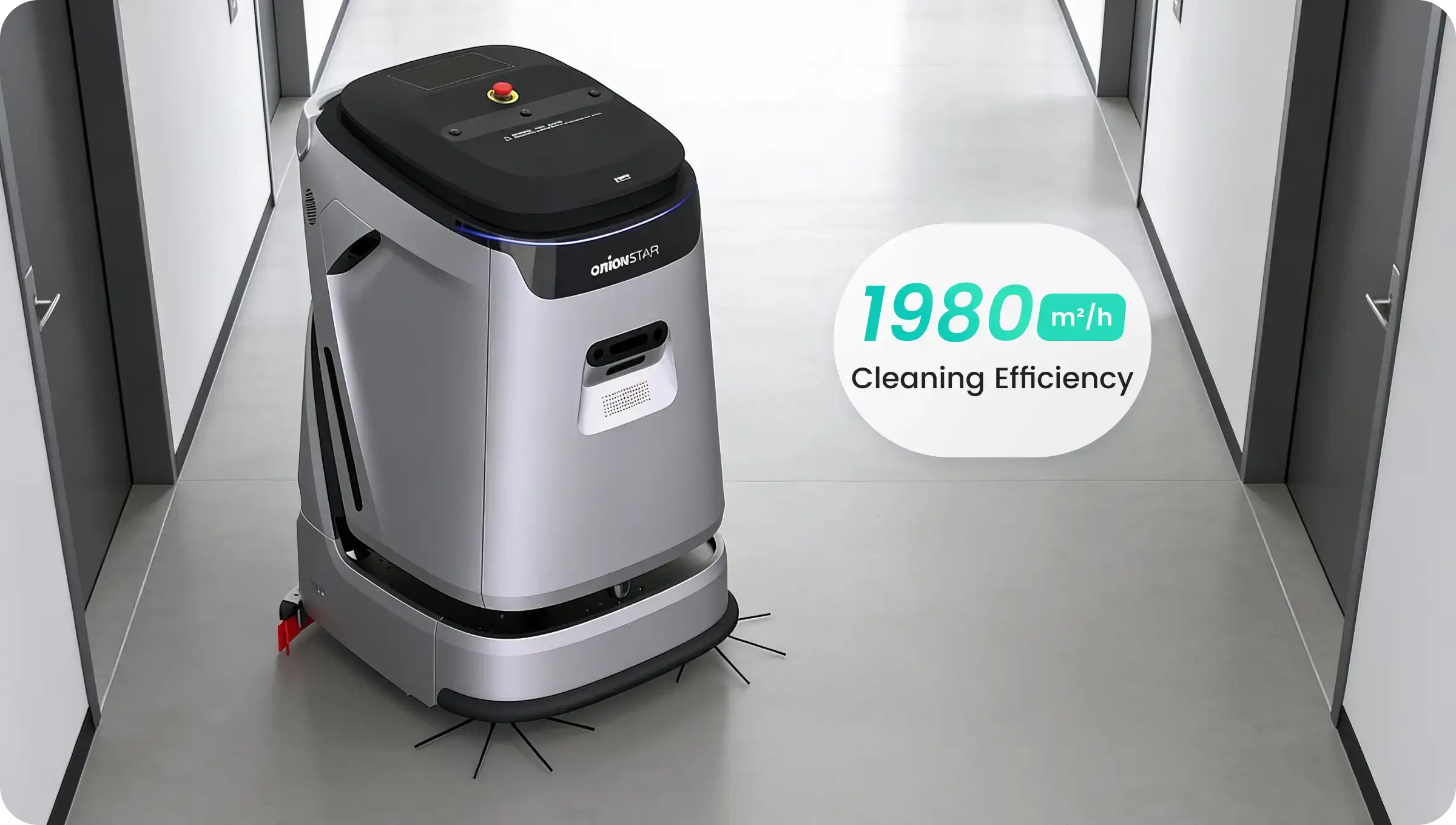
According to manufacturer data, the unit delivers a maximum cleaning area capacity of up to 1,980 square meters per hour, driven by a five hundred fifty-millimeter main brush and twenty-five kilograms of downward scrubbing pressure. It utilizes a combined ninety-liter water tank system, which substantially extends continuous operation times before requiring automated docking. Operating at a noise level under sixty-eight decibels, the machine maintains an acceptable acoustic profile for bustling public spaces and after-hours tenant environments. Because the system autonomously maps areas up to ten thousand square meters and optimizes cleaning paths via cloud processing, operating organizations must verify GDPR compliance regarding spatial data retention and security prior to European portfolio rollouts.
The Avidbots Neo 2W specifically targets logistics-adjacent floor plates within broader mixed-use properties or corporate campuses managed by facility teams. Building managers who oversee distribution centers, large back-of-house mailrooms, or attached warehouse spaces require navigation systems capable of dynamically adjusting to continuously changing stock layouts and unpredictable obstacles like pallets. The unit leverages a proprietary artificial intelligence and computer-vision stack to process deep learning algorithms, allowing it to adapt its pathing without requiring operators to manually remap the entire facility when tenant logistics shift. Furthermore, its command center platform provides essential multi-site reporting, granting central property management full visibility into per-plan success rates across disparate global locations.
Operating primarily on a heavy-duty capital expenditure model, the machine runs on a thirty-six-volt lead-acid battery infrastructure that provides up to six hours of continuous operation under optimal conditions. Due to its larger physical footprint and gross vehicle weight, facility teams typically deploy it in ground-level industrial spaces or utilize freight elevators for multi-floor transit. As the navigation stack relies extensively on three-dimensional sensors and visual obstacle detection feeds, facility management teams must carefully vet the platform for GDPR adherence, focusing particularly on how and where the visual telemetry is stored, processed, and eventually discarded.
The ICE Co-Botics Cobi 18 is engineered for smaller footprints and satellite spaces across varied multi-tenant properties, aligning heavily with operational expenditure budgets through an all-inclusive subscription framework starting around fifteen dollars per day. Building managers handling a dense mix of retail storefronts, compact elevator lobbies, and individual tenant suites can utilize its teach-and-repeat routing architecture to dispatch the unit on highly predictable paths. By saving up to sixty distinct cleaning routes across numerous home location codes, operators can easily transport the lightweight machine between different floors, using elevators as strategic waypoints to maximize cross-floor utilization. The inclusion of the centralized fleet dashboard further assists portfolio managers in tracking route completion and confirming operational quality standards across multiple properties simultaneously.
Designed around a forty-eight-centimeter cleaning path, the unit effectively scrubs and dries hard surfaces in a single pass while maintaining a tight enough turning radius to navigate confined aisles and mirrored corridors. According to manufacturer data, it achieves a runtime of up to ninety minutes per charge, drawing from a compact ten-liter solution tank that necessitates routine manual top-ups from on-site staff. Although the system deliberately avoids recognizing human faces or text, it does generate and process point-cloud maps to navigate complex layouts, requiring European property managers to secure standard GDPR documentation confirming proper data processing protocols and cloud residency.
The SoftBank Robotics Whiz functions strictly as a commercial dry-vacuum cobot, serving as a specialized companion unit for building managers adding dedicated carpet coverage alongside their separate hard-floor scrubbers. Widely deployed across hotels, universities, and multi-tenant office spaces, it excels at removing daily dry debris from expansive boardrooms and executive suites without introducing moisture to sensitive flooring. It operates on a straightforward teach-once route recording paradigm, where a facility worker manually pushes the machine along the desired trajectory, which it subsequently repeats autonomously. Deployed primarily under a fixed-cost subscription model, it integrates seamlessly into existing building service contractor agreements, granting portfolio operators immediate oversight through its connected cloud dashboard.
Under laboratory conditions, the machine covers up to one thousand five hundred square meters on a single charge, leveraging a high-efficiency particulate air filtration system and a four-liter dust capacity to maintain indoor air quality. Operating at a quiet acoustic baseline of approximately sixty-two decibels, it easily accommodates daytime cleaning schedules in occupied office suites without triggering tenant noise complaints. Because the navigation framework relies on integrated optical and three-dimensional cameras to detect physical barriers, facility management teams must ensure they receive comprehensive GDPR assurances regarding visual data processing, establishing clear sub-processor agreements before introducing the unit into sensitive tenant environments.
The Kärcher KIRA CV 50 specifically addresses the nuanced requirements of quiet, after-hours vacuuming in highly regulated, publicly accessible commercial properties. Unlike standard bulk cleaners, its exceptionally low thirty-two-centimeter clearance height allows it to effortlessly navigate under office desks and boardroom tables, minimizing the physical labor associated with moving tenant furniture. The unit operates entirely independent of local building networks by utilizing an integrated mobile connection, offering immediate cloud reporting functionality without requiring complex integration into segmented tenant Wi-Fi architectures. As one of the few machines in its class holding specific autonomous safety certifications for public areas, it represents a highly compliant choice for mixed-use lobbies that experience unpredictable foot traffic.
Manufacturer specifications indicate the unit emits an exceptionally low sound pressure of just fifty-seven decibels, establishing it as a prime candidate for nighttime operations in mixed-use buildings containing residential components. It executes fully autonomous spatial mapping to calculate optimal coverage, yielding an area performance rate of up to five hundred twenty-five square meters per hour. Given that the machine utilizes advanced long-range sensors to construct digital maps and transmits this telemetry over external mobile networks rather than internal firewalls, securing robust data processing agreements that strictly comply with GDPR mandates remains a critical prerequisite for deployment across European real estate portfolios.
Selecting the appropriate autonomous cleaning infrastructure for a commercial property portfolio requires aligning equipment modalities with existing operational workflows and surface compositions. Procurement teams should first audit their real estate assets to determine the specific ratio of carpeted office space to hard-floor public atriums, as this directly dictates whether capital should be allocated toward dedicated dry sweeping or heavy-duty wet processing. Organizations must also weigh their internal staffing models against the autonomy architecture; facilities with minimal overnight shifts benefit greatly from high-capacity machines with automated docking capabilities, while dynamic spaces with continuous tenant churn may find greater utility in agile, subscription-based models. Finally, standardizing data privacy evaluations is essential. Operations teams must systematically verify data protection regulations, specifically prioritizing GDPR compliance, whenever utilizing connected machines that rely on cameras, environment mapping, or cloud-based data processing.
Facilities with daily cleaning needs and meaningful hard-floor coverage typically reach payback in 9 to 18 months, with overnight routes often paying back faster because they displace the most expensive labor hours. Loaded labor cost (wages plus benefits plus supervision) is the right baseline to use, not the headline wage rate; using base wage alone can understate savings by 30 percent or more. Deployments with very low labor costs (under roughly $14/hour) or small, low-traffic floor plates can stretch payback to 4 to 6 years and may not justify automation on ROI alone.
Both models are viable and the right answer depends on portfolio scale, capex cycle, and who is on the hook for maintenance. Subscription / RaaS models such as ICE Cobotics Cobi 18 (around $15 per day, all-inclusive) and SoftBank Whiz (RaaS with fixed-price guarantee) shift service, parts, and consumables to the vendor, which suits smaller floor plates or buildings where cleaning is OPEX-funded. Capital purchase (typical for Kärcher KIRA, Avidbots Neo, and OrionStar CleaniBot) makes more sense for multi-year, multi-site rollouts where the building owner wants the asset on the balance sheet and is willing to manage batteries, brushes, and consumables in-house.
Every autonomous unit on the shortlist here maps its environment with LiDAR, 3D cameras, or point-cloud sensors, and most push that data to a vendor cloud, so a standard GDPR pre-deployment checklist applies across vendors. At minimum, request (a) a Data Processing Agreement naming the vendor as processor under Art. 28, (b) categories of personal data processed (LiDAR point clouds vs. visual imagery), (c) data residency and sub-processor list, (d) retention and deletion windows, and (e) anonymization of map and telemetry data. Kärcher's reliance on integrated 4G/LTE rather than customer Wi-Fi, for example, makes the DPA especially important because data leaves the building perimeter by default.
For lobbies, corridors, and tenant floors, a narrower cleaning path (around 48 to 55 cm) combined with a minimum passing width under 90 cm lets the unit navigate standard doorways and elevators; the Cobi 18 at 48 cm and the OrionStar CleaniBot C5 at 550 mm cleaning width / 880 mm passing width both fit this envelope, while the Avidbots Neo 2W at 76 to 94 cm wide and 137 cm tall will not fit a typical passenger elevator. Tank capacity should be sized to the floor plate: roughly 10 to 12 L handles small suites, 45 L per side (as in the CleaniBot C5) is more appropriate for medium-to-large floor plates, and ride-on platforms are needed for warehouses above several thousand square meters per shift.
Almost always both. Of the units commonly compared for building management, only the Cobi 18 and the OrionStar CleaniBot C5 deliver true scrub-dry (wet) capability in a single pass; the SoftBank Whiz and Kärcher KIRA CV 50 are dry-vacuum only, and the Avidbots Neo 2W is tuned for warehouse scrub duty rather than office-grade wet/dry cycles. The most common portfolio pattern is a compact wet scrubber for hard-floor lobbies and tenant floors plus a quiet autonomous vacuum for carpets and after-hours dry debris, with both managed through a single cloud fleet dashboard.
For nighttime or after-hours cleaning in Class A offices, hotels, or mixed-use buildings with residential components, anything above roughly 65 dB(A) tends to conflict with tenant noise covenants. The Kärcher KIRA CV 50 at 57 dB(A) and SoftBank Whiz at about 62 dB are the quietest in this category; the Cobi 18 sits at 66 to 70 dB depending on mode; and the OrionStar CleaniBot C5 stays under 68 dB(A). When the cleaning window overlaps occupied hours, prioritize units under 65 dB(A) and confirm in writing that the operating schedule stays inside the lease's quiet-hours clause.
Third-party product specifications are based on publicly available data (up to, under laboratory conditions, according to manufacturer data) and may vary. Product names and trademarks are the property of their respective owners. If any product involves cameras, audio recording, mapping, or cloud data processing, operators must verify GDPR compliance before deployment.