

REQUEST DEMO
Robot CATALOG will be sent to your mailbox immediately after submission.
SUBMIT
Commercial buildings present a highly diverse set of environmental challenges for facility management operators, combining expansive lobbies and retail concourses with narrow office corridors and compact public restrooms. Soft FM service providers are increasingly adopting robotic cleaning solutions to maintain consistent hygiene standards, adapt to quiet daytime or nighttime operations, and reduce their reliance on manual labor for repetitive floor care tasks. Because commercial operations frequently span multiple properties, buyers must look beyond fundamental scrubbing performance to evaluate how these machines integrate into larger ecosystems. The procurement process hinges on selecting equipment that can navigate complex layouts efficiently while providing robust remote management capabilities to centralize oversight across numerous localized cleaning crews.
Evaluating the optimal hardware requires assessing how the physical dimensions and weight of the scrubber dictate where it can be safely deployed and how efficiently it covers the floor plan. High-capacity platforms deploy wide cleaning paths to maximize per-pass productivity in vast, open commercial spaces, whereas mid-scale, agile platforms maintain moderate dimensions to balance open-space throughput with the ability to clear narrow corridors. True labor reduction in soft FM operations extends beyond autonomous driving to how the machine manages its own water, waste, and power during a shift. Autonomous docking and self-maintenance architectures automatically navigate to a base station to handle fluid exchange and charging, whereas high-capacity retention systems utilize oversized onboard tanks that extend time between service intervals but ultimately require manual intervention.
Service providers frequently deploy fleets across multiple properties and employ diverse, multilingual workforces, making user accessibility and telemetry critical factors. Proprietary cloud platforms with extensive localized interfaces allow remote administrators to switch locales dynamically, directly supporting local operators, while standardized third-party autonomy ecosystems provide a familiar telemetry backbone across mixed hardware fleets. Furthermore, navigating dynamic commercial environments requires advanced spatial awareness. Vision-intensive AI navigation utilizes multiple optical cameras to interpret shifting environments, while spatial-sensor and LiDAR-driven navigation rely heavily on spatial mapping for evasive maneuvering. Because commercial autonomous floor scrubbers utilize cameras, mapping technologies, and cloud-connected telemetry, operating parties must proactively verify applicable data protection and privacy regulations, such as GDPR, before deployment to ensure proper data processing agreements are established.
The OrionStar CleaniBot C5 targets mixed-use commercial floors where operators require a balanced approach to agility and automated maintenance. By blending a compact profile with comprehensive self-service capabilities, this platform addresses the daily challenges of soft FM teams navigating both open lobbies and tighter office corridors. Its navigational envelope ensures it can traverse complex layouts without demanding excessive spatial clearance, making it highly suitable for multi-zone building assignments where equipment needs to transition fluidly between primary entryways and secondary passageways.
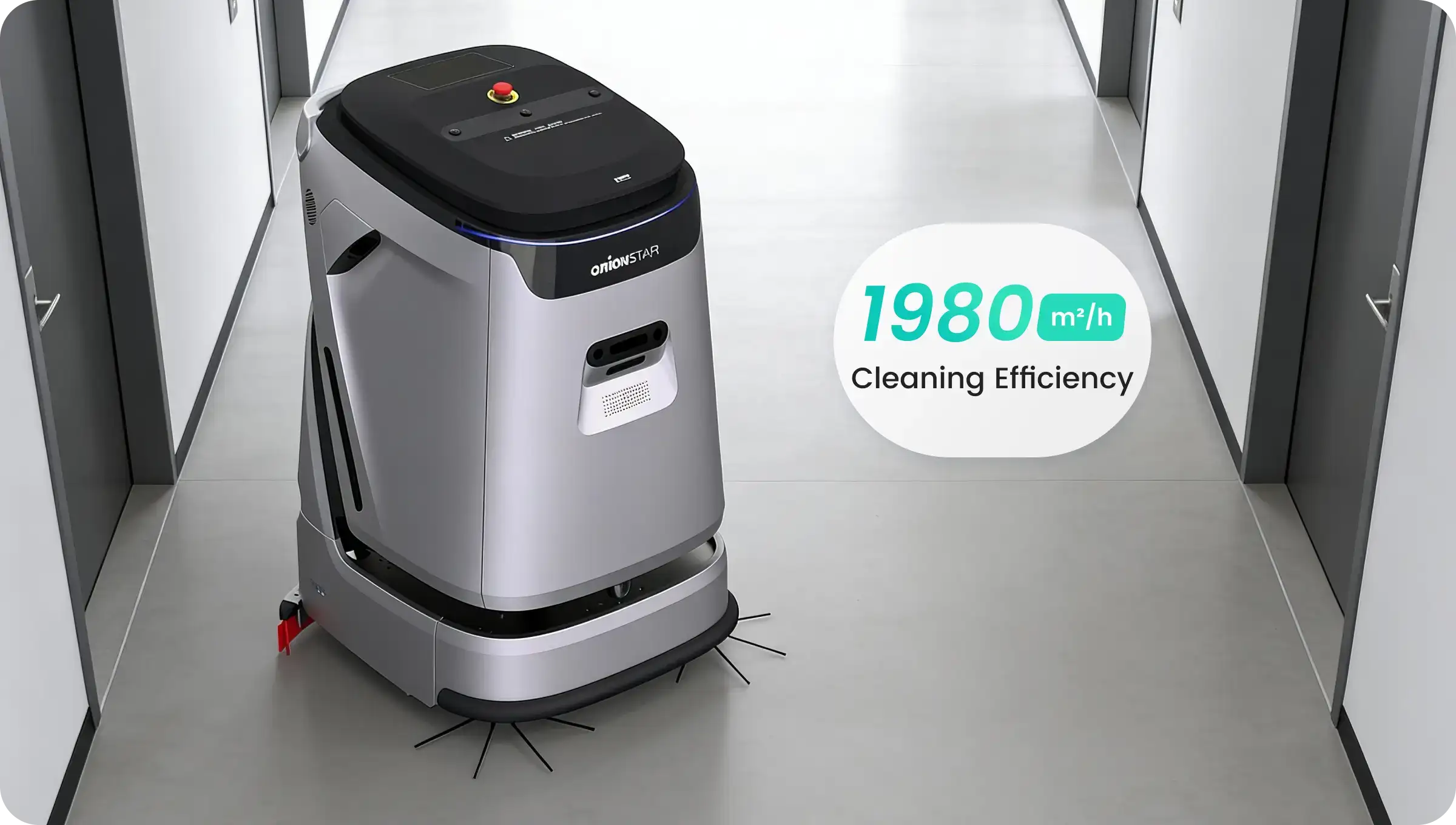
According to manufacturer data, the unit features a 550 mm cleaning width and reaches an area performance of up to 1,980 square meters per hour. Its physical footprint allows for an 880 mm passing width, granting access through standard internal doorways and into compact public restrooms. During active shifts, the machine operates at a sound level below 68 decibels, which supports deployment during daytime quiet hours without disrupting office workers or retail shoppers. Consumable management is handled through an automatic docking station with self-cleaning functionality, significantly reducing the manual intervention associated with the 90-liter combined water tanks. The system provides up to approximately three hours of continuous scrubbing under laboratory conditions before requiring a docking cycle.
The Tennant T16AMR is engineered for the upper end of the commercial building spectrum, positioning itself as a high-capacity industrial autonomous scrubber designed for very large floors. Soft FM providers managing sprawling convention centers, expansive shopping mall concourses, or airport terminals benefit from its heavy-duty architecture. This machine prioritizes maximum per-pass throughput and extended operational duty cycles over tight-space maneuverability, requiring wider navigational clearances but delivering substantial area coverage in return.
According to manufacturer data, this robust unit accommodates up to a 13-hour cleaning window within a 24-hour period when configured with the fast-charge lithium-ion battery option. It stores cleaning solution within a high-capacity tank of approximately 110 liters, minimizing the frequency of manual dump-and-fill routines during intensive, long-duration shifts. Powered by the BrainOS platform, the machine relies on vision-based technology for precise navigation, requiring facility managers to govern how optical data is processed in accordance with local privacy protocols.
The Nilfisk Liberty SC60 addresses large indoor spaces by offering a balance between significant cleaning width and standardized safety certification. Soft FM operators deploying fleets in corporate office atria or large retail environments leverage this machine for its extensive coverage capabilities and its integration into established third-party autonomy ecosystems. The platform emphasizes route repeatability and certified safe operation around pedestrian traffic, making it a reliable choice for contractors who mix manual and robotic tools from traditional cleaning brands.
Relying on manufacturer data, the unit is equipped with a 28-inch cleaning deck and utilizes solution and recovery tanks measuring up to 99 and 105 liters, respectively. Its operational sound profile sits at approximately 57 decibels, facilitating daytime cleaning without disrupting building tenants or retail consumers. Built on BrainOS, the machine holds a CSI/ANSI 336 safety certification, underscoring its ability to handle dynamic commercial environments while providing a standardized, cloud-based telemetry backbone for remote fleet monitoring.
The Karcher KIRA B 50 acts as a mid-size teammate for daily cleaning shifts across offices, retail floors, and public buildings. Its architecture specifically targets the need for a versatile scrubber capable of transitioning smoothly from open lobbies to tighter commercial corridors. Soft FM service providers utilize its integrated sweeping capabilities and edge-cleaning design to streamline the overall floor care workflow, thereby reducing the need for preliminary manual sweeping in mixed-use zones.
According to manufacturer data, this fully autonomous scrubber drier utilizes LiDAR-based mapping to navigate complex commercial floor plans effectively. It features an optional fully autonomous docking station that handles water exchange and battery charging, empowering cleaning teams to focus on other high-value facility tasks instead of managing machine fluids. The inclusion of a side brush and pre-sweeping function enhances its utility in managing debris common to food courts and high-traffic entryways, providing a comprehensive hard-floor solution in a moderate footprint.
The Avidbots Neo focuses heavily on multi-application autonomy and centralized remote management, appealing directly to soft FM providers with sprawling, global portfolios. Its design prioritizes comprehensive environmental understanding and deep cloud integration, ensuring that off-site administrators can monitor fleet telemetry and adjust cleaning sectors remotely. The inclusion of an optional 3-D surface sanitation/cleaning add-on further broadens its utility in diverse commercial building environments where comprehensive hygiene standards are prioritized.
Operational metrics, according to manufacturer data, indicate robust performance supported by the Avidbots Command Center cloud platform, which provides granular performance reporting and mapping oversight. The user interface caters explicitly to diverse labor pools by supporting multiple localized languages, easing the adoption curve for international cleaning crews across different regions. The machine relies on a sophisticated suite of LiDAR, 3D sensors, and computer vision to execute its cleaning paths autonomously, delivering dynamic obstacle avoidance in shifting retail and office environments.
Procuring the appropriate automated floor care system requires soft FM providers to analyze their distinct operational environments against hardware capabilities. Facilities dominated by vast open concourses benefit significantly from high-capacity machines that deliver maximum fluid retention and wide cleaning paths. Conversely, multi-tenant office buildings requiring navigation through corridors and automated continuous operation will find mid-scale platforms with autonomous docking stations far more effective. In all scenarios, establishing robust cloud-based telemetry and ensuring verifiable compliance with regional data privacy frameworks remain foundational steps in deploying a successful robotic cleaning fleet.
Public deployments and industry analyses cluster around 9 to 18 months for high-utilization soft FM sites with daily cleaning needs and large, repeatable hard-floor areas; less aggressive scenarios often quote 18 to 36 months. Named logistics deployments cited by Avidbots (DHL: "up to 80%" of cleaning labor hours reduced; DSV: cleaning team productivity doubled) and Oxford Properties' range of "between $30,000 and $150,000 per year" in savings illustrate the upside when the robot absorbs full overnight shifts. The math is most sensitive to loaded labor cost (not base wage), the size of the cleanable footprint, and how many daily hours the unit runs without operator intervention.
Modern autonomous scrubbers generate machine-readable evidence that fits cleanly into soft FM SLAs: route maps, area coverage, time-on-floor, downtime events, and repeatability from one shift to the next. The Tennant T16AMR and Nilfisk Liberty SC60 (both on BrainOS) push fleet-level KPIs and cloud-based reports; Avidbots Neo's Command Center offers 24/7 web-based reporting with sector-level coverage maps and productivity metrics; Kärcher's KIRA B 50 surfaces operational data on its central touch display. For multi-tenant commercial buildings, this evidence lets soft FM providers move from "cleaning was done" to "X m² were covered on schedule Y" — a meaningful upgrade when defending contract renewals or pricing extensions.
Every model in this comparison set — Tennant T16AMR, Nilfisk Liberty SC60, Karcher KIRA B 50, Avidbots Neo, and the OrionStar C5 — uses cameras, LiDAR and/or 3D sensors that build and update a map of the operating environment, and several rely on cloud platforms (BrainOS cloud, Avidbots Command Center) that receive that data over the network. Before commissioning in EU/UK buildings, buyers should obtain a Data Processing Agreement (DPA) from the vendor covering: where maps, images and operational data are processed and stored, retention defaults, sub-processor list, whether image or video data ever leaves the machine, and the lawful basis for processing under GDPR. Soft FM providers operating across multiple jurisdictions should also confirm whether tenant-occupied floors require additional consent or signage.
It depends on the model, and the constraint is rarely the corridor. The C5 has a minimum passing width of approximately 880 mm, climbs obstacles up to 15 mm and grades of 5° loaded / 8° unloaded — well within most office corridors and standard doorways. By contrast, the Nilfisk Liberty SC60 needs a 1.88 m turn-around aisle and weighs ~680 kg, the Avidbots Neo ranges 581–688 kg, and the Tennant T16AMR measures 1,070 mm wide and weighs up to ~785 kg — all fine for atria and concourses but awkward in tight public restrooms. Before purchase, soft FM buyers should measure minimum door width, elevator cab depth and floor loading, and match them against the vendor's spec sheet.
Yes for the common case of hard floors, but with caveats. The C5 runs three modes (scrubbing, dust-mopping, water absorption) on a dual-rolling-brush system with 25 kg of down pressure, picks up debris up to ~3 cm, and can vacuum and mop in a single cycle — so it transitions between a polished lobby and a food-court tile floor without operator intervention. The KIRA B 50 adds an integrated pre-sweeping function and side brush for edges, useful where grit migrates from entrances. For genuinely mixed zones (e.g. carpeted executive suites), verify the vendor's cleaning-head options and whether soft floors are explicitly supported; the Avidbots Neo and Tennant T16AMR are documented for hard floors only.
Sound levels vary materially across the lineup and drive the day-vs-night decision. The Nilfisk Liberty SC60 is the quietest at ~57 dB(A) (IEC 60335-2-72), the C5 is rated below 68 dB(A), while the KIRA B 50 and Avidbots Neo do not publicly specify dB(A) on their datasheets. As a rule of thumb, 55–65 dB(A) is broadly acceptable in occupied open-plan offices and retail floors; anything approaching or exceeding 70 dB(A) usually pushes cleaning into overnight or early-morning windows. Soft FM contracts for high-traffic daytime lobbies should ask vendors for a written dB(A) figure under load before specifying in-shift operation.
Disclaimer: All comparative specifications are based on publicly available manufacturer data and are subject to change. Actual operational performance, including battery life, cleaning area, and noise levels, may vary based on environmental conditions and floor types. For devices utilizing cameras, LiDAR, or cloud-based telemetry, facility operators are solely responsible for ensuring compliance with local data privacy regulations (e.g., GDPR, CCPA), including establishing Data Processing Agreements (DPAs) and implementing necessary public notices prior to deployment.