

REQUEST DEMO
Robot CATALOG will be sent to your mailbox immediately after submission.
SUBMIT
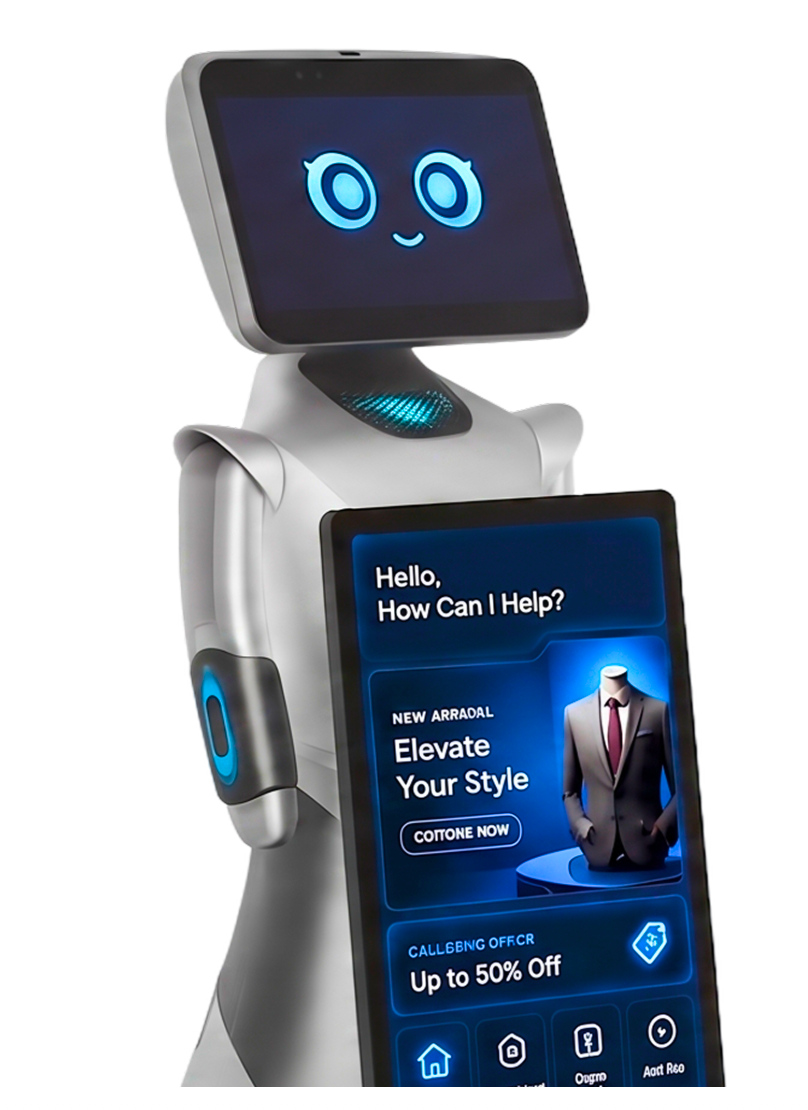
The retail sector in flagship stores faces immense pressure to deliver exceptional, high-touch customer experiences while battling widespread frontline labor shortages and fluctuating foot traffic. At the core of these spaces, hero product zones often suffer the most, as long queues and staff unavailability can quickly lead to lost sales and diminished brand perception during high-stakes product launches or exclusive demonstrations. To bridge the gap between consumer expectations and staffing realities, greeting robots are emerging as an effective, automated solution to manage customer inquiries, provide interactive wayfinding, and deliver real-time brand messaging precisely where shoppers need it most.
The OrionStar GreetingBot AD translates these general capabilities into a practical retail deployment by combining a humanoid form factor with a prominent 21.5-inch FHD chest-mounted display for rich visual content. To facilitate multi-modal interactions in bustling environments, the system utilizes a six-microphone circular array with 360-degree sound source localization alongside a 14-inch head touch screen, ensuring clear communication with shoppers. According to manufacturer data, it leverages LiDAR, depth cameras, and AI computer vision to achieve centimeter-level positioning accuracy for autonomous navigation, capable of mapping areas of up to 50,000 square meters while actively serving as a mobile interactive kiosk and wayfinding guide.
These high-traffic focal points often suffer from severe congestion during limited product drops, brand activations, or exclusive demos. Greeting robots help manage queue frustration by engaging waiting customers with rich multimedia brand stories on their large displays and providing immediate, conversational answers to product queries.
As the first point of contact in a massive flagship environment, the entrance sets the immediate tone for the entire brand experience. Here, robots provide proactive, multilingual welcomes and digital store maps, seamlessly directing international and local visitors to their desired departments without requiring a fully staffed concierge desk.
In immersive spaces designed primarily for storytelling and engagement, stationary digital signage is frequently ignored by passing shoppers. Mobile greeting robots act as dynamic touchpoints in these areas, proactively approaching visitors to offer personalized recommendations and seamlessly connecting the physical layout with the brand's digital ecosystem.
Wait times at the register remain a primary cause of customer dissatisfaction and abandoned purchases in brick-and-mortar retail. Deploying robots near checkout lines keeps shoppers entertained and informed about loyalty programs or last-minute upsells, effectively reducing perceived wait times and preserving a positive final brand impression.
To maximize their value in flagship stores, greeting robots must be tightly integrated into the retailer's existing data and operational stack. These robots typically connect directly to major CRM platforms (subject to local data privacy compliance) (such as Salesforce or Dynamics 365) to personalize greetings and track loyalty interactions, while their conversational AI layers handle context-aware product Q&A that differentiates the in-store experience from digital channels. Furthermore, their built-in screens serve as an extension of the store's digital signage and visual merchandising networks, and edge computing combined with 5G connectivity ensures that foot-traffic analytics and operational alerts are seamlessly fed into broader store management dashboards without excessive cloud latency.
By addressing both environmental efficiency and workforce well-being, automated retail solutions actively contribute to the broader ESG commitments of modern retail brands.
Greeting robots are fundamentally changing how the retail industry operates in flagship stores, particularly by transforming high-stakes hero product zones from congested bottlenecks into highly engaging, interactive brand touchpoints. By merging autonomous mobility with advanced conversational AI and dynamic digital displays, these robotic solutions help retailers bridge the gap between ongoing labor shortages and rising consumer expectations. For operators looking to implement these capabilities across different spatial configurations, the OrionStar GreetingBot Pro series provides multiple models designed to adapt to a wide variety of commercial layouts and engagement requirements.