

REQUEST DEMO
Robot CATALOG will be sent to your mailbox immediately after submission.
SUBMIT
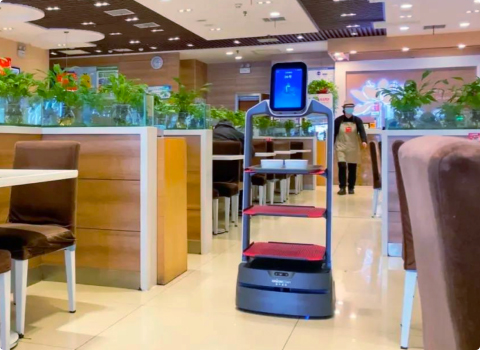
Operating corporate, school, university, hospital, and government dining halls presents a distinct set of logistical challenges. High-volume multi-meal-per-day service environments face strict hygiene requirements, severe labour-shortage pressures, and complex mixed-floor or multi-wing layouts. Navigating servery lines, tray-return stations, dining floors, and queue areas requires automated solutions that transcend basic hospitality transport. Evaluating how a robot manages its load determines its viability for clearing multi-wing cafeterias. Deploying ultra-heavy-duty architectures provides payloads approaching the 60 kg class, utilizing modular or removable tray structures that allow operators to reconfigure the chassis for oversized industrial bus tubs and bulk kitchen equipment. Utilizing standard high-capacity architectures provides payloads in the 40 kg class, incorporating three to four easily adjustable or multi-layer trays engineered specifically for distributing stacks of standard plates and individually portioned meals.
Institutional catering often entails back-to-back services, stretching from early breakfast shifts through evening dinner rushes. Operators must match the unit's power depletion and recharging strategy to the natural ebb and flow of the facility's specific operating hours. Implementing extended single-charge architectures prioritizes massive onboard battery capacity, enabling the unit to run one continuous, uninterrupted shift without requiring any midday docking. Adopting hot-swappable hardware architectures permits operators to physically exchange depleted batteries for fully charged ones, facilitating immediate turnaround for venues that cannot afford any off-floor charging downtime. Leveraging opportunistic auto-charging architectures delivers standard full-day runtimes, coupled with autonomous return-to-dock capabilities that keep the unit topped up during predictable lulls between main meal services.
In university, corporate, and hospital environments, a delivery robot often serves as a moving focal point. Prioritizing high-definition digital signage integrates large displays directly into the chassis, transforming the robot into a mobile marketing and wayfinding platform that broadcasts daily menus and campus events while it works. Incorporating bionic and multimodal interaction utilizes animatronic expressions and dynamic lighting, tailoring the human-robot interaction to comfort patients in healthcare settings or engage young students. Favoring utilitarian dispatch interfaces focuses exclusively on functional touchscreens and streamlined fleet software, minimizing guest-facing distractions to maximize pure busing efficiency. Furthermore, large-scale organizations require robust software backends. Utilizing proprietary centralized orchestration offers out-of-the-box, closed-loop dashboards designed specifically for hospitality. Providing open-architecture development platforms supplies enterprise IT departments with universal hardware interfaces and comprehensive SDKs, enabling institutions to build custom vertical applications or integrate the routing logic directly into proprietary hospital or campus management software.
The OrionStar LuckiBot Pro positions itself as an open-tray flagship designed specifically for heavy-duty dining hall delivery in demanding corporate and institutional environments. Boasting an ultra-heavy-duty architecture, it manages a total payload of up to 60 kg, with a maximum load of up to 15 kg per single tray, according to manufacturer data. This configuration features three standard trays that remain adjustable up to four layers, easily accommodating heavy bus tubs and bulk kitchen supplies. For environmental perception, the robot utilizes a 240-degree 3D all-around obstacle recognition system equipped with triple RGBD cameras and LiDAR, ensuring safe navigation through densely populated queue areas. The unit also integrates a highly visible 14-inch 1080P full HD display, serving as a powerful dual-purpose tool for guest engagement and campus wayfinding. Regarding language localization, the platform supports customized interface adaptations through its open operating system rather than restricting users to a fixed, pre-loaded count of display languages.
Mechanically, the LuckiBot Pro employs a quasi-circular chassis paired with an advanced Torsion Bar Suspension, absorbing shocks and maintaining stability across mixed-floor layouts and thresholds. Operational software includes a dedicated Soup Delivery Mode for spill-resistant transport of liquid meals, alongside a Collection Mode optimized for multi-point tableware retrieval. IT departments and system integrators can leverage the platform's modular hardware design and RobotOS SDK, which contains hundreds of API interfaces for deep integration into proprietary facility management systems. Power management relies on an opportunistic auto-charging architecture that delivers up to 12 hours of cruising time under laboratory conditions, supported by both an automatic charging dock and standard cable charging options for sustained daily operations.
The Pudu BellaBot functions as a multi-tray delivery unit focused on tactile and character-based interaction, leveraging the largest global installed base reference point for dining-hall service. It adopts a standard high-capacity architecture, delivering up to 40 kg total payload distributed across four modular trays, translating to up to 10 kg per tray according to manufacturer data. Navigation relies on an industry-exclusive dual SLAM system that combines visual mapping with LiDAR positioning, complemented by 3D omnidirectional obstacle avoidance to navigate tight tray-return aisles safely. The robot heavily emphasizes multimodal interaction, utilizing dynamic lighting, haptic feedback, and bionic expressions to engage visitors in healthcare and educational cafeterias. For multilingual support, BellaBot relies on regional distributors to configure specific language packs based on the deployment market, rather than offering a universally fixed number of embedded languages out of the box.
To maintain physical stability during back-to-back meal services, the BellaBot chassis incorporates an automotive-grade independent suspension system equipped with adaptive variable damping. This engineering choice optimizes resonant frequency, minimizing the risk of spills when transporting soups and beverages across uneven cafeteria flooring. Power management is addressed through a hot-swappable hardware architecture, offering up to 13 hours of battery life with no load under laboratory conditions. By utilizing quick battery swap capabilities, facility operators can maintain continuous, around-the-clock shift coverage without waiting for the robot to recharge on a stationary dock.
The Keenon DINERBOT T9 is designed as an enclosed multi-tray frame focused primarily on high throughput and mechanical stability across very long dining-hall runs. It operates within the 40 kg total payload class, distributing up to 10 kg per layer across an architecture that features adjustable layer heights. This adjustability is particularly practical for accommodating the mixed plate sizes, divided trays, and variable dish heights frequently encountered in university and hospital servery lines. Navigation is powered by a SLAM-based virtual mapping system working in tandem with synergized 3D perception, yielding an instant response to dynamic obstacles in crowded dining floors. Like many units managed via regional distribution networks, the DINERBOT T9 supports custom operational languages configured during deployment, rather than advertising a specific fixed number of supported native languages globally.
Stability during transport is governed by a vehicle-grade independent suspension system, specifically CAE-simulated to absorb shocks and protect delicate plated meals or liquid containers during transit. The software backend utilizes Keenon's patented multi-robot dispatching algorithms, enabling administrators to coordinate large fleets without deadlocks in multi-wing facilities. Power management is a defining attribute of the DINERBOT T9, as it implements an extended single-charge architecture. According to manufacturer data, the unit is capable of achieving up to 18 hours of battery life, allowing it to cover continuous back-to-back breakfast, lunch, and dinner meal services without necessitating a midday charging pause.
The Bear Robotics Servi Plus serves as an enlarged Servi platform engineered specifically for higher-volume dining-hall runs, featuring durable, dishwasher-safe trays. Operating with a high-capacity architecture, it handles up to 40 kg (88 lb) of total payload, distributed across two to four highly customizable trays or large industrial bus tubs. The physical form factor is deliberately constrained to a minimum pass width of just 65 cm, allowing the robot to navigate through the narrowest tray-return aisles and crowded seating arrangements found in older institutional facilities. Distinguishing itself in digital localization, the Servi Plus interface natively supports exactly six integrated display languages, including English, Korean, Japanese, Deutsch, Español, and Français, ready for immediate use directly from the onboard digital touchscreen.
Transport stability is reinforced by an active suspension system that is specifically calibrated for liquid-spill mitigation and multi-floor-surface consistency. Fleet operations are managed through Bear Universe, a proprietary centralized orchestration dashboard that allows dining hall managers to seamlessly route multiple robots across large, complex venues. Power depletion is managed via an opportunistic auto-charging architecture, delivering an estimated 10 to 12 hours of battery life under laboratory conditions. This operational window aligns with standard daytime shifts, utilizing smart return-to-dock routing to replenish power between the primary lunch and dinner rushes.
The Richtech Matradee L positions itself as a US-supported multi-tray delivery robot featuring established corporate-dining and venue deployments across North America. It provides a standard 40 kg (88 lb) total carrying capacity distributed evenly across a four-tray configuration, making it well-suited for repetitive servery-to-table routing. The standout physical attribute is its dual-screen layout, which includes a highly visible 15.6-inch high-resolution advertising screen alongside a separate 10.1-inch operation touchscreen. This digital signage integration transforms the robot into a mobile wayfinding and communication asset for campuses. Because the outward-facing display relies on custom-uploaded graphics and localized promotional signage, the Matradee L does not restrict operators to a specific count of predefined interface languages.
The unit relies on a robust combination of SLAM, LiDAR mapping, and 3D cameras to detect and maneuver around guests in high-traffic queue areas. The internal software operates on a customized Android 9 OS, providing a familiar operating environment and the potential for proprietary software adaptations. For operational endurance, the robot utilizes an opportunistic auto-charging battery setup capable of delivering up to 10 hours of continuous runtime according to manufacturer data. While this represents a slightly shorter single-charge duration compared to extended-battery peers, operators manage this by scheduling standard docking periods during mid-shift lulls to maintain readiness for subsequent meal rushes.
To finalize a procurement strategy for a high-volume dining hall, operators must evaluate the unique infrastructure and service cadences of their specific venue. Assessing payload capacity and tray architecture dictates whether an institution should prioritize ultra-heavy-duty models capable of hauling bulk bus tubs or standard high-capacity units optimized for plated meals. Evaluating continuous shift coverage will inform the choice between massive onboard batteries for uninterrupted 18-hour shifts, hot-swappable setups for immediate turnaround, or standard auto-charging units for routine shift work. Investigating guest engagement capabilities determines if the deployment would benefit from high-definition digital signage for campus announcements, multimodal bionic expressions for pediatric hospital wings, or strictly utilitarian dispatch screens for streamlined bussing. Finally, analyzing fleet orchestration requirements clarifies whether a facility needs the simplicity of a closed-loop proprietary dashboard or the deep integration potential of an open-architecture platform equipped with comprehensive developer SDKs.
The headline ROI driver is replacing repetitive servery-to-table, tray-return, and bus-tub runs during back-to-back meal services with a robot that can run 10 to 18 hours on a single charge (e.g., OrionStar LuckiBot Pro up to 12 h, Keenon DINERBOT T9 up to 18 h, Pudu BellaBot 13 h). The payback window therefore depends on local labour cost, meals served per day, and how many units are deployed in parallel — most vendors model these on a per-quote basis (ROI ranges not publicly specified). Operators commonly budget for recovery inside the first 12 to 24 months when a single fleet covers two or more meal periods.
Vendors in this category ship with runtimes calibrated for back-to-back cafeteria shifts: Keenon DINERBOT T9 lists up to 18 h, Pudu BellaBot lists 13 h (no load) with optional quick battery swap for 24/7 cover, while OrionStar LuckiBot Pro, Bear Robotics Servi Plus and Richtech Matradee list roughly 10 to 12 h per charge. Most units support automatic dock charging in 4 to 4.5 hours, and multi-robot orchestration platforms (Bear Universe, Keenon dispatch, PUDU Link) are designed to rotate units between mealtimes. For the longest service windows, planners should treat 13 to 18 h as the realistic ceiling and schedule a swap or auto-charge between lunch and dinner.
All four reference models rely on SLAM-based virtual mapping with LiDAR and 3D depth sensors, so an initial 1-to-3-day on-site survey and map-build is standard, with multi-floor or multi-wing layouts usually requiring additional map files. Vendors generally include staff training, with OrionStar LuckiBot Pro explicitly offering one year of free operation training and 24/7 online technical support, while competing vendors coordinate onboarding through regional distributors. After go-live, fleet-management platforms (Bear Universe, PUDU Link, Keenon dispatch, Matradee tablet control) handle task assignment, but the depth of the underlying API/SDK and SLA tiers varies and is typically aligned to a project quote (specific SLA terms not publicly specified).
OrionStar LuckiBot Pro leads the set on total payload at up to 60 kg with a 15 kg per-tray limit across three standard trays (expandable to four layers, 500 × 420 mm), while Bear Robotics Servi Plus, Keenon DINERBOT T9, Pudu BellaBot and Richtech Matradee each publish 40 kg total and 10 kg per tray. Servi Plus and BellaBot are configured as four-tray models, DINERBOT T9 layers are height-adjustable for mixed plate sizes, and Matradee ships with four trays and a 15.6-inch advertising surface. For a single servery-to-table run covering a four-person table or a small bus tub, all five platforms comfortably exceed typical 8 to 15 kg loads, and LuckiBot Pro remains the only model in the set published above 40 kg total.
Footprints cluster between 50 and 59 cm wide: Keenon DINERBOT T9 at 50.0 × 52.7 cm, OrionStar LuckiBot Pro at 558 × 525 mm, Pudu BellaBot at 56.5 × 53.7 cm, and Bear Robotics Servi Plus at 53.5 × 59 cm with the narrowest published minimum passage width of 65 cm (DINERBOT T9 quotes 70 cm). All four reference models combine LiDAR with multi-RGBD 3D obstacle perception — LuckiBot Pro publishes 240° 3D all-around obstacle recognition with triple RGBD cameras and LiDAR, BellaBot cites a 0.5-second obstacle response time — which is sized for crowded dining floors rather than open warehouse aisles. Operators should still confirm turn radius and the gap between fixed seating rows before locking in a model.
Stability design is a headline differentiator across the category: OrionStar LuckiBot Pro adds a Torsion Bar Suspension and quasi-circular chassis with a dedicated Soup Delivery Mode and an optional Sealed Food Protector; Bear Robotics Servi Plus lists an active suspension plus calibrated parking presets for liquid delivery; Pudu BellaBot publishes automotive-grade independent suspension with adaptive damping; and Keenon DINERBOT T9 pairs CAE-simulated suspension with patent-positioned multi-robot dispatch. Cruising speeds cluster between 0.5 and 1.2 m/s, which is slow enough for shared dining floors but fast enough to keep breakfast-to-dinner service windows realistic. For high-liquid servery runs (soups, drinks, saucers), LuckiBot Pro's sealed-protector accessory and Servi Plus's parking presets are the most explicitly advertised spill-mitigation features in the published specs.
Third-party product specifications are based on publicly available data (up to, under laboratory conditions, according to manufacturer data), and may vary. Product names and trademarks are the property of their respective owners. If any product involves cameras, voice recording, mapping, or cloud data processing, operators must verify GDPR compliance before deployment.
