

REQUEST DEMO
Robot CATALOG will be sent to your mailbox immediately after submission.
SUBMIT
Commercial buildings present highly dynamic environments for facility operators, characterized by shifting foot traffic, diverse surface types, and intricate architectural layouts. Facility teams face the daily challenge of maintaining pristine lobbies, high-traffic corridors, and expansive parking decks while managing fluctuating labor availability and stringent operational budgets. Deploying robotics offers a strategic response to these pressures, transforming routine surface maintenance from a labor-intensive chore into a predictable, data-driven process. By transferring repetitive route cleaning to autonomous platforms, integrated facility management providers can reallocate human janitorial staff to detailed, high-value tasks, thereby optimizing overall site hygiene and operational efficiency.
Evaluating automation for mixed-use public floors and commercial offices requires a structured analysis of hardware capabilities and software intelligence. Form factor, spatial accessibility, and area productivity dictate how efficiently a machine maneuvers through tight office corridors versus expansive lobbies, determining its practical throughput within a specific architectural footprint. Navigating a narrow hallway demands vastly different equipment dimensions and maneuvering capabilities than managing a multi-story parking facility.
Cleaning mechanism and soil handling strategy form the operational core of these platforms, establishing whether a robot aggressively tackles heavy fluid-bound grime or performs light daily dry-debris maintenance on sensitive flooring. Operational autonomy and infrastructure integration assess how independently a machine functions, analyzing its ability to interface with automated docking stations, interface with building plumbing for fluid exchange, and potentially integrate with elevator systems for multi-floor transit. Finally, environmental perception and data processing logic govern navigational safety, relying on combinations of LiDAR, optical sensors, and cloud-based fleet software to dodge dynamic obstacles while documenting spatial coverage. Because these platforms map environments and process spatial data, operating entities must strictly verify compliance with applicable data protection and privacy regulations, such as the GDPR, before deployment.
The OrionStar CleaniBot C5 is designed as a heavy-duty industrial autonomous floor scrubber suited to large commercial buildings, parking levels, and mixed-use integrated facility management estates. Engineered to handle significant soil loads across expansive hard floors, this machine addresses the high-traffic demands of concourses and internal logistical zones where substantial downward brush pressure is critical. Its robust architecture prioritizes sustained area productivity and thorough grime removal, enabling facility operators to manage vast hard-surface environments effectively without constantly intervening for manual maintenance.
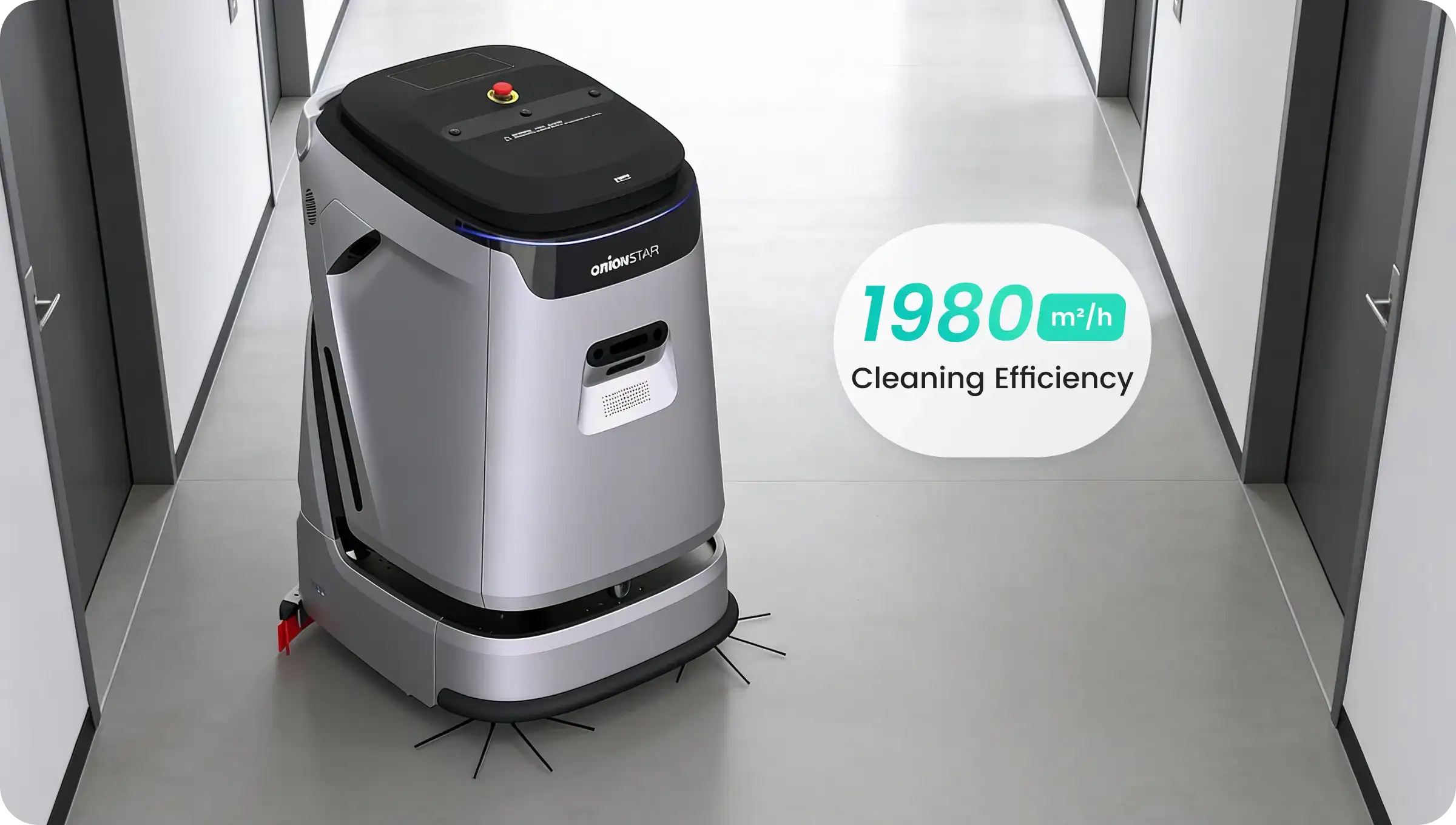
To achieve this heavy-duty performance, the platform utilizes a 550 millimeter main brush, delivering an area coverage capacity of up to 1,980 square meters per hour, according to manufacturer data. The unit weighs approximately 170 kilograms and incorporates a combined 90-liter tank system, maximizing uninterrupted runtime by reducing the frequency of water exchanges. When paired with its optional automated workstation, the machine autonomously manages fluid replenishment, waste discharge, and internal tank rinsing, maintaining consistent multi-shift operations under laboratory conditions.
The Kärcher KIRA CV 50 operates as an ultra-compact autonomous vacuuming robot engineered specifically for narrow corridors, under-desk coverage, and daily dry-debris maintenance in commercial offices and lobbies. Procurement teams must frame this unit as a dry-maintenance complement to wet-scrubbing machines, rather than a direct substitute for heavy soil removal. Its highly maneuverable profile allows it to navigate tight seating arrangements, intricate office layouts, and carpeted transition areas where larger fluid-based machines would struggle to fit or operate safely around pedestrians.
Functioning with a working width of around 350 millimeters and a low weight of approximately 15 kilograms, this platform easily traverses confined commercial spaces while operating discreetly. The compact footprint enables precise edge cleaning and obstacle negotiation in densely furnished zones, ensuring daily dust and debris are managed comprehensively. According to manufacturer data, the unit relies on sophisticated mapping sensors to negotiate complex indoor environments safely, providing reliable baseline cleanliness before heavier, periodic wet scrubbing is applied by larger platforms.
The Gaussian Robotics, or Gausium, Scrubber 50 serves the mid-size wet-scrubbing segment, offering a highly versatile solution for office floors, retail spaces, and corridor-heavy facility management environments. This platform balances navigational agility with substantial fluid capacity, making it a highly pragmatic choice for commercial buildings that feature a mix of open lobby spaces and narrower transitional hallways. By incorporating multi-modal sweeping and mopping functions, the machine adapts to varied hard-floor maintenance requirements without relying on an overly massive physical footprint.
Supported by an optional workstation, the robot can execute its water refilling and charging cycles with minimal human oversight, elevating its operational autonomy for extended shifts. Advanced environmental perception systems allow the machine to navigate dynamic retail and office environments smoothly, maneuvering around pedestrians and temporary obstacles intelligently. According to manufacturer data, this mid-range machine scales effectively across typical commercial floor plates, delivering reliable wet-scrubbing performance while integrating neatly into automated, daily maintenance routines.
The Tennant T7AMR is a substantial ride-on autonomous scrubber that boasts a deep deployment base across airports, retail centers, healthcare facilities, education campuses, and large commercial concourses. While this heavy-duty machine exceeds the spatial and operational requirements of typical enclosed office floors or tight corridors, it is exceptionally well-suited to wide-open concourses, expansive main lobbies, and multi-story parking decks where raw coverage speed is paramount. Facility teams deploy this unit to manage vast, uninterrupted square footage, leveraging its heavy-duty construction to process heavy foot traffic and significant soil accumulation efficiently.
This imposing platform features an expansive cleaning path of around 650 millimeters and carries massive fluid reserves, utilizing approximately 110-liter solution and recovery tanks. Weighing roughly 492 kilograms, the machine maximizes area productivity and minimizes manual dump-and-fill interruptions across prolonged cleaning shifts, under laboratory conditions. The sophisticated navigational stack allows this large-format scrubber to interpret complex environments safely, steering its substantial mass securely around structural columns, parked vehicles, and active pedestrian zones.
The Avidbots Neo 2W functions as a warehouse and logistics-tuned industrial autonomous scrubber optimized for wide-open transit spaces and heavy industrial debris environments. Within mixed-use commercial facility estates, this robust platform represents the right pick for back-of-house operations, loading bays, and large internal storage areas, rather than customer-facing lobbies or aesthetic reception zones. Its specialized engineering prioritizes rugged durability, rapid deployment in dynamic environments, and the ability to process the specific dirt profiles typically generated in loading and logistical transit hubs.
Equipped with advanced 360-degree obstacle detection, the machine continuously monitors its surroundings to negotiate safely around moving forklifts, temporary pallets, and shifting inventory layouts. According to manufacturer data, the platform supports swappable battery architectures, facilitating near-continuous operational uptime during demanding facility shifts. By directing this heavy-duty unit to the utilitarian sectors of a commercial building, facility managers can maintain rigorous cleanliness standards in operational hubs while reserving sleeker, more compact platforms for their public-facing environments.
Selecting the optimal autonomous floor scrubber for integrated facility management requires balancing architectural constraints against daily soil loads and operational objectives. Facility teams managing intricate office layouts should prioritize highly maneuverable dry vacuums for daily upkeep, supported by mid-sized wet scrubbers that can negotiate tight corners while offering automated fluid exchange. For estates featuring expansive public concourses and large parking decks, heavy-duty industrial platforms and ride-on robotic units deliver the necessary fluid capacity and raw area productivity to maintain extensive square footage efficiently. By aligning the machine's form factor, cleaning mechanism, and navigational capabilities with the specific demands of each building zone, operators can maximize their robotics investments and elevate overall site hygiene.
Note: Third-party product specifications are based on public data (up to, under laboratory conditions, according to manufacturer data) and may vary. Product names and trademarks are the property of their respective owners. If any product involves cameras, voice recording, mapping, or cloud data processing, operating entities must verify GDPR or applicable privacy law compliance prior to deployment.
For medium-to-large commercial IFM estates, published buyer guidance and vendor case studies typically put payback in the 12–24 month range, driven mainly by labour-hour substitution on repetitive routes (lobbies, corridors, parking decks). The cleanest savings come from reassigning janitorial hours away from long routes and toward detail work, rather than from raw scrubbing speed; vendors in this segment (OrionStar CleaniBot C5, Tennant T7AMR, Gausium Scrubber 50) generally quote sustained coverage of roughly 1,000–1,200 m²/h under defined conditions. Actual payback depends on shift density, local labour cost, and how quickly routes can be mapped.
Both structures are common in commercial-IFM robotics, and the choice is mostly about capital flexibility and SLA risk. Outright purchase fits sites where the fleet is permanent, the route mix is stable, and the procurement team is comfortable owning maintenance windows. RaaS (monthly or per-area fee that bundles mapping, service and software updates) fits multi-tenant offices or portfolios where a single FM provider runs cleaning across many buildings and wants predictable operating cost and built-in refresh cycles. Either way, the contract should specify uptime guarantees, who owns the floor maps, what happens to data when the unit is decommissioned, and whether software updates are included for the contract life.
Every autonomous scrubber in this category relies on LiDAR and/or 3D cameras and reports back to a cloud or web-based fleet platform, so a written GDPR posture should be a hard prerequisite for procurement. At minimum, facility teams should obtain from the vendor the data-storage region for floor maps and any incidentally captured imagery, the retention period, the sub-processor list, and the process for handling data-subject access and deletion requests that may be triggered by occupants or visitors. For multi-tenant commercial buildings, confirm in writing that mapping data is logically segregated per site and is not used to train shared models. Vendors in this segment (Gausium, Tennant/BrainOS, Avidbots, Kärcher) typically treat this as a dealer-led conversation rather than publishing it on the product page.
Most compact and mid-sized units in this segment do not enter elevators on their own; they are carried by an operator or ride a passenger-rated elevator under remote supervision, then continue mapping on the destination floor. A small number of platforms — notably the Gausium Scrubber 50 via Gausium's developer platform, and some Tennant T7AMR sites integrated through BrainOS partners — can dispatch elevator calls through the BMS to operate truly lights-out across floors. Before specifying multi-floor autonomy, confirm the elevator controller exposes an API the robot vendor can integrate with, and that the car has the load rating for the scrubber with full tanks (the C5 is 170 kg with combined 90 L tanks, the T7AMR is about 492 kg).
Robotic floor cleaners intended for commercial and public environments are typically certified to IEC 63327, the harmonised robotic floor-cleaning safety standard covering hazard analysis, emergency stop, obstacle detection and behaviour around people. Buyers should ask to see the IEC 63327 certificate (Kärcher publishes this for the KIRA CV 50 explicitly) and the EU Machinery Directive / local equivalent declaration of conformity. In day-to-day operation, also plan for audible warning, blue-light projections, redundant bump sensors and a documented e-stop procedure that the cleaning and security teams both understand. Standard commercial noise output in this segment falls in the high-50s to low-70s dB(A) range, which is generally compatible with daytime cleaning around occupants.
Cleaning path width sets raw throughput; aisle width sets where the machine can physically go. The KIRA CV 50's 350 mm path and roughly 650 mm drive-through width suit under-desks, narrow corridors and lobby seating where a 1,000 mm-wide ride-on cannot fit. The Gausium Scrubber 50 (medium-sized scrubber dimensioned for office and retail corridors) and the CleaniBot C5 — at 550 mm main brush width, about 880 mm minimum passing width, and roughly 1,980 m²/h coverage under defined conditions — are the typical mid-range fit for commercial-building floor plates. The Tennant T7AMR's 650 mm cleaning path and ~850 mm footprint, plus 110 L solution and recovery tanks, pay off on open concourses, multi-storey parking decks and large lobbies but require wider corridors and passenger-rated elevator access. Match the spec to the narrowest route the robot will run, not the largest open area.