Introduction
Building management teams in airports face an unprecedented combination of high passenger traffic, chronic labor shortages, and stringent compliance demands that make traditional manual cleaning unsustainable. As facility budgets tighten and the pressure to maintain verifiable, 24-hour hygiene standards grows, airport operators are increasingly turning to commercial cleaning robots as a strategic solution to bridge the gap between elevated cleanliness expectations and limited workforce availability.
The Growing Need for Smarter Cleaning in Airports
- Record-breaking passenger traffic multiplies the wear on hard floors and high-touch surfaces, demanding continuous cleaning cycles that strain existing staff resources.
- A staggering 61% annual turnover rate in the facility services sector leaves building managers and facility managers struggling to fill physically demanding janitorial roles.
- The industry-wide shift toward visible daytime cleaning increases the labor load for airport operations teams while adding pressure to maintain consistent quality amidst heavy foot traffic.
- Insurers and corporate airline tenants now expect documented, auditable cleaning standards, creating a compliance burden that manual operations cannot easily scale to meet.
How Commercial Cleaning Robots Can Help
- LiDAR navigation and autonomous path planning allow these machines to efficiently cover large, complex floor plans without constant human supervision.
- Advanced obstacle avoidance technologies ensure safe operation around passengers, luggage, and temporary physical barriers in busy transit hubs.
- Auto-charging and docking capabilities enable continuous, multi-shift operation by minimizing the downtime required for manual battery management.
- Real-time monitoring and digital fleet management provide facility teams with auditable cleaning maps, performance logs, and instant exception reports.
- Because these platforms utilize on-board cameras, environmental mapping, and cloud data processing, facility operators must carefully configure sensors and conduct vendor due diligence to ensure strict GDPR compliance regarding personal data minimization. Data is processed locally on the edge, with strict personal data anonymization (e.g., face blurring) to ensure full GDPR compliance. No PII is stored in the cloud.
A Closer Look: OrionStar CleaniBot S55 Pro in Action
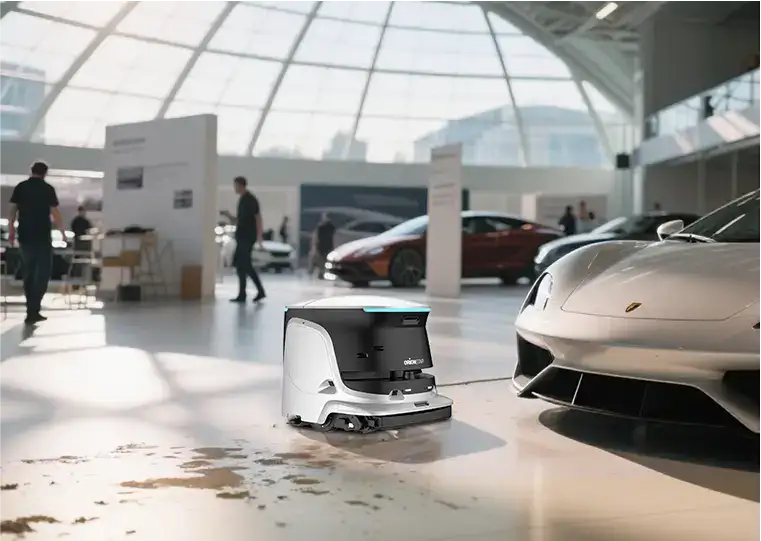
The OrionStar CleaniBot S55 Pro illustrates how these autonomous capabilities are implemented in a modern floor-care platform designed for expansive public spaces. According to manufacturer data, the unit utilizes a 15-sensor navigation system—including LiDAR, stereo cameras, and ultrasonic sensors—to construct maps of up to 10,000 square meters while safely detecting cliffs and avoiding dynamic obstacles. It supports multiple autonomous cleaning modes, delivering a theoretical cleaning efficiency of up to 1,368 square meters per hour in its sweeping and vacuuming modes, and can operate for up to 28 hours on a single charge when performing quiet dust mopping, ensuring continuous coverage across large facility footprints without disrupting passenger flow.
Benefits for Building Managers, Facility Managers, Airport Operations Teams
- Labor reallocation: By automating repetitive floor care, operations teams can redeploy human staff to higher-value, specialized tasks such as high-contact surface sanitation and rapid spill response.
- Cost reduction: Robotic deployments are increasingly justified by favorable total-cost-of-ownership savings, with reported payback periods across airport environments clustering between 12 and 24 months.
- Resource efficiency: Precision dosing and smart fluid management deliver measurable resource conservation, with industry deployments achieving up to 20% water savings compared to traditional manual mopping.
- Verifiable quality: Automated exception reports and real-time digital cleaning maps turn an historically unverifiable manual task into an auditable, KPI-driven service that satisfies airline tenants and aviation authorities.
- Asset preservation: Consistent pad pressure and precise chemical solution dosing extend the lifecycle of premium airport flooring, reducing the frequency and cost of replacement cycles.
- Unobtrusive operation: Purpose-built commercial units can perform maintenance cleaning during operating hours with minimal noise disruption, allowing for continuous daytime hygiene maintenance alongside passenger traffic.
Real-World Applications
Terminals and Check-In Halls
These expansive, high-traffic zones experience constant footfall and luggage movement, making it difficult to maintain clean floors during peak operational hours. Autonomous scrubbing robots navigate around moving passengers and queue barriers, providing consistent hard-floor maintenance that prevents dirt from being tracked deeper into the airport.
Retail Concourses and Gate Lounges
Retail concourses and lounges often feature a mix of hard flooring, carpets, and dense seating arrangements that trap dust and debris. Robots equipped with adaptable sweeping and vacuuming modes can maneuver through these varied surfaces, utilizing edge-cleaning lasers to reach close to walls and storefronts without damaging displays or disrupting waiting passengers.
Baggage Claim Halls
Baggage claim areas face heavy wear from luggage carts and frequent passenger bottlenecks, demanding robust debris removal and spill management. Automated floor care systems can be scheduled to run targeted cleaning cycles between flight arrivals, quickly restoring the area to baseline hygiene standards before the next wave of passengers descends.
Back-of-House Corridors
The logistical arteries of an airport are heavily utilized by staff and cargo vehicles, making them prone to scuffs, spills, and accumulated grime that degrade the working environment. Deploying autonomous units in these wide, utilitarian passageways ensures routine, intensive scrubbing without pulling essential janitorial staff away from critical passenger-facing zones.
Integration with Other Smart Systems
Commercial cleaning robots are increasingly treated as mobile IoT nodes that seamlessly integrate into the broader smart-building ecosystem of an airport. Through standardized protocols like MQTT or BACnet, these units can communicate directly with Building Management Systems (BMS) to coordinate cleaning schedules with HVAC setbacks, lighting zones, and automated doors. Furthermore, when linked with Computerized Maintenance Management Systems (CMMS), the robots can automatically generate work orders for persistent spills or trigger predictive maintenance alerts based on sensor wear, while simultaneously feeding ambient data such as foot traffic and floor conditions back into the facility's centralized digital twin.
Supporting ESG and Sustainability Goals
- Water and chemical reduction: Precisely metered dosing and water recycling systems significantly reduce the volume of fresh water and chemical cleaning agents required per square meter, directly minimizing chemical runoff and plastic packaging waste.
- Energy load shifting: When integrated with energy management systems, robotic fleets can be scheduled to charge and operate during off-peak hours, shifting electricity loads away from grid peaks and supporting scope-2 emissions reduction strategies.
- Sustainable asset lifecycle: Maintaining consistent mechanical pressure and eliminating harsh manual over-scrubbing extends the functional life of premium terminal flooring, ultimately reducing the embodied carbon associated with premature material replacements.
By aligning automated floor care with rigorous environmental frameworks like the Airport Carbon Accreditation program, facility managers can drive measurable sustainability improvements, and the OrionStar CleaniBot series provides multiple models to match these diverse operational and ecological requirements across different facility zones.