

REQUEST DEMO
Robot CATALOG will be sent to your mailbox immediately after submission.
SUBMIT
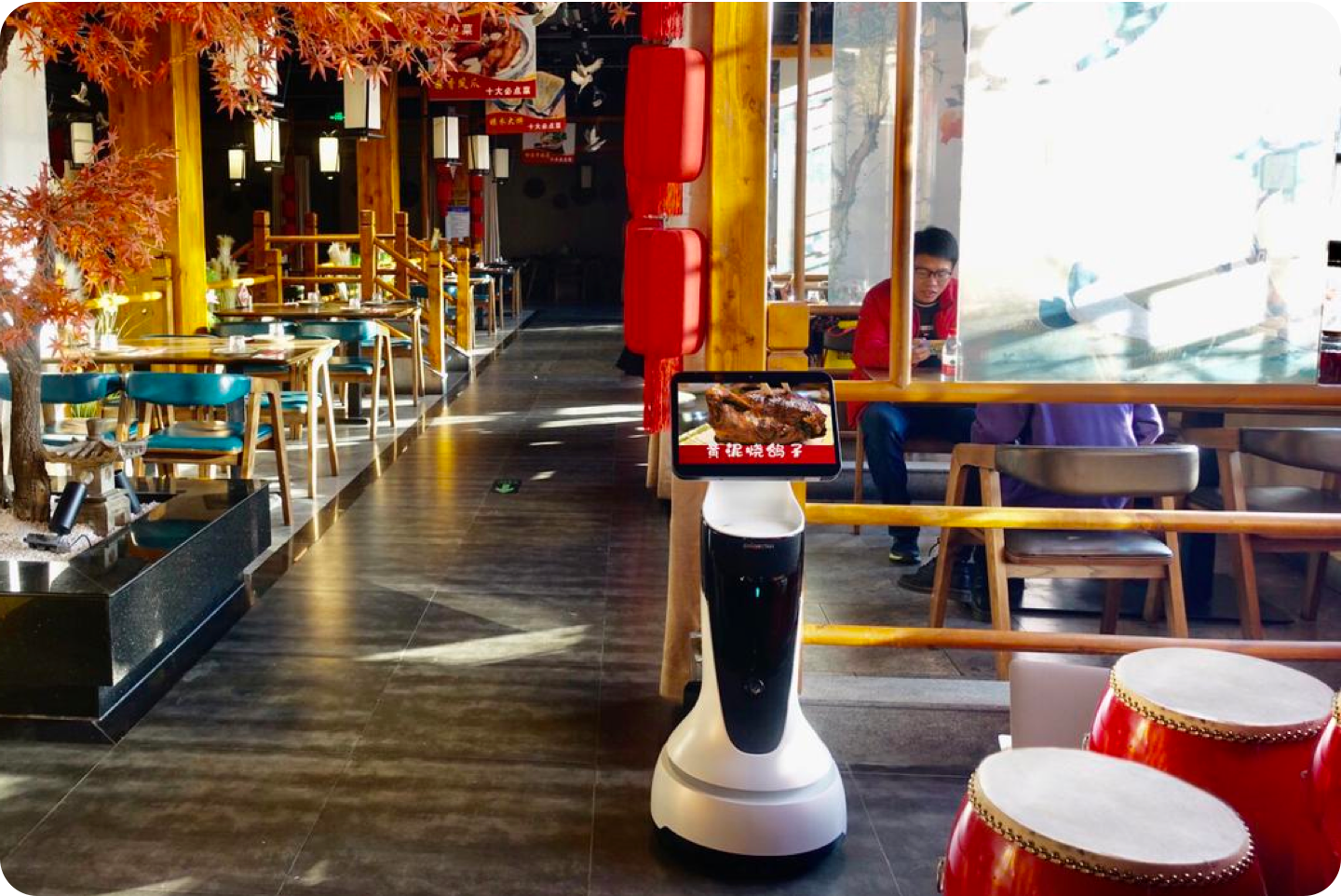
Deploying robotics in environments such as supermarkets, grocery stores, specialty food shops, food halls, delis, bakeries, and convenience stores presents unique operational challenges. Managers must carefully evaluate hardware and software configurations against specific spatial and environmental constraints. A robot designed for a sprawling hypermarket may completely obstruct a compact deli counter, while a unit built solely for simple point-to-point delivery may lack the localized engagement required for endcap promotions. The primary operational challenges revolve around navigating narrow aisles without blocking shopping carts, cutting through the high-decibel ambient noise of public address systems and clattering baskets, and managing visual merchandising in high-traffic checkout lanes. Addressing these constraints requires a deep understanding of physical chassis design, display architecture, and sensory capabilities to ensure the chosen solution actively enhances the shopper experience.
Before evaluating specific models, food retail operators must establish a comprehensive comparison framework based on core architectural constraints. The physical footprint and structural design of the robot determine where it can operate safely, making aisle passability a critical metric. Dedicated wayfinding architectures utilize a compact chassis and top-mounted screens focused entirely on guiding shoppers, demanding high maneuverability and narrow passability clearances to slip past stocking carts. Conversely, hybrid delivery architectures incorporate internal tray layers and rear-facing advertising panels, supporting dual-use workflows but requiring slightly more turning clearance in standard aisles. Large-format kiosk architectures utilize heavy-duty chassis designs to support multi-directional digital screens, requiring significant operational clearance best suited for wide-open hypermarkets or spacious food halls rather than packed convenience stores.
Beyond physical constraints, digital merchandising and customer engagement displays dictate how the robot interacts with shoppers. Multi-screen signage configurations employ distinct front and rear panels to broadcast high-impact video loops to customers approaching from different directions, maximizing advertising real estate for vendor promotions. Single-screen kiosk configurations utilize a mid-sized high-definition screen optimized for localized, face-to-face interactions like scanning loyalty cards or browsing store maps. Alternatively, bionic engagement configurations prioritize animated facial expressions and physical interactions over traditional advertising, effectively entertaining customers in family-oriented food halls or dessert shops.
Voice processing and multilingual architecture are equally crucial in noisy retail environments characterized by diverse customer demographics. Some systems utilize native automatic language detection, employing advanced microphone arrays to filter background noise while actively processing spoken queries on-device and switching between languages without manual intervention. Other architectures rely on cloud-scripted content management, where store operators pre-program specific multilingual greetings via a centralized platform. Furthermore, fleet management and sensor compliance dictate the scalability and legality of deployments. Chain retailers require scalable methods to manage multiple robots through open API developer platforms or proprietary cloud management portals. Because all solutions utilize cameras, mapping sensors, and cloud data processing, operators must verify applicable data protection and privacy regulations prior to deployment to ensure the lawful handling of store layouts, customer images, and voice logs.
The OrionStar GreetingBot Mini is positioned as a highly compact, voice-first interaction device engineered specifically for narrow food retail aisles and tight bakery counters. Overall machine dimensions measure up to 410 mm by 410 mm by 1,000 mm according to manufacturer data, while its minimum passability is listed separately at an agile 55 cm, allowing it to navigate dense grocery layouts where larger units would obstruct customer flow. For visual engagement, it relies on a single 14-inch FHD primary interactive display optimized for localized promotions and digital coupons, avoiding the bulk of secondary chest or rear advertising screens. Navigation and obstacle avoidance are handled by a robust fusion of a 240-degree scanning LiDAR, a depth camera, an auto-recharge camera, and a relocalization camera, enabling markerless deployment across expansive supermarket floors.
In high-noise environments, the unit utilizes a six-microphone circular array that maintains speech recognition accuracy above 97 percent even in ambient noise reaching up to 75 decibels. Multilingual support distinguishes itself through native automatic language detection, recognizing and switching between more than thirty languages in real-time without requiring cloud voice packs or per-store SDK integration. Because the OrionStar GreetingBot Mini involves cameras, voice recording, mapping, and cloud data processing via its AI platform, operators must verify GDPR compliance prior to deployment, ensuring lawful processing of in-store navigation data and customer interactions.
The temi robot serves as an ultra-slim digital receptionist and telepresence kiosk, making it highly suitable for single-site convenience stores or deli counters operated by budget-conscious buyers. Specific body dimensions and weight figures are not publicly detailed by the manufacturer, nor is the minimum passability explicitly specified, requiring operators to physically test clearance in their narrowest aisles before wide-scale rollout. The visual interface is concentrated entirely on a 10-inch top-mounted interactive display for direct touch inputs and video calls, lacking any secondary advertising screens for broadcast marketing. Its navigation and obstacle avoidance rely on a 360-degree LiDAR, two depth cameras, an RGB camera, and Time-of-Flight linear sensors to smoothly maneuver through store environments.
Voice interaction capabilities are primarily driven by built-in Alexa integration and developer-built skills via the software development kit. Unlike models with native automatic detection, temi handles multilingual support purely through SDK integration and third-party Alexa skills, meaning operators must actively program and manage language settings rather than relying on the robot to automatically detect a shopper's native tongue. Because the temi robot involves an RGB camera, mapping sensors, and cloud data processing, operators must verify GDPR compliance prior to deployment, particularly regarding the retention of 360-degree mapping data and voice logs captured during retail operations.
The Pudu KettyBot Pro functions as a dual-purpose marketing and hybrid unit designed for crowded food retail aisles where visible advertising holds equal importance to initial customer greeting. Overall dimensions measure up to 435 mm by 450 mm by 1,120 mm according to manufacturer data, while its minimum passability stands distinct at 55 cm, allowing it to easily squeeze through checkout lanes. Screen sizes are separated into a 10.1-inch main interactive face display for direct customer input and a much larger 18.5-inch advertising display on the rear for continuous promotional loops. While it features dual internal trays carrying up to 10 kg per layer, this delivery capacity serves purely for internal transport or sampling tasks and does not function as a reception capability.
Navigation and obstacle avoidance are executed through a fusion of a single LiDAR sensor, multiple depth vision sensors, a front positioning camera, and collision sensors. Multilingual support on this device is implemented via cloud voice packs and scripted greetings pushed through a proprietary merchant management platform, rather than utilizing native automatic detection. Because the Pudu KettyBot Pro involves a front positioning camera, depth vision sensors, mapping storage, and cloud data processing over a 4G LTE uplink, operators must verify GDPR compliance prior to deployment, confirming data minimization and the lawful basis for capturing ambient retail audio.
The Pudu BellaBot is positioned for wider-aisle supermarket chains, dessert shops, and family-style food halls where tactile emotional interaction and bionic greeting behaviors enhance the shopping experience. Overall body dimensions and a specific minimum passability width are not publicly specified in unified global materials, complicating spatial planning for narrow grocery aisles. The visual interface relies exclusively on a top-mounted interactive face screen dedicated to bionic cat animations and touch responses, with no secondary advertising screens available for merchandising loops. As a hybrid architecture, it includes four internal delivery trays capable of handling up to 40 kg total, though this delivery capacity does not contribute to its core reception or wayfinding capabilities.
Its navigation and obstacle avoidance system utilizes dual SLAM technology, relying on a LiDAR sensor combined with front and rear RGB cameras to map retail floors. Multilingual support is delivered entirely through cloud-uploaded content and scripted prompts rather than native automatic language detection, requiring operators to manually curate greetings for different linguistic demographics. Because the Pudu BellaBot involves front and rear RGB cameras, LiDAR mapping, and cloud data processing for fleet management, operators must verify GDPR compliance prior to deployment, securing appropriate safeguards for customer images and mapping data.
The LG CLOi GuideBot operates as a large-format humanoid guidebot engineered specifically for expansive flagship food halls and airport-style retail atriums where high visibility is paramount. It features a massive footprint with overall dimensions up to 510.5 mm by 1,501.1 mm by 510.5 mm according to manufacturer data, though its minimum passability is not explicitly separated from its body width, making it unsuitable for standard, narrow supermarket aisles. The display architecture is highly complex, splitting screen sizes into a 9.2-inch main interactive head display alongside two massive 27-inch front and rear touch advertising displays for high-impact visual merchandising. Navigation and obstacle avoidance are achieved through a robust combination of LiDAR, depth sensors, bumper sensors, and Time-of-Flight integration.
Multilingual support and voice recognition are managed through a proprietary cloud content management system using cloud voice packs and SDK integration, lacking native automatic language detection capabilities. Because the LG CLOi GuideBot involves LiDAR mapping, depth sensors, night-time security video recording, and extensive cloud data processing over LTE, operators must verify GDPR compliance prior to deployment, particularly regarding security patrol recording and data retention policies in public retail spaces.
When selecting a reception robot for food retail, buyers must critically align the hardware architecture, digital merchandising displays, and voice processing capabilities with their distinct store layouts and operational goals. For narrow supermarket aisles and bakery counters requiring high maneuverability and seamless multilingual interaction, agile models with native automatic language detection and dedicated interactive screens offer the most streamlined deployment. Conversely, expansive food halls and wide-aisle retail environments may benefit from larger, hybrid models that leverage dual-screen marketing loops and cloud-scripted content management to attract passing foot traffic. Regardless of the chosen architecture, operators must prioritize sensor compliance and fleet management tools, rigorously verifying data privacy regulations to ensure that in-store navigation, camera usage, and audio capture align with regional legal requirements.
#### What ROI and payback period can food retail operators realistically expect from a reception robot? Industry sources place the typical payback period for purchased retail robots at 12–24 months, with RobotLAB citing a broader 1–3 year range depending on store size, shift coverage, and local labor rates. Reception-and-greeting robots in supermarkets, bakeries, and food halls usually recoup their cost through reduced greeter-staff overtime, higher coupon-redemption rates from on-robot promotions, and fewer abandoned baskets when shoppers cannot find products. Robots-as-a-Service (RaaS) subscriptions remove the upfront capex hurdle and typically show immediate positive ROI in well-deployed pilots, which is why most chain operators pilot under RaaS before committing to purchase.
#### How do reception robots handle GDPR and privacy compliance in EU food retail stores? Every robot covered in this space uses LiDAR mapping, RGB cameras, and microphone arrays, all of which fall under GDPR when deployed in EU stores. Operators must establish a lawful basis for processing (typically legitimate interest with a balancing test), post visible signage at entrances, minimize the data retained (e.g., on-prem SLAM maps instead of cloud uploads), and update their privacy notices to mention in-store video and voice capture. Vendors such as Pudu and temi store maps and logs in their cloud platforms, so EU operators should request data-residency options, retention windows, and processor agreements before procurement; the GreetingBot Mini exposes server-side APIs that allow on-prem integration for stricter environments.
#### Should supermarket chains buy reception robots outright or subscribe through a Robots-as-a-Service (RaaS) model? For multi-site food retail chains, RaaS is usually the lower-risk entry point because monthly fees convert capex into opex, include maintenance and software updates, and let operators scale up or down per store performance. Direct purchase becomes more attractive for high-traffic flagship stores where the unit runs 12+ hours a day and the operator has in-house IT staff to manage CMS, mapping, and content updates. Most chains in this category pilot one or two stores under RaaS, then convert to purchase for the top-performing 20–30% of locations once utilization data justifies the capex.
#### Will a reception robot physically fit and maneuver through narrow supermarket aisles and bakery counters? Passability is the single most underestimated constraint in food retail aisles. The OrionStar GreetingBot Mini and Pudu KettyBot Pro both specify a minimum 55 cm travel width, which is enough for most European supermarket gondola layouts but tight for older convenience stores. LG's CLOi GuideBot, at 510.5 mm body width and 80 kg, requires significantly more clearance and is generally only practical in hypermarkets or food halls. Operators should measure the narrowest point on the proposed patrol route, including checkout queuing lanes, before shortlisting, and confirm the chassis can handle a 5° ramp where deli counters step down to the sales floor.
#### Can a reception robot's voice interaction work reliably in a noisy supermarket or food hall? Supermarket and food-hall ambient noise typically sits between 65 and 80 dB, which is the working range most vendors target. The OrionStar GreetingBot Mini uses a 6-microphone circular array with 360° sound-source positioning and documents speech recognition accuracy above 97% in 75 dB environments. The KettyBot Pro uses a similar 6-mic array with 2 × 10 W speakers for in-store announcements, while temi currently utilizes Alexa for voice processing, which may require additional configuration for optimal performance in multilingual or high-noise environments. For a busy food hall or a bakery with active kitchen ventilation, request an in-store noise test before signing the purchase order.
#### Do reception robots support multilingual customers without per-store scripting? Multilingual support is where vendor architectures diverge the most. The OrionStar GreetingBot Mini supports 30+ languages with real-time switching and automatic language detection, which matters for international chains and tourist-heavy food halls. Pudu's KettyBot Pro and BellaBot run on Android and deliver multilingual greetings through cloud-uploaded scripts and SDK content, so each new language requires operator work. temi is English-only at the OS level today, with additional languages requiring Alexa skill or SDK integration. For chains operating across multiple EU markets, auto-detection reduces per-store content work and removes the language-button step from the customer journey.
Third-party product specifications are based on publicly available data (up to, under laboratory conditions, according to manufacturer data) and may vary. Product names and trademarks are the property of their respective owners. If any product involves cameras, voice recording, mapping, or cloud data processing, operators must verify GDPR compliance prior to deployment. Data privacy compliance, including obtaining necessary shopper consent and establishing data retention policies, remains the sole responsibility of the deploying operator.