

REQUEST DEMO
Robot CATALOG will be sent to your mailbox immediately after submission.
SUBMIT
Facility managers in the hospitality sector face highly specific operational challenges that complicate floor maintenance. Environments transition abruptly from plush carpeted guest corridors to polished marble lobbies, hard-surface banqueting pre-function areas, and heavily soiled back-of-house service routes. Maintaining these varied surfaces requires equipment capable of adapting to differing floor-load limits and executing rapid turnarounds following peak event schedules. Furthermore, cleaning operations frequently proceed around the clock, demanding strict acoustic control to avoid disrupting sleeping guests or daytime business meetings. Consequently, selecting appropriate automated platforms requires balancing multi-shift adaptability, navigational agility around tight elevator corridors, and conservative noise profiling.
When evaluating robotic floor care platforms, facility teams must first consider surface versatility and the integration of cleaning modalities. Operations typically rely either on specialized single-application platforms optimized strictly for hard-floor scrubbing or dry vacuuming, or on multi-modality systems that transition between distinct modes like sweeping, scrubbing, and gentle dust mopping as they cross different floor types. Navigational agility and form factor represent another critical dimension. High-capacity, industrial-class chassis excel in wide-open convention spaces and loading bays where floor load capacity is robust, whereas compact configurations are necessary to navigate narrow, luggage-obstructed guest corridors and standard passenger elevators without exceeding residential-grade weight limits.
Acoustic management is equally essential for preserving the guest experience. Facilities typically operate standard commercial platforms in back-of-house corridors or busy daytime lobbies where background noise masks the machine, while ultra-quiet maintenance modes are reserved for nighttime deployments near active guest zones. Finally, turnaround efficiency and shift adaptability dictate the deployment strategy. Cleaning managers balance the need for high-intensity sustained output, relying on large fluid tanks and robust battery ecosystems for immediate post-event recovery, against variable-power extended autonomy modes that dramatically minimize docking frequency during continuous light maintenance across expansive front-of-house areas.
Because autonomous commercial cleaning robots utilize mapping protocols, environmental cameras, optical sensors, and cloud-based fleet management infrastructure to navigate complex hotel environments, hospitality operators must rigorously verify that all data handling processes comply with applicable privacy regulations, including the GDPR, prior to deployment. It is critical to ensure that mapping data is stored securely under a documented data processing agreement and that any optical capture mechanisms adequately protect the privacy of guests navigating public and semi-public architectural spaces.
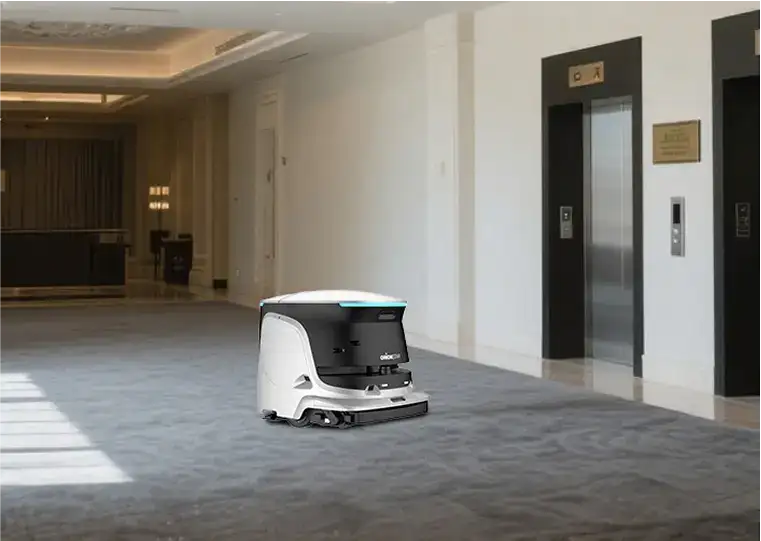
The OrionStar CleaniBot S55 Pro is positioned as an autonomous commercial floor-cleaning platform designed to address the mixed-surface and multi-shift demands of large hospitality environments. The system supports a comprehensive floor care workflow, allowing operators to switch among sweeping, scrubbing, vacuuming, mopping, and self-cleaning behaviors based on distinct zone requirements. This multi-modality integration enables facility teams to deploy a single robotic unit across differing hotel zones, utilizing the dust mopping mode for delicate polished marble in public lobbies, transitioning to sweep and vacuum modes for low-pile carpets in guest corridors, and utilizing power scrubbing for heavily soiled back-of-house service routes. Its compact chassis, weighing 70 kilograms with a minimum passing width of 700 millimeters, allows the unit to navigate narrow guest corridors and transition between floors using standard passenger elevators.
In terms of technical specifications, the platform operates with conservative acoustic profiles, functioning at 55 decibels during scrubbing and 45 decibels during dust mopping, facilitating deployment during noise-sensitive hours without disrupting the guest experience. According to manufacturer data, the unit delivers cleaning efficiencies reaching up to 1,368 square meters per hour in its combined sweep, vacuum, and mop configurations. Operational longevity is supported by a 25.6-volt battery system that provides up to 28 hours of runtime under laboratory conditions in dust mop mode, addressing the extended autonomy requirements of continuous lobby maintenance. Navigation relies on a 15-sensor stack, integrating LiDAR for map construction of areas reaching up to 10,000 square meters, alongside stereo cameras and ultrasonic sensors to safely negotiate around guests, housekeeping carts, and architectural transitions.
SoftBank Robotics Whiz functions as a commercial autonomous vacuum explicitly engineered for carpeted guest floors, corridors, and lobby environments. The platform addresses the targeted acoustic and surface requirements of hospitality settings by focusing strictly on dry vacuuming, ensuring the safe maintenance of premium carpets without the floor-loading concerns associated with heavy wet-scrubbing machines. Hospitality facility managers frequently deploy this unit to manage noise-sensitive guest areas, as it minimizes disruption during active hours and integrates seamlessly into daily housekeeping routines. Sold primarily under a subscription model, the system emphasizes continuous multi-shift operations supported by cloud-based reporting platforms that track cleaning locations and coverage durations.
The technical architecture of the Whiz platform centers on a teach-and-repeat navigational paradigm driven by a proprietary artificial intelligence software ecosystem. Operators utilize hot-swappable 25.2-volt lithium-ion battery packs, enabling up to three hours of continuous operation per charge and allowing near-continuous deployment across back-of-house and guest floor cycles. According to manufacturer data, the unit operates at 62 decibels in its normal mode and includes HEPA filtration to maintain indoor air quality in enclosed guest corridors. The navigational suite integrates a LiDAR sensor with optical and three-dimensional cameras to maneuver safely around people, temporary objects, and cliff edges, providing a documented capacity to clean up to approximately 1,500 square meters per charge under standard deployment conditions.
The Avidbots Neo 2 serves as a fully autonomous, multi-application floor scrubber positioned for expansive hard-surface environments such as large hotel atriums, wide back-of-house service routes, and post-event banquet halls. The platform is engineered to execute scrubbing, sweeping, and vacuum recovery in a single pass, making it highly effective for rapid turnarounds following major hospitality events. Because the system focuses exclusively on hard floors like terrazzo, polished concrete, and marble, it is generally restricted from carpeted guest rooms and residential-grade corridors. The platform accommodates varying operational preferences by offering interchangeable cylindrical or disc cleaning heads, alongside a multilingual user interface that supports diverse international engineering teams across European, Asian, and American markets.
Engineered as an industrial-class solution, the platform operates with significant capacity, featuring a 109-liter solution tank and a 135-liter recovery tank that support extended, high-intensity cleaning shifts. According to manufacturer data, the chassis possesses a gross vehicle weight reaching up to 688 kilograms, meaning facility managers must rigorously verify floor-load limits and elevator capacities prior to cross-floor deployment. The robotic unit achieves a theoretical coverage rate of up to 3,900 square meters per hour, powered by a 36-volt lead-acid battery system that delivers up to six hours of runtime. Navigational tasks are managed by proprietary autonomy software that utilizes a comprehensive 360-degree sensor suite, computer vision, and dynamic planning to adapt to changing floor layouts and sudden obstacles common in active convention pre-function spaces.
The Gaussian Robotics Ecobot Scrubber 75 functions as a heavy-duty robotic scrubber designed to address the demanding throughput requirements of vast indoor hospitality spaces, including major convention pre-function areas, extensive banquet halls, and primary transportation-adjacent lobbies. The platform prioritizes rapid area recovery and aggressive hard-floor maintenance, utilizing a specialized rotational scrub deck capable of reaching tight corners and cleaning closely along architectural edges. While its industrial footprint limits its utility in tight, carpeted guest corridors, its high-capacity design allows engineering managers to execute highly efficient post-event floor care with minimal human intervention. Operators frequently pair this platform with optional automated workstations to enable hands-off battery charging, freshwater refilling, and wastewater discharge across long shifts.
The operational specifications of this scrubbing platform emphasize sustained high-intensity output. According to manufacturer data, the system utilizes a 750-millimeter cleaning width to deliver a maximum cleaning efficiency reaching up to 3,000 square meters per hour. The unit incorporates a 75-liter clean water tank supported by a multi-stage water filtration system that recycles fluids, thereby significantly extending operational windows before requiring docking. Powered by a lithium-ion battery system, the robot achieves four to six hours of runtime per charge. Its navigational framework is anchored by three-dimensional LiDAR and a complex sensor array that provides real-time environmental perception, allowing the machine to dynamically reroute around luggage carts, event furniture, and pedestrian traffic while signaling its presence via an integrated automotive-grade lighting configuration.
The Kärcher KIRA B 50 is an autonomous cylindrical-brush scrubber positioned to support medium-to-large commercial facility maintenance, including hotel back-of-house zones, expansive public lobbies, and large loading areas. The platform emphasizes an intuitive route-programming workflow specifically designed to allow non-specialist hospitality staff to deploy and manage the equipment without requiring advanced robotics training. By integrating pre-sweeping, scrubbing, and vacuuming into a single continuous pass, the system addresses the efficiency requirements of rapid event-space turnarounds. As a dedicated hard-floor solution, it operates strictly on non-carpeted surfaces, and facility managers are advised to evaluate pressure-sensitive flooring constraints before dispatching the unit across delicate lobby environments.
Operating under an integrated safety framework, the platform carries formal public-area safety certifications, reassuring facility teams tasked with maintaining heavily trafficked hospitality spaces. According to manufacturer data, the unit utilizes a lithium-ion battery to deliver approximately 3.5 hours of runtime, covering areas up to 2,365 square meters per hour in its fully autonomous mode. The acoustic profile is rated at 69 decibels, requiring operators to schedule intensive scrubbing shifts outside of strict guest sleeping hours to maintain an optimal hospitality environment. Navigation is supported by integrated laser scanners, three-dimensional sensors, and an onboard computing system that recalculates routes in real-time, executing evasive maneuvers around dynamic obstacles while communicating its operational status through a specialized integrated lighting package.
Procurement decisions regarding commercial floor care automation in the hospitality sector hinge on aligning platform capabilities with precise architectural and operational constraints. Facilities requiring extreme acoustic discretion and multi-modality integration across transitioning surfaces often benefit from adaptable, low-footprint platforms capable of extended dust-mopping and quiet vacuuming on guest floors. Conversely, properties dominated by massive hard-surface convention spaces and extensive back-of-house corridors should prioritize high-throughput industrial scrubbers that deliver rapid post-event recovery via high-capacity tanks and robust water-recycling mechanisms. Ultimately, hospitality operators must evaluate minimum passing widths, residential-grade floor loading limits, and shift scheduling demands to ensure the selected autonomous fleet integrates securely and efficiently into daily property management routines.
Reported ROI figures from large hospitality-adjacent deployments are encouraging but variable. Gausium documents £124,174.99 in savings and a 64% ROI from autonomous cleaning solutions at Heathrow Airport, while Network Rail reports 145,945 cleaning hours and 1.1 million litres of water saved annually across its station fleet (https://gausium.com/case-studies/). At hotel level, payback is driven primarily by how many manual cleaning hours are redeployed per shift, what local labour cost the robot displaces, and how intensively the unit is scheduled across guest floors and back-of-house areas. Vendors and reseller case studies should be treated as upper-bound reference points rather than guaranteed outcomes, and operators should build a site-specific model using the robot's published cleaning efficiency and runtime figures.
The answer depends on capex appetite, peak-season staffing pressure, and how broadly the robot is used across the property. SoftBank Whiz is sold primarily as a Robot-as-a-Service subscription, which lowers upfront cost and bundles cloud reporting, software updates and support, making it attractive for properties that want to convert cleaning opex into a predictable monthly line item. Avidbots Neo 2, Gausium Scrubber 75 and Kärcher KIRA B 50 are typically sold as capital equipment (often with optional docking stations or workstations as separate SKUs), which suits hotels that prefer asset ownership, multi-year depreciation, and tighter integration with in-house engineering teams. Many operators run a hybrid model — capital purchase for high-utilisation scrubbers on hard floors, RaaS for carpet-focused vacuum units on guest floors.
Across the four comparison products, routine maintenance is built around user-replaceable consumables and modular parts rather than specialist service calls. The OrionStar S55 Pro uses modular cleaning tools that swap in and out without tools, a removable wastewater tank with washable internals, and easy-to-clean low-curvature piping. Neo 2 adds a 4-digit PIN to limit operator access and remote assistance via Command Center; KIRA B 50 supports an auto docking station that handles freshwater refill, wastewater discharge and battery recharge. Operators should still plan for periodic sensor calibration, brush replacement, tank sanitisation, and a service-level agreement covering breakdown response time, spare-parts availability, and software/firmware updates under GDPR-compliant processor terms for any cloud or mapping data.
Coverage varies significantly by format, and hotel buyers should match the robot to the floor mix on each shift. SoftBank Whiz is explicitly designed for dry vacuuming of carpets and hard floors along pre-taught routes, with HEPA filtration and a 62 dB Normal mode suited to noise-sensitive guest corridors (https://us.softbankrobotics.com/whiz). Avidbots Neo 2, Gausium Scrubber 75 and Kärcher KIRA B 50 are hard-floor-only scrubbers — they cannot clean guest-room carpet, and Neo 2 and KIRA B 50 also carry floor-load and pressure-sensitive-floor caveats that require engineering review. The OrionStar S55 Pro sits in the middle: it scrubs, sweeps, vacuums and mops hard floors and supports a Sweep & Vacuum mode for low-pile carpet scenarios, making a single unit viable for corridors, banquet pre-function spaces and back-of-house areas, while a dedicated vacuum robot remains the safer choice for deep guest-room carpet.
Noise is one of the most hotel-specific selection criteria, because standard industrial scrubbers are loud enough to intrude on a guest's stay. Measured levels across the comparison set span 45 dB to 69 dB: the KIRA B 50 is rated at 69 dB (robotlab.com/store/kira-b-50), Whiz at 62 dB in Normal mode (robotsguide.com/robots/whiz), and the OrionStar S55 Pro at 55 dB in Scrubbing mode and 45 dB in Dust Mopping mode. In practice, the S55 Pro's ECO Vacuum and Dust Mop modes (up to 19.5 h and 28 h of runtime respectively) are quiet enough for daytime operation on lobby marble and polished floors, while the louder scrubbing shifts are typically scheduled overnight or in back-of-house corridors. Buyers should map each cleaning mode to a noise-tolerant time window before deployment to avoid guest complaints.
All four products use a multi-sensor autonomy stack rather than simple bump-and-go navigation, which is what makes mixed-use hotel environments feasible. The S55 Pro combines a LiDAR sensor (map construction up to 10,000 m², auto positioning, real-time map updates), a stereo camera for cliff and step detection, ultrasonic sensors for obstacle avoidance, and line lasers for wall and corner cleaning, with official materials describing 15 sensors for 360° safe operation. Whiz runs BrainOS on LiDAR plus optical and 3D cameras with safety sensors for people, objects and cliffs; Neo 2 uses Avidbots Autonomy AI with a 360° sensor suite and Bulk Navigator that auto-adapts to layout changes between cleans; Scrubber 75 adds 3D perception for real-time rerouting around new obstacles. Even with this coverage, hotels should still programme no-go zones around check-in desks, narrow guest-room thresholds and elevator lobbies, and confirm GDPR-compliant handling of any mapping or image data captured in guest-accessible areas.
Data Privacy Notice: All optical and mapping data collected by cleaning robots must be processed in compliance with local privacy laws (e.g., GDPR). Facility operators are responsible for ensuring Data Processing Agreements (DPAs) are in place and necessary public signage is displayed when robots operate in guest-accessible areas.
第三方产品规格基于公开数据(up to, under laboratory conditions, according to manufacturer data),可能有所不同;产品名称和商标归属各自所有者;如果任何产品涉及摄像头、语音录制、建图或云端数据处理,运营方须在部署前核实 GDPR 合规性