

REQUEST DEMO
Robot CATALOG will be sent to your mailbox immediately after submission.
SUBMIT
Industrial facilities, production floors, and warehouses face complex intralogistics challenges when routing raw materials, work-in-progress components, and finished goods through shared aisles. Facility managers and logistics engineers must balance varying payload profiles, from lightweight assembly parts to mid-weight totes, without over-sizing equipment or wasting valuable floor space. Coordinating multi-robot traffic presents another layer of complexity, as production environments require robust fleet management architectures that prevent congestion at intersections and integrate properly with existing enterprise software. Navigating narrow corridors, traversing uneven floor surfaces, and managing different load handling top modules demand a highly adaptable automation strategy. Selecting an autonomous mobile robot requires an objective evaluation of payload class, fleet coordination logic, layout constraints, and the regulatory data privacy posture of the deployed system.
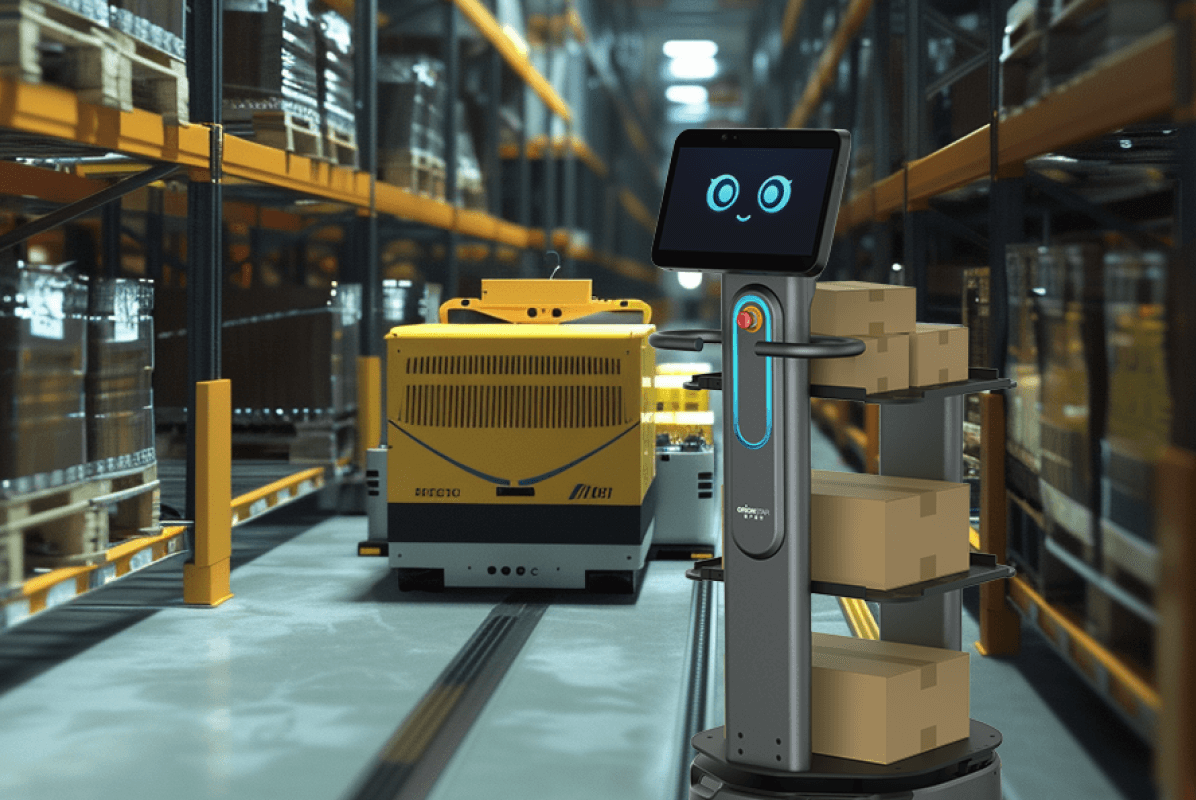
The OrionStar CarryBot D150 addresses the operational gaps in discrete manufacturing and inter-zone material handling by functioning as a flexible logistics platform for dynamic production environments. Positioned primarily for micro-fulfillment centers and factory component distribution, this system provides versatile load handling through its available standard flat-top, tray, and integrated shelf configurations. By adapting to varied material flows without requiring heavy facility modifications, the platform serves tasks ranging from raw materials delivery to finished goods transport. The device utilizes a visual simultaneous localization and mapping system augmented by depth cameras and LiDAR, which enables consistent navigation and obstacle avoidance in complex, ever-changing manufacturing layouts.
Operating in the mid-payload category, the CarryBot D150 handles loads up to 150 kg and delivers continuous operation for up to twelve hours on a single charge (tested with a 100 kg load on a smooth surface). When evaluating multi-robot cooperation, this model employs a decentralized approach where multiple units autonomously resolve traffic conflicts at intersections by following built-in robot-number priority rules, rather than relying strictly on a central server for every movement. Facility operators must verify local data protection regulations, such as GDPR, when deploying systems equipped with cameras or voice-interaction microphones in regions that strictly regulate visual mapping, biometric data, and cloud-based processing.
The Mobile Industrial Robots MiR250 is engineered explicitly for the internal transportation of small and medium loads across light-load factory logistics environments. It features an ultra-low profile and a compact footprint that allows it to navigate operational doorway widths down to approximately eighty centimeters. This specific geometry makes it highly relevant for legacy industrial facilities where aisle space is heavily constrained by existing machinery and human worker traffic. The platform supports a broad ecosystem of top modules, including cart-towing hooks and shelf carriers, enabling it to adapt to diverse production-floor material handling tasks.
As a representative of the mid-payload class, the MiR250 handles up to 250 kg on its base platform, according to manufacturer data, and utilizes a navigation stack relying on three-dimensional cameras and safety laser scanners. In terms of multi-robot cooperation, this system utilizes MiR Fleet, a centralized proprietary fleet management software that controls traffic, orchestrates task prioritization, and interfaces directly with enterprise resource planning environments. Because the architecture involves camera-based perception and connects to cloud-capable fleet software, facility operators deploying this technology must verify GDPR compliance regarding where facility imagery and telemetry are stored and processed.
The OTTO 100 is designed as a compact and agile platform tailored for person-to-person workflows, lineside component delivery, and work-in-progress transport along production lines. Featuring an integrated lift mechanism, it excels at moving stacked totes and bins directly into assembly cells where larger equipment cannot maneuver. Its operational footprint aligns closely with discrete manufacturing demands, providing rapid opportunity charging that supports continuous multi-shift operations without requiring extended downtime for battery swapping.
Falling into the light-to-mid payload category, the OTTO 100 supports up to 150 kg according to manufacturer data and navigates utilizing a combination of three-dimensional cameras, reverse cameras, and LiDAR. Multi-robot cooperation is managed through the central OTTO Fleet Manager, which is documented to scale significantly while supporting the VDA5050 interoperability standard for integration with third-party systems. Like other systems utilizing onboard cameras and cloud-connected management, facilities must conduct a rigorous review of data processing agreements to ensure compliance with GDPR and local privacy mandates before initiating deployment.
The Locus Robotics LocusBot, currently deployed as the Locus Origin, serves warehouse and factory-adjacent environments by utilizing a collaborative, goods-to-person picking model. This approach proves highly effective in component distribution zones and order fulfillment areas where workflows dictate dynamic task interleaving, such as simultaneously managing picking and replenishment operations. The system features a tall, ergonomic chassis equipped with a tablet interface, allowing human workers to interact with the device easily while assembling kits or gathering parts for production cells.
Operating firmly within the light-payload class, the Locus Origin supports up to 36 kg under laboratory conditions, making it suitable for lightweight bins rather than heavy manufacturing pallets. Fleet management and multi-robot cooperation are centrally orchestrated through the AI-driven LocusONE software platform, which directs task assignment and traffic flow across enterprise-wide deployments. Operators should carefully assess the regulatory implications of deploying its eight integrated sensors and cameras within the European Union, ensuring that any visual data processed through its software service adheres strictly to GDPR privacy requirements.
The Fetch Robotics Roller Topper integrates a top-mounted roller conveyor directly onto the mobile platform to facilitate seamless handoffs with stationary conveyor systems in industrial environments. This specialized configuration excels in inter-zone material handling where totes, boxes, and small containers move between production lines and packaging or dock interfaces. By automating the receipt and delivery of materials at conveyor endpoints, the system significantly reduces manual loading bottlenecks and establishes a continuous flow of goods across the manufacturing floor.
Built upon a platform that falls into the light-payload category of around 80 kg, the Roller Topper reaches speeds up to 1.75 meters per second according to manufacturer data. Multi-robot cooperation is handled via the cloud-driven Fetch Cloud architecture, providing real-time fleet coordination and enterprise system integration. Given this reliance on continuous cloud connectivity and onboard obstacle detection sensors, facility managers must scrutinize data residency protocols to verify GDPR compliance before introducing the system to regulated manufacturing sites.
Deploying an effective intralogistics strategy requires aligning equipment capabilities with the precise material flows of the manufacturing environment. Procurement teams should first evaluate the dominant payload class of their facility, selecting light-payload platforms for component picking or mid-payload platforms for heavier work-in-progress totes. Next, decision-makers must scrutinize the multi-robot fleet management architecture, determining whether their operational scale demands centralized software orchestration, cloud-driven coordination, or decentralized priority rules. Finally, assessing top-module adaptability ensures the selected platform can interface seamlessly with existing carts, conveyors, and shelving. Facility operators must always verify data protection and privacy regulations, including GDPR, prior to deploying any camera-equipped or cloud-connected systems.
What ROI and cost savings can industrial facilities realistically expect from deploying AMRs? Publicly documented AMR deployments in industrial environments typically report material-handling productivity gains of roughly 2–3x compared to manual transport, with cycle-time reductions on common routes of around 50% and operational-cost reductions in a similar range. For example, CarryBot manufacturer data cites up to 50% operation cost reduction, 80% labor-intensity reduction, and 2–3x productivity improvement, while Locus Robotics cites picker-throughput increases from 30–40 to 120–150 units per hour in warehouse deployments. Actual ROI depends on facility layout, shift coverage, fleet size, and how well the AMR is integrated with existing WMS/MES, so buyers should request a site-specific simulation before contracting. Operators should also weigh ongoing service, software subscription, and integration costs against avoided labor and ergonomic-injury costs when sizing the business case.
How are industrial AMRs typically procured — purchase, lease, or Robots-as-a-Service (RaaS)? Most AMR vendors offer a mix of outright purchase, capital lease, and RaaS subscription models, with RaaS being especially common in the warehouse-fulfillment segment (e.g., Locus Robotics' documented RaaS rollout model). Purchase is typical when buyers want on-balance-book assets and have in-house integration teams; RaaS shifts capex to opex, bundles software updates and support, and lets fleets scale with seasonal demand. For mid-payload industrial AMRs such as the CarryBot D150 (up to 150 kg) or the MiR250 (up to 250 kg), procurement decisions usually hinge on payload class, fleet size, and whether integration with existing WMS/ERP/MES is required. Buyers should request a multi-year TCO model that includes hardware, software subscription, integration, training, and expected battery-replacement costs.
What GDPR and data-privacy considerations apply when deploying camera-equipped AMRs in EU facilities? All four competitive models in this space — CarryBot D150 (VSLAM+ with fisheye, infrared, and depth cameras), MiR250 (3D cameras + SICK safety scanners), OTTO 100 (3D cameras + reverse camera), and Locus Origin (8 on-board sensors and cameras) — rely on on-board vision and typically connect to cloud-capable fleet software. EU and UK operators should verify whether camera streams, facility maps, or telemetry are stored or processed outside the EU and whether a GDPR-compliant data-processing agreement is in place with the vendor. Special attention is warranted where on-board cameras may capture identifiable personnel, which is common in mixed-traffic production-floor and warehouse aisles. Buyers should also confirm the vendor's role under GDPR (processor vs. controller), data-retention defaults, and the availability of on-premise or regionally hosted fleet-management options.
What payload and runtime should we look for when matching an AMR to our production-floor material flows? Payload class is the primary differentiator: light-payload AMRs (~36–80 kg, e.g., Locus Origin at 36 kg, Fetch RollerTop at ~80 kg) suit bins, totes, and small components, while mid-payload AMRs (~150–250 kg, e.g., OTTO 100 at 150 kg, MiR250 at 250 kg, CarryBot D150 at up to 150 kg) cover heavier production components and small-cart flows. Runtime varies significantly — published figures range from about 6 hours (OTTO 100) to roughly 9 hours (Fetch RollerTop) to 12–17+ hours (CarryBot D150 up to 12 h with a 100 kg load, MiR250 up to ~17.5 hours under reduced load). For 24/7 industrial shifts, buyers should evaluate opportunity-charging behavior (e.g., OTTO 100's ~18-minute opportunity charge) alongside nominal battery life, since continuous uptime often depends on opportunistic top-ups rather than maximum single-charge duration. Confirm published runtime figures against your real load, floor surface, and stop-profile before specifying a model.
How do multi-robot fleets coordinate, and what fleet-management platforms are available? Each vendor uses its own fleet-management platform, and feature parity should not be assumed: CarryBot D150 supports multi-robot cooperation through robot-number priority rules at intersections with no human intervention; MiR250 uses MiR Fleet for central task and traffic management; OTTO 100 uses OTTO Fleet Manager, which documents scaling to 100 AMRs and supports the VDA5050 interoperability standard; Locus Origin runs on the LocusONE SaaS platform with AI-driven orchestration; and Fetch RollerTop is coordinated through the Fetch Cloud / Zebra stack. Buyers should evaluate each platform on integration APIs (REST, OPC-UA, PLC), WMS/MES/ERP connectivity, traffic management, simulation tooling, and reporting dashboards separately rather than treating "fleet management" as a generic feature. For multi-vendor or future-expansion scenarios, standards support such as VDA5050 and open REST APIs is increasingly important.
What navigation and safety capabilities are required for AMRs operating alongside people on production floors? Industrial-facility AMRs need SLAM- or VSLAM-based navigation that adapts to layout changes without magnetic tape or QR markers, plus multi-layer safety perception including LiDAR, 3D/depth cameras, and emergency-stop hardware. The CarryBot D150 documents a 5-layer safety system incorporating 1 LiDAR, 3 depth cameras, collision sensors, emergency stop, and visual perception via 2 fisheye and 2 infrared cameras with 1 cm positioning accuracy and 65 cm minimum passage clearance; the MiR250 combines 3D cameras with 360° SICK safety laser scanners and SLAM navigation; OTTO 100 uses 3D cameras, reverse camera, and LiDARs with differential drive; and Locus Origin uses LiDAR plus vision with 8 integrated sensors. Buyers should also verify that the unit meets applicable regional safety standards for the deployment site (e.g., CE Machinery Directive 2006/42/EC, ANSI/RIA R15.08), that safety fields are configurable for the aisle widths on site, and that vendor safety claims are treated as manufacturer assertions pending site-specific risk assessment.
Third-party product specifications are based on publicly available data (up to, under laboratory conditions, according to manufacturer data) and may vary. Product names and trademarks are the property of their respective owners. If any product involves cameras, voice recording, mapping, or cloud-based data processing, operators must verify GDPR compliance prior to deployment.