

REQUEST DEMO
Robot CATALOG will be sent to your mailbox immediately after submission.
SUBMIT
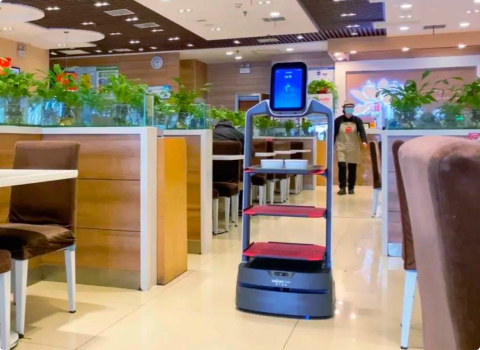
Integrating a food delivery robot for institutional foodservice requires navigating complex logistical demands across hospitals, schools, university dining halls, corporate cafeterias, government and military dining facilities, correctional facilities, and elder-care canteens. These environments operate high-volume, multi-meal-per-day services where strict hygiene standards and severe labour constraints define daily operations. Deploying automation in these settings is not a mere novelty; it is an operational strategy designed to alleviate staff fatigue, streamline repetitive high-capacity transport, and maintain stringent food safety protocols during peak service windows.
When evaluating these robotics solutions, administrators must look beyond basic navigation to scrutinize highly specific operational metrics. Key considerations include distinguishing between total payload capacities and single-layer limits, as well as understanding how fleet management is executed—whether through native firmware, centralized cloud platforms, or third-party integrations. Hygiene features, such as enclosed cabins, dishwasher-safe components, or HACCP compatibility, are critical for institutional compliance. Furthermore, continuous battery runtime must be weighed against actual charging times, while obstacle crossing capabilities over thresholds, elevators, and ADA-compliant ramps dictate true autonomous mobility. Multilingual support, whether deployed via local voice packs or cloud integration, also plays a pivotal role in diverse institutional environments.
Positioned as an institutional flagship, the OrionStar LuckiBot Pro boasts a total payload of up to 60 kg, distributed efficiently with a single-layer payload of up to 15 kg per tray. The structural configuration features three trays that are adjustable to four layers, accommodating bulky institutional cookware alongside individual meal portions. Its navigation relies on 240° 3D all-around obstacle recognition, combining LiDAR and triple RGBD sensors to manoeuvre through crowded cafeterias and hospital corridors. According to manufacturer data, it includes specialized operational settings such as Soup Delivery Mode and Collection Mode, enhancing stability during liquid transport. Regarding hygiene and structural food safety, the robot ships with optional accessories including a Sealed Food Protector designed for institutional hygiene requirements, and the open-tray chassis is intended to be wiped down between shifts per standard manual sanitation protocols. Formal HACCP certification and fully enclosed-cabin operation are not publicly specified. Obstacle crossing capabilities for specific door thresholds and elevators are also not publicly specified, though its sensor array indicates robust general avoidance.
The unit supports continuous operation with up to 12 hours of runtime under laboratory conditions, with a full-charge time of around 4.5 hours via automatic charging dock or cable. Fleet management and software customizations are natively supported through the RobotOS SDK, enabling advanced multi-robot dispatch alongside standard cloud capabilities. For user interaction, the robot employs a 14-inch 1080P FHD display and a sophisticated six-microphone array, achieving up to 97% voice accuracy in up to 75 dB ambient noise. Multilingual capabilities can be implemented via this local and cloud-supported software environment, although the exact number of supported languages is not publicly specified.
Recognized for its distinctive cat-themed exterior, this model demonstrates its strongest fit in environments where character-driven engagement matters, such as paediatric wards, elder-care facilities, and student dining halls. It provides a total payload of up to 40 kg distributed across four trays, with a single-layer payload of up to 10 kg per tray. Navigation is powered by a dual-SLAM system integrating both LiDAR and Visual SLAM technologies, allowing it to adapt to changing institutional layouts. Specific capabilities regarding complex obstacle crossing, such as navigating elevators or steep ADA ramps, are not publicly specified. Additionally, hygiene-focused features like enclosed meal cabins or dishwasher-safe surfaces are not publicly specified, meaning standard manual sanitation protocols apply.
To address the demanding schedules of high-volume multi-meal-per-day service, this unit utilizes a battery-swap system rather than relying on standard plug-in charging. This design allows for continuous 24/7 operation, effectively bypassing traditional charging time constraints that can interrupt mid-day service windows. Multi-robot coordination is achieved via cloud platform integration, enabling multiple units to operate within the same facility. Multilingual interaction is facilitated through its expression-based interface and voice systems, though the specific distinction between local voice packs and the total number of languages is not publicly specified.
Engineered as a strong fit for back-to-back institutional meal windows, this robot features a highly practical enclosed multi-tray frame. This enclosed design directly addresses stringent hygiene and food safety constraints by shielding meals during transit. The internal structure supports a total payload of up to 40 kg, clearly divided into four layers with a strict single-layer payload of 10 kg per layer. To manage the architectural realities of older hospitals, government buildings, and schools, it is equipped with vehicle-grade independent suspension. This suspension specifically enhances its obstacle crossing capabilities, ensuring stable transit over uneven flooring, thresholds, and ramps common in institutional architecture.
Power management is a core advantage for this model, offering an extended continuous runtime of up to 18 hours on a single charge under laboratory conditions. This prolonged battery life minimizes mid-day charging interruptions, with full charging taking roughly four hours from a 15% state. Multi-machine scheduling and fleet deployment rely on centralized cloud platform support to manage traffic in busy corridors. While the interface facilitates basic user interaction, detailed parameters regarding its multilingual capabilities—such as local voice pack availability or specific language counts—are not publicly specified.
Tailored specifically for healthcare and senior living environments, this robot prioritizes cleanability and accessibility. The unit handles a total payload of up to 40 kg, flexibly arranged across two to four trays that each support a single-layer payload of up to 10 kg. To meet strict institutional hygiene requirements, the trays are entirely dishwasher-safe, allowing kitchen staff to streamline sanitization protocols alongside standard cookware. Navigation in complex institutional architecture is bolstered by specific ADA ramp and threshold handling capabilities, ensuring smooth obstacle crossing in facilities requiring strict compliance with accessibility standards, though autonomous elevator integration specifics are not publicly specified.
Coordination across large dining facilities is managed through its native Bear Universe fleet platform, streamlining multi-robot dispatch. Battery runtime is published at 10–12 hours per charge, with a 4–6 hour charging window via auto-charge or wired charger. Furthermore, while the interface communicates operational status, the technical implementation of multilingual support—whether through localized firmware or cloud-based UI languages—is documented across English, Korean, Japanese, Deutsch, Español, and Français for the LED display, with additional operator-app languages per vendor documentation.
This model represents a strong fit for senior-living dining halls and corporate dining deployments where on-screen advertising and information display are part of the procurement brief. The structural capacity includes three large trays that are expandable to four layers, with a single-layer payload of up to 22 lb each, enabling the delivery of up to 12 meals per trip. The aggregate total payload limit across all configurations is not explicitly detailed beyond these per-tray metrics. Specific hygiene features, such as enclosed delivery cabins, sealed compartments, or food-grade material certifications, are not publicly specified, meaning operators must evaluate its open-tray design against internal food safety mandates.
Operational endurance is supported by a battery delivering up to 15 hours of continuous runtime under laboratory conditions, though the required charging time between shifts is not publicly specified. Multi-robot coordination and fleet management frameworks—whether native or cloud-based—are documented at the marketing level but require vendor consultation for large-scale deployments. Similarly, detailed capabilities for structural obstacle crossing, such as threshold clearance limits or elevator integration, are not publicly specified. While backed by US-based support, the specific multilingual capabilities of its interface and voice systems are not publicly specified.
Successfully deploying a food delivery robot for institutional foodservice demands a rigorous alignment between a facility's logistical constraints and the hardware's verified capabilities. Administrators must balance total and single-layer payloads with continuous runtime and charging realities to maintain service continuity. By critically evaluating structural hygiene, fleet management frameworks, obstacle crossing mechanics, and multilingual interfaces, institutions can implement automated solutions that genuinely optimize their high-volume foodservice operations.
Institutional pilots consistently report payback inside 12–24 months when the robot offsets two part-time diet-aide or runner shifts, driven by labor reallocation rather than headcount cuts. A 2021 senior-living pilot comparing Bear Robotics Servi against Richtech Matradee documented up to 124% three-year ROI, with the robot covering roughly 91 hours per week versus 42 hours for two human runners. RobotLAB's institutional deployment data echoes 12–24 month payback and frames the math around hours offloaded rather than staff eliminated. Exact payback depends on local wage rates, meal-period coverage, and how many trips the robot absorbs per service window, so operators should request an ROI model built around their own square footage and shift schedule. (Sources: seniorhousingnews.com, robotlab.com)
Yes, every major brand in this category — Bear Robotics, Keenon, Pudu, Richtech, and OrionStar — is offered through both outright purchase and monthly subscription. US integrator pricing puts typical RaaS subscriptions in the $279–$519/month range over 36-month terms (Bear Robotics Servi+ from $479/month, Pudu BellaBot Pro from $399/month, Keenon T10 from $519/month), versus outright purchase of $9,990–$21,600 per unit depending on model. The senior-living pilot referenced above leased a Servi at $11,700 for the first year against roughly $33,100 in annual labor cost for two part-time diet aides, with the robot paying for itself in year one. For hospitals, schools, and government facilities with capital-budget constraints, RaaS converts the CapEx purchase into an OpEx line that typically bundles maintenance and software updates. (Sources: robotlab.com, seniorhousingnews.com)
Deployment starts with a site survey, a one-time floor-mapping session, and configuration of routes and no-go zones, followed by staff training and a short live pilot. US integrators report most institutions are operational within days of delivery rather than weeks, with Wi-Fi coverage and charging-dock placement reviewed up front so the robot can run and recharge autonomously. Multi-floor institutional settings — hospitals, university residence dining halls, government office towers — may require elevator integration, which should be confirmed with the vendor before purchase since cross-building elevator handling is not uniformly documented across brands. RaaS plans typically bundle mapping, training, and ongoing support into the monthly fee, while purchased units are covered by a separate service agreement with response-time commitments negotiated at signing. (Source: robotlab.com)
Battery life is the single biggest constraint, and across the competitive set, single-charge runtime ranges from 10–12 hours (Bear Robotics Servi Plus) to 13 hours (Pudu BellaBot) to 18 hours (Keenon DINERBOT T9, no-load manufacturer claim), with OrionStar LuckiBot Pro publishing up to 12 hours of cruising on a single charge. A typical institutional service window — 7 a.m. breakfast through 7 p.m. dinner — runs 12–14 hours of active duty, so most platforms will need a mid-day top-up or overnight charging unless the venue operates a battery-swap program. Charging time is 4–6 hours across the category, and auto-dock return at end of shift is standard on every flagship model reviewed. Operators planning continuous 24/7 service — for example correctional facilities or 24-hour hospital cafeterias — should ask specifically about battery-swap or hot-swap options, since these are not standard on every platform (Pudu BellaBot publishes battery-swap support as a 24/7 enabler).
Most institutional meal-tray deliveries weigh 2–6 kg per tray and run 4–10 trays per trip, so total payload is usually the binding spec. Across the major models, total payload ranges from roughly 36 kg (Richtech Matradee L) to 40 kg (Keenon DINERBOT T9, Bear Robotics Servi+, Pudu BellaBot) up to 60 kg (OrionStar LuckiBot Pro, with 15 kg per single tray) — LuckiBot Pro's 50% payload advantage over the standard LuckiBot is the highest in this peer group. Tray count typically runs 3–4 configurable layers; LuckiBot Pro supports 3 standard trays adjustable to 4 layers with 500 × 420 mm trays, while Servi Plus and BellaBot publish 2–4 trays at 10 kg each and Matradee L markets up to 12 meals per trip. For elder-care dining halls where multi-course trays are common, operators should size for the busiest single-trip window rather than the average, since under-sized robots become runner traffic themselves.
All current institutional-grade models combine LiDAR with multiple depth/RGBD cameras and run SLAM-based navigation, which is sufficient for the corridor and dining-hall layouts typical of hospitals, schools, and government canteens. OrionStar LuckiBot Pro publishes 240° 3D all-around obstacle recognition with triple RGBD cameras plus LiDAR, plus a Torsion Bar Suspension for uneven floors and a quasi-circular chassis designed for tight aisles; competitor benchmarks in the same range include Pudu BellaBot's dual-SLAM (LiDAR + Visual SLAM) with sub-0.5 second stop response, Keenon T9's vehicle-grade independent suspension, and Bear Servi Plus's ADA ramp/threshold handling up to 1/2 inch. Operating speed is universally capped between roughly 0.1 and 1.2 m/s, which keeps the robot slower than walking pace in crowded resident zones. Operators in EU/UK sites should confirm GDPR posture before deployment — every vendor in this category maps the environment with cameras and/or LiDAR, so the vendor's data-processing role (controller vs. processor), map-data residency, and retention policy must be verified during procurement.
Privacy & Data Protection Notice: The environmental mapping (via LiDAR/RGBD sensors) and voice interaction features operate in strict accordance with local data protection regulations (including GDPR). Spatial data and voice commands are processed locally on the device or routed through secure, compliance-verified cloud servers with zero retention of personally identifiable information (PII) unless explicitly configured by the venue operator. Operating entities are responsible for displaying appropriate privacy notices in deployed areas.
Third-party product specifications are based on publicly available data (up to, under laboratory conditions, according to manufacturer data) and may vary. All product names and trademarks are the property of their respective owners. If any deployed product involves cameras, voice recording, spatial mapping, or cloud-based data processing, the operating entity must verify GDPR compliance prior to deployment.