

REQUEST DEMO
Robot CATALOG will be sent to your mailbox immediately after submission.
SUBMIT
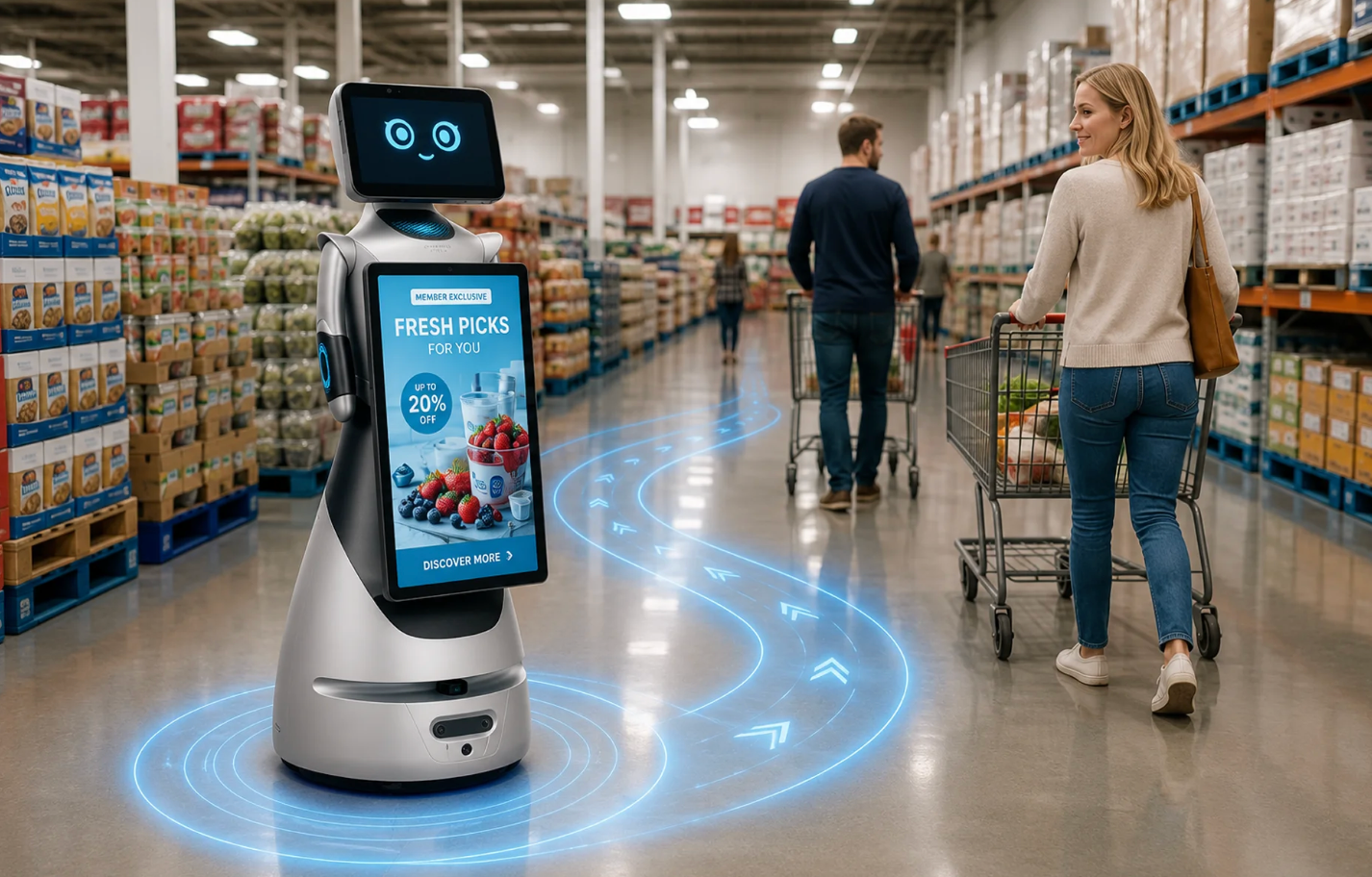
Physical retail stands at a critical inflection point across retail stores worldwide. Store operators face a structural squeeze between rising consumer expectations and persistent labor shortages. Therefore, traditional scaling through aggressive hiring is no longer viable. Shoppers demand highly personalized, seamless experiences around the clock. Meanwhile, the sector struggles with high turnover and mounting payroll expenses. As a result, the industry is shifting toward in-store digital touchpoints and automation. Technology maturity and favorable cost curves now make large-scale deployment feasible. The advertising robot has emerged as a practical, industry-level solution to these intersecting challenges. These platforms bridge the gap between digital marketing and physical presence. They handle proactive engagement and dynamic promotions without straining existing staff. Ultimately, they allow retailers to maintain high service standards while optimizing their operational footprint.
These pressures collectively point to a single conclusion—traditional operational models are increasingly unsustainable.
To address these complex operational pressures, the OrionStar GreetingBot series provides a differentiated, dual-model solution. This approach ensures reliable coverage across various retail store layouts. The GreetingBot AD functions as a high-end reception and engagement platform. It is particularly suited for spacious storefronts, flagship aisles, and brand showrooms. According to manufacturer data, it pairs a 14-inch head touch screen with a prominent 21.5-inch FHD chest display. This allows it to manage proactive greetings while simultaneously broadcasting dynamic promotions. Furthermore, its larger 20 Ah battery supports up to 8 to 10 hours of runtime for demanding retail shifts.
Conversely, the GreetingBot Mini targets tighter spaces like supermarket entrance zones and crowded retail aisles. It features a compact body with a minimum passable width of just 55 cm, according to manufacturer data. It maintains strong interaction capabilities through a 14-inch FHD screen and a 6-mic array boasting over 97% speech recognition accuracy in noisy environments. These two models do not compete; instead, they serve complementary roles. The larger AD model commands attention in open spaces, while the Mini navigates constrained layouts smoothly.
Moreover, both models support advanced digital management. Retail operators can utilize 4G and Wi-Fi 6 connectivity for remote deployment, cloud-based scheduling, and multi-robot coordination. Because these platforms utilize built-in cameras and sensors to interact with shoppers, operators must ensure data collection practices align with local regulations. Strict adherence to GDPR and data-minimization principles is necessary when deploying these visual and audio systems in regulated markets.
These results are not theoretical concepts; they are the realities that retail operators and store managers are already verifying in the field.
The introduction of automation into retail environments is not designed to replace human workers. Instead, it elevates the human role on the sales floor. Robots efficiently absorb repetitive, large-scale tasks such as continuous greeting, basic wayfinding, and mobile promotional broadcasting. As a result, human employees are freed to focus on high-judgment, high-value responsibilities. Store associates shift their attention toward complex customer service inquiries, quality supervision, and building genuine shopper relationships. This transition fosters a more collaborative working environment. Furthermore, this shift creates new operational roles within the retail space. Store managers and staff develop new skills in fleet management, digital content curation, and robotic performance monitoring. Early adopters report strong employee retention when robots are paired with human teams. By handling the monotonous aspects of retail operations, automation reduces daily physical strain. Above all, this collaborative model ensures that human empathy and human judgment remain central to the customer experience.
The physical retail landscape will continue to adapt to tight labor markets and high consumer expectations. The advertising robot is steadily transitioning from a novel attraction to essential operational infrastructure. By bridging the physical and digital realms, these platforms provide a reliable foundation for continuous in-store engagement. The OrionStar GreetingBot series offers multiple models to accommodate diverse spatial and operational requirements, allowing retail operators to explore solutions tailored to their specific layouts. Moving forward, the successful retail store will not be defined solely by headcount. Instead, success will rely on the intelligent distribution of labor between human expertise and automated consistency. This strategic integration of robotics will define the next phase of retail management.