

REQUEST DEMO
Robot CATALOG will be sent to your mailbox immediately after submission.
SUBMIT
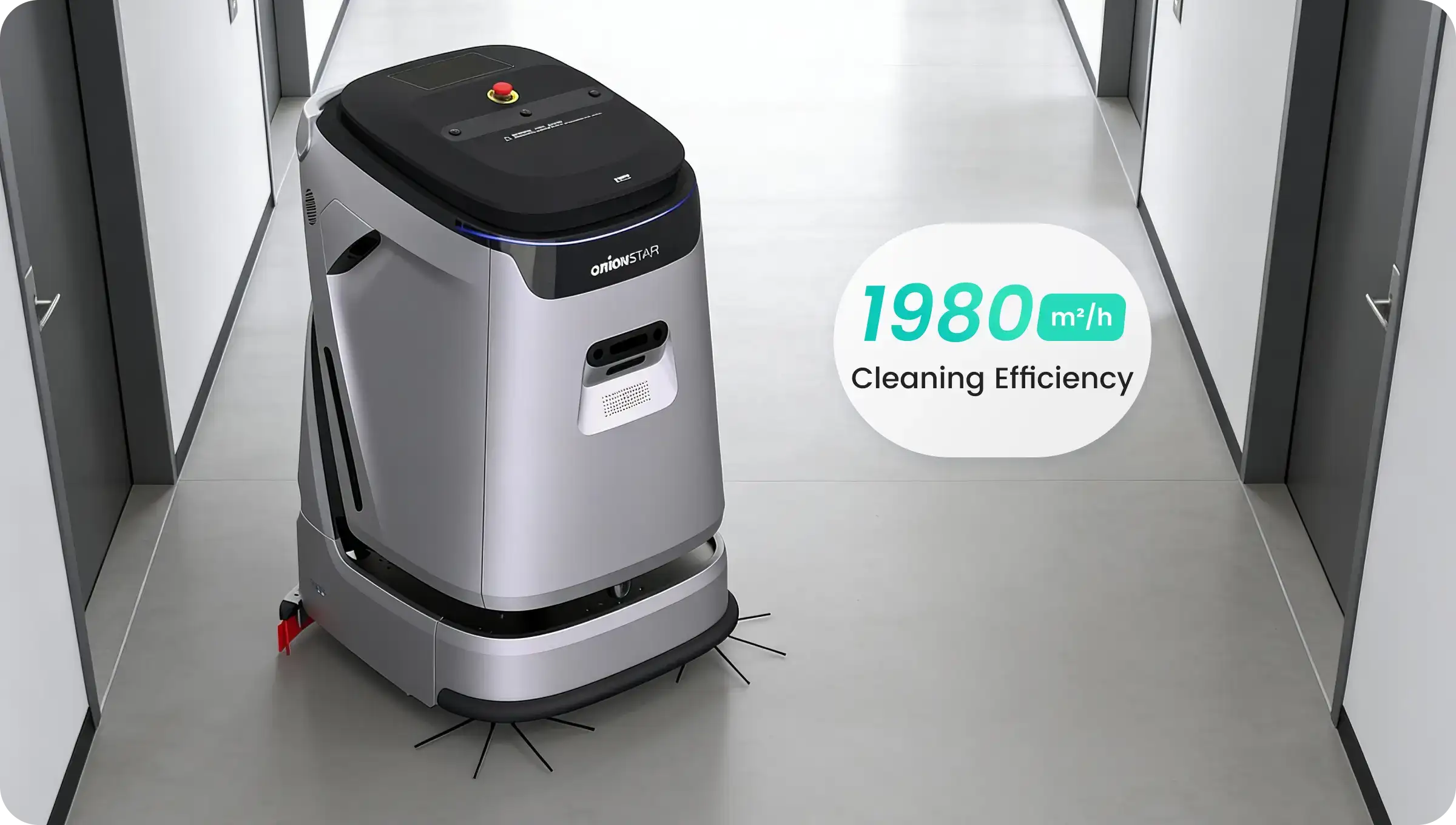
Facility Management in shopping malls currently faces unprecedented operational pressure driven by severe labor shortages, escalating overhead costs, and stringent compliance requirements. With janitorial turnover rates frequently exceeding 200% annually and the physical strain of maintaining massive retail footprints leading to high workers' compensation exposures, traditional manual cleaning methods are no longer sustainable for large venues. To address these compounding challenges, operators are increasingly turning to the automatic floor scrubber as a transformative solution that delivers consistent, scalable, and cost-effective floor care while alleviating the daily burden on human staff.
The OrionStar CleaniBot C5 exemplifies these autonomous capabilities by integrating high-capacity floor care into a heavy-duty industrial design. According to manufacturer data, the unit can manage a maximum cleaning area of up to 1,980 square meters per hour, utilizing a dual-rolling-brush system that applies 25 kg of downward pressure to remove stubborn grime in a single pass. To support continuous multi-shift operation, it features an automated workstation for self-cleaning, water refilling, and recharging, delivering a scrubbing runtime of about 3 hours per charge. Furthermore, its multi-sensor obstacle avoidance is complemented by a low operating noise level of less than 68 dB(A), allowing it to navigate safely and quietly through active retail environments without disrupting the shopping experience.
Food courts experience continuous, heavy foot traffic and frequent fresh spills that require immediate attention to maintain safety and hygiene. AI-powered robots can dynamically target these high-need zones, delivering immediate spot cleaning without requiring the entire seating area to be cleared of patrons.
The expansive corridors and multi-surface atriums of a modern shopping mall present a massive square-footage challenge for limited manual cleaning crews. Autonomous floor scrubbers excel in these environments, executing long, repetitive runs during low-traffic off-hours or safely navigating around shoppers during operating hours using advanced sensor suites.
Outdoor and semi-enclosed parking structures are notoriously difficult to maintain and often rely on loud, heavily polluting legacy equipment. Transitioning to battery-electric autonomous machines eliminates the fuel emissions and noise footprint associated with propane or diesel scrubbers, ensuring a cleaner approach to the facility's perimeter.
Anchor-store approaches and escalator landings serve as critical chokepoints where dirt and moisture are rapidly tracked across floors. Robots can be dynamically dispatched in response to occupancy sensor data, concentrating their scrubbing efforts exactly where foot traffic is heaviest to prevent slip hazards.
To maximize operational efficiency, an automatic floor scrubber can seamlessly integrate with a shopping mall's existing Building Management Systems (BMS) and Computerized Maintenance Management Systems (CMMS) through standard IoT connectivity. This integration enables the robots to coordinate their cleaning schedules around peak occupancy periods, HVAC system operations, and elevator availability, allowing them to autonomously traverse multiple floors without human intervention. Furthermore, real-time telemetry from the fleet feeds directly into central facility dashboards, facilitating demand-driven dispatching based on actual foot traffic and enabling predictive maintenance alerts before mechanical failures occur.
By generating auditable logs of resource consumption and validated cleaning performance, automated fleets provide the transparent metrics essential for supporting green building certifications and comprehensive ESG reporting.
The deployment of the automatic floor scrubber is fundamentally changing how Facility Management approaches the daily maintenance of shopping malls. By directly addressing chronic labor shortages, reducing operational costs, and providing verifiable environmental benefits, these autonomous systems are proving to be a highly practical infrastructure upgrade. For operations teams evaluating a transition to robotic floor care, the OrionStar CleaniBot series offers multiple configurations designed to adapt to the specific spatial, traffic, and hygiene demands of modern retail environments.
Data Privacy Notice: OrionStar automated floor scrubbers process environmental mapping and telemetry data strictly for navigation and operational reporting. Any on-device sensor data used for obstacle avoidance is processed locally in real-time without capturing or storing Personally Identifiable Information (PII). Cloud deployments comply with GDPR and local data privacy regulations, requiring explicit user consent for fleet management data uploads.