

REQUEST DEMO
Robot CATALOG will be sent to your mailbox immediately after submission.
SUBMIT
Environmental Services (EVS) teams operate under intense sustained pressure. With annual turnover in the janitorial sector routinely running between 40% and 75%, and the American Hospital Association projecting a critical shortage of 3.2 million U.S. healthcare workers by 2026, hospital operations teams are forced to do more with significantly fewer resources.
When EVS personnel are expected to fully disinfect a patient room in under 15 minutes, their focus must remain on terminal cleaning to prevent hospital-acquired infections. This often leaves high-traffic public areas under-resourced. Commercial cleaning robots offer a structural solution to this imbalance. By automating repetitive floor care in expansive public spaces, these autonomous platforms allow healthcare facility managers to reallocate scarce human labor to high-stakes, manual disinfection tasks.
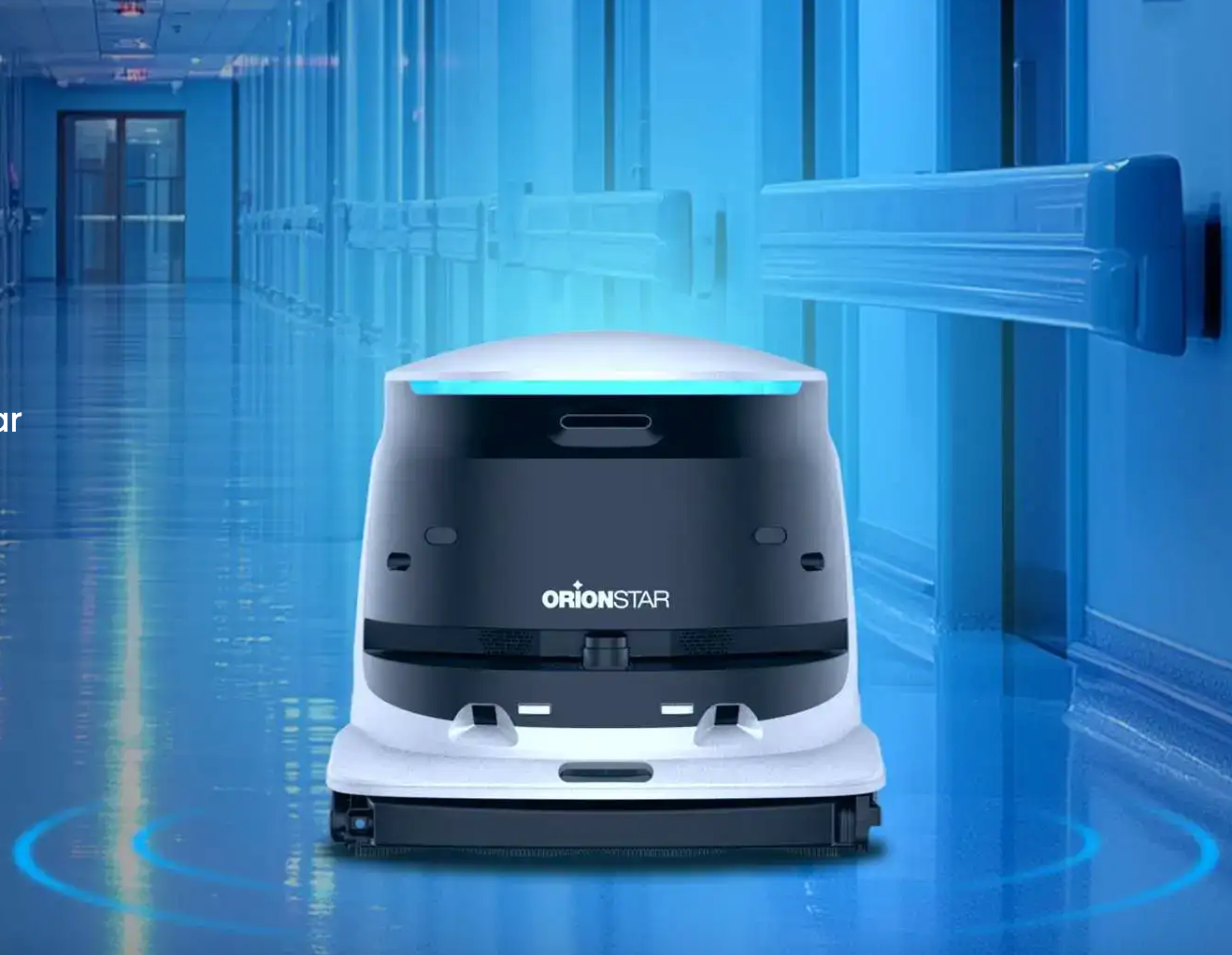
As a versatile solution within this category, the OrionStar CleaniBot S55 Pro is designed to manage large-scale floor maintenance. By aligning specific hardware capabilities with the distinct spatial requirements of clinical environments, it provides a measurable layer of operational support for strained EVS departments.
Healthcare facilities are not uniform; they are complex ecosystems with varying traffic patterns, floor types, and acoustic requirements. The CleaniBot S55 Pro adapts to these distinct zones without requiring manual tool changes.
First impressions in lobbies and reception areas directly influence patient perception, which research ties closely to HCAHPS scores and facility reimbursement rates. However, daytime cleaning in these areas is often restricted by noise concerns.
The CleaniBot S55 Pro features an ECO Vacuum mode and a Dust Mopping mode. According to manufacturer data, the robot operates at a noise level of just 45 dB during dust mopping, making it suitable for continuous daytime deployment in crowded waiting rooms without disrupting patient intake or administrative conversations. Furthermore, its runtime of up to 28 hours in Dust Mop mode allows for constant environmental maintenance across multiple shifts.
Long corridors and outpatient hallways represent the highest volume of cleanable square footage in a hospital, often requiring daily scrubbing to remove organic matter, spills, and debris.
In these transit arteries, the robot’s Scrubbing and Power Scrubbing modes deliver a maximum cleaning efficiency of up to 1,197 m²/h under typical configurations. By assigning the robot to autonomously navigate staff-only hallways and public corridors, EVS directors can ensure consistent floor hygiene without tying up a human worker behind a manual push-scrubber for hours.
While deep sanitization of public restrooms remains a manual task, the CleaniBot S55 Pro can integrate these areas into its broader hard-floor scrubbing routes. Its minimum passing width of 700 mm and multi-sensor navigation allow it to safely maneuver in and out of wider restroom entrances to maintain the primary floor space, complementing daily manual spot-cleaning.
The value of the CleaniBot S55 Pro lies in its ability to directly address the operational friction points identified in recent healthcare industry research.
With 83% of EVS staff reporting they must train new recruits on the job—sometimes in as little as three days—traditional cleaning equipment can become underutilized if training is too complex. The CleaniBot S55 Pro is engineered for practical, low-friction daily maintenance.
Navigating a healthcare facility requires navigating around moving gurneys, IV poles, patients with limited mobility, and unexpected temporary obstacles. The CleaniBot S55 Pro incorporates a 360-degree sensor array featuring LiDAR, stereo cameras, ultrasonic sensors, and line lasers.
Hospital operators increasingly expect cleaning equipment to fit into existing digital frameworks. The CleaniBot S55 Pro supports Wi-Fi and 4G connectivity, allowing EVS directors to remotely monitor battery states, track fault codes, and verify route adherence. This shifts floor care from an assumption to a documented metric, supporting internal compliance audits.
Note on Data Compliance: Because the CleaniBot S55 Pro utilizes cameras, LiDAR mapping, cloud-based telemetry, and supports Over-The-Air (OTA) updates, hospital operations teams must independently verify that their deployment architecture complies with HIPAA, GDPR, and applicable local data protection regulations, particularly regarding network security and data minimization.
Automating floor care is a highly effective structural approach to offset the structural undervaluation and shortage of EVS labor. By taking over the high-fatigue task of corridor scrubbing and lobby sweeping, the OrionStar CleaniBot S55 Pro allows human staff to focus on the intricate, high-touch disinfection protocols that directly prevent hospital-acquired conditions.
Because facility layouts and cleaning demands vary from rural clinics to multi-building hospital campuses, operations teams should evaluate their specific footprint. As part of the broader OrionStar CleaniBot series, which offers multiple models tailored to different environmental scales, the S55 Pro provides a flexible, high-capacity starting point for modernizing healthcare floor care.
Can the robot handle the transition between hard hospital corridors and carpeted waiting areas? Yes. The CleaniBot S55 Pro supports Sweep & Vacuum modes specifically suited for low-pile carpets common in reception areas, and it can automatically switch modes based on pre-programmed zones to accommodate mixed-surface environments.
How does the robot respond if a corridor is unexpectedly blocked by medical equipment? The robot utilizes ultrasonic sensors and LiDAR to detect unexpected obstacles. It will attempt to path-plan around the obstruction safely. If the minimum passing width (700 mm) is unavailable, it will record the exception and continue its route in accessible areas.
Does the robot require a dedicated water line for its station? The CleaniBot S55 Pro is equipped with a charging dock for auto-recharge, but the robot itself houses a 22 L clean water tank and a 15 L wastewater tank that require manual filling and emptying by EVS staff as part of their routine shift maintenance.