

REQUEST DEMO
Robot CATALOG will be sent to your mailbox immediately after submission.
SUBMIT
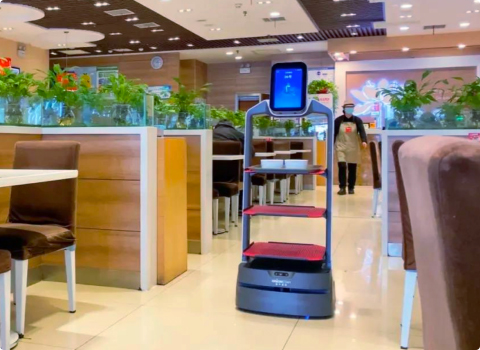
For cafeteria operators, contract catering managers, and food service directors, the ongoing labor shortage is no longer a temporary disruption; it is a structural reality. According to industry analyses, 70% of food service operators report having job openings that are difficult to fill, and the broader hospitality sector has experienced turnover rates of around 65%, with some food service segments historically peaking past 100%.
When cafeterias are understaffed, the operational friction is immediate. Ticket times increase, tables in the dining hall remain cluttered, and staff face mounting physical fatigue from hauling heavy trays back and forth. To maintain throughput and protect margins without overburdening their remaining teams, many operators are turning to automation.
This guide examines how the OrionStar LuckiBot Pro operates as a food delivery robot in institutional and corporate cafeteria environments, evaluating its hardware specifications against the practical realities of high-volume food service.
Deploying a serving robot successfully requires moving beyond the novelty of automation and integrating the unit into the facility's specific workflows. Cafeterias feature distinct sub-spaces, each with its own operational bottlenecks that the OrionStar LuckiBot Pro is designed to address:
Instead of operating as a traditional waiter robot that fully replaces human interaction, the OrionStar LuckiBot Pro functions as a high-capacity mobile logistics hub. Its specifications align with the heavy-duty requirements of cafeteria settings in several key areas.
In a busy contract catering environment, payload directly dictates efficiency. The LuckiBot Pro features a total payload capacity of up to 60 kg, a 50% improvement over the standard LuckiBot model, with a single-tray load limit of up to 15 kg. Equipped with three standard trays (adjustable up to four layers), the unit can carry the equivalent of multiple human armloads in a single trip. The trays measure 500 mm by 420 mm, accommodating standard cafeteria food trays and large bus tubs.
Cafeteria dining halls are dynamic, obstacle-dense environments populated by moving chairs, dropped utensils, and guests with varying mobility needs. The LuckiBot Pro utilizes visual SLAM (Simultaneous Localization and Mapping) combined with a 240-degree 3D all-around obstacle recognition system. According to manufacturer data, its sensor suite includes a LiDAR unit, three RGBD depth vision sensors, a fisheye camera, and an infrared camera. This allows for rapid response to tiny obstacles, ensuring safe navigation around the serving line and wheelchair-accessible pathways.
Institutional flooring often features transition strips, textured tiles, or slight ramps. The LuckiBot Pro incorporates a quasi-circular chassis design and an advanced Torsion Bar Suspension system. Under defined test conditions, this setup adapts to complex ground environments, minimizing the vibration that leads to spills and reducing the tip-over risk when fully loaded with 60 kg of dishware.
A robot is only useful if it can survive a full shift. The LuckiBot Pro supports a cruising time of up to 12 hours on a single charge under typical cruising conditions. It requires approximately 4.5 hours for a full charge and supports both an automatic charging dock and manual cable charging, allowing it to recharge overnight and remain active throughout breakfast and lunch service peaks.
Field deployments of food delivery robots in cafeteria-style and institutional dining settings demonstrate measurable operational benefits. Documented case studies in senior living facilities—environments that closely mirror corporate and hospital cafeterias in their service cadence—show that automated units can take on up to 91 hours of transport work per week, effectively assuming the transit workload of two part-time aides.
Consolidated metrics from real-world food service deployments indicate:
Modern cafeteria managers expect hardware to integrate into their broader digital ecosystems. The LuckiBot Pro runs on a deeply customized RobotOS (based on Android 9) and features an open SDK with hundreds of API interfaces. This allows IT teams to integrate the robot with existing kitchen display systems (KDS) or fleet management software over 4G or Wi-Fi (2.4 GHz / 5 GHz) networks.
However, the deployment of sensor-rich devices in semi-public spaces like university or corporate cafeterias carries strict regulatory obligations. Because the LuckiBot Pro utilizes cameras and LiDAR for navigation, it captures environmental data that may incidentally include identifiable individuals. Operators in the EU/EEA, or those serving European clients, must verify that their deployment complies with the General Data Protection Regulation (GDPR). Facilities must establish clear policies regarding data minimization, local processing versus cloud storage, retention periods, and required signage. Consulting with legal counsel on local data privacy and employee consultation laws is a necessary step before activating any autonomous visual mapping systems on site.
The OrionStar LuckiBot Pro represents the heavy-duty, highly interactive tier of the manufacturer's lineup, highlighted by its 14-inch 1080P full HD display (which offers a 92% larger viewable area than the standard model for digital signage and guest interaction). However, no single machine fits every facility layout. The broader OrionStar LuckiBot series includes multiple models to accommodate different footprint constraints, aisle widths, and budget requirements, allowing operators to scale their robotic fleets according to the specific spatial realities of their venues.
How does the robot handle noise in a busy cafeteria? The LuckiBot Pro is equipped with a 6-microphone array designed for voice-triggered guidance and interaction. According to manufacturer specifications, it maintains an AI voice recognition accuracy of up to 97% in environmental noise levels up to 75 dB, allowing it to function effectively during peak lunch rushes.
Can the robot's trays be adjusted for different tasks? Yes. The three standard trays can be repositioned or expanded to four layers. They can also be entirely disassembled and modified for alternative heavy-duty carrying requirements, making it easy to switch from delivering plated meals to hauling bulk beverage containers.
How is the robot updated and maintained? The robot supports Over-The-Air (OTA) updates for navigation and behavior patches. Additionally, the modular hardware interfaces and Android-based architecture allow facility IT teams to manage system diagnostics remotely. Operators should ensure that any network connection used for OTA updates complies with their organization's cybersecurity and data protection standards.
*Privacy Notice: The LuckiBot Pro processes environmental mapping data locally. Any incidental personal data captured via sensors is not stored long-term or uploaded to the cloud without explicit opt-in. Operators are responsible for complying with local CCTV/surveillance signage regulations.