

REQUEST DEMO
Robot CATALOG will be sent to your mailbox immediately after submission.
SUBMIT
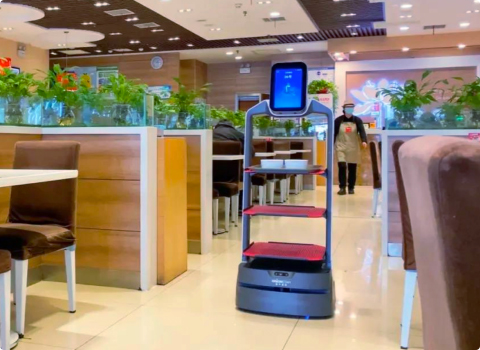
The diner industry is currently at a critical inflection point across operating venues. Post-pandemic demographic shifts and a permanently altered labor pool have severely strained traditional service models. Simultaneously, guests now expect faster, more consistent service times and often prefer reduced human contact during routine transactions. Therefore, operators must adapt to these compounding realities. The technology cost curve has flattened recently, making advanced automation accessible to independent operators and regional chains alike. Moreover, navigational technology has matured enough to handle the tight, dynamic layouts typical of these high-volume spaces. As a result, operators are adopting the food delivery robot as an industry-level solution. Rather than a novelty, this technology provides a reliable mechanism to bridge the gap between fixed labor constraints and rising customer expectations. In short, automation is shifting from an experimental concept to a necessary operational baseline for sustained profitability.
These pressures collectively point to a single conclusion—the traditional operational model is no longer sustainable.
The OrionStar LuckiBot series provides a differentiated, dual-model solution tailored for varied service layouts. Therefore, it addresses specific operational bottlenecks across different functional zones. The standard LuckiBot excels in navigating the primary dining floor and managing consistent traffic from the kitchen pass. According to manufacturer data, it handles payloads up to 40 kg and can complete up to 400 deliveries per day. This continuous throughput makes it highly effective for routine plate running and basic table bussing in standard aisle widths.
Conversely, the LuckiBot Pro manages heavier demands near the high-traffic pickup window, tight booths, and the diner counter. Featuring an increased payload of up to 60 kg and 240-degree 3D obstacle recognition according to manufacturer data, it safely navigates highly congested pathways and uneven floors. Importantly, these two models follow a complementary logic. Instead of one being universally better, they operate collaboratively to cover different spatial and payload requirements within the same venue. A busy diner might deploy the standard model for continuous table runs while utilizing the Pro model for heavy-duty tray clearing near tight booths.
Moreover, the series integrates robust digital management capabilities. Diner operators can leverage built-in cloud platforms for remote fleet deployment, monitor detailed data reports, and manage multi-robot cooperation seamlessly over 4G or Wi-Fi networks. Because these systems rely on advanced depth cameras and visual SLAM sensors to navigate public spaces, operators must act prudently regarding privacy. European operators, in particular, should proactively verify GDPR compliance with the vendor, specifically confirming data retention policies and sensor processing limits before deployment.
These results are not theoretical; they are the reality that diner operators, F&B managers, and front-of-house service staff are already validating.
Automation in diners is not designed to replace human staff, but rather to elevate their core functions. When robots take over repetitive, large-scale tasks like plate running and bussing dirty dishes, the division of labor fundamentally shifts. Consequently, human staff can transition toward higher-value responsibilities. Waitstaff spend less time walking back and forth to the kitchen and more time actively engaging with guests. They focus on quality supervision, order taking, menu recommendations, and handling complex customer service interactions.
Furthermore, this technological shift creates entirely new operational roles and skill sets. Large-scale deployments have introduced roles like dedicated robot instructors, who manage fleet integration and on-site troubleshooting. F&B managers are also adapting, learning to monitor automated fleet performance as a recurring operational skill. Instead of eliminating headcount, operators are redeploying labor to cover chronic shift gaps and reduce physical strain. Ultimately, this collaborative model improves workplace conditions and helps staff feel supported during their most demanding service hours.
The food delivery robot is rapidly transitioning from an operational experiment to foundational infrastructure within the diner industry. As labor markets remain tight and operational costs climb, automation provides a vital stabilizing force. The OrionStar LuckiBot series, offering multiple models to suit different spatial and capacity needs, exemplifies how these tools adapt to specific venue layouts. By matching the right robotic configuration to the right task, operators can seamlessly bridge the gap between kitchen and table. Moving forward, the most successful dining establishments will be those that integrate physical automation as a standard utility. Therefore, embracing this technology is no longer just an option for efficiency; it is an emerging prerequisite for long-term commercial viability in food service.