

REQUEST DEMO
Robot CATALOG will be sent to your mailbox immediately after submission.
SUBMIT
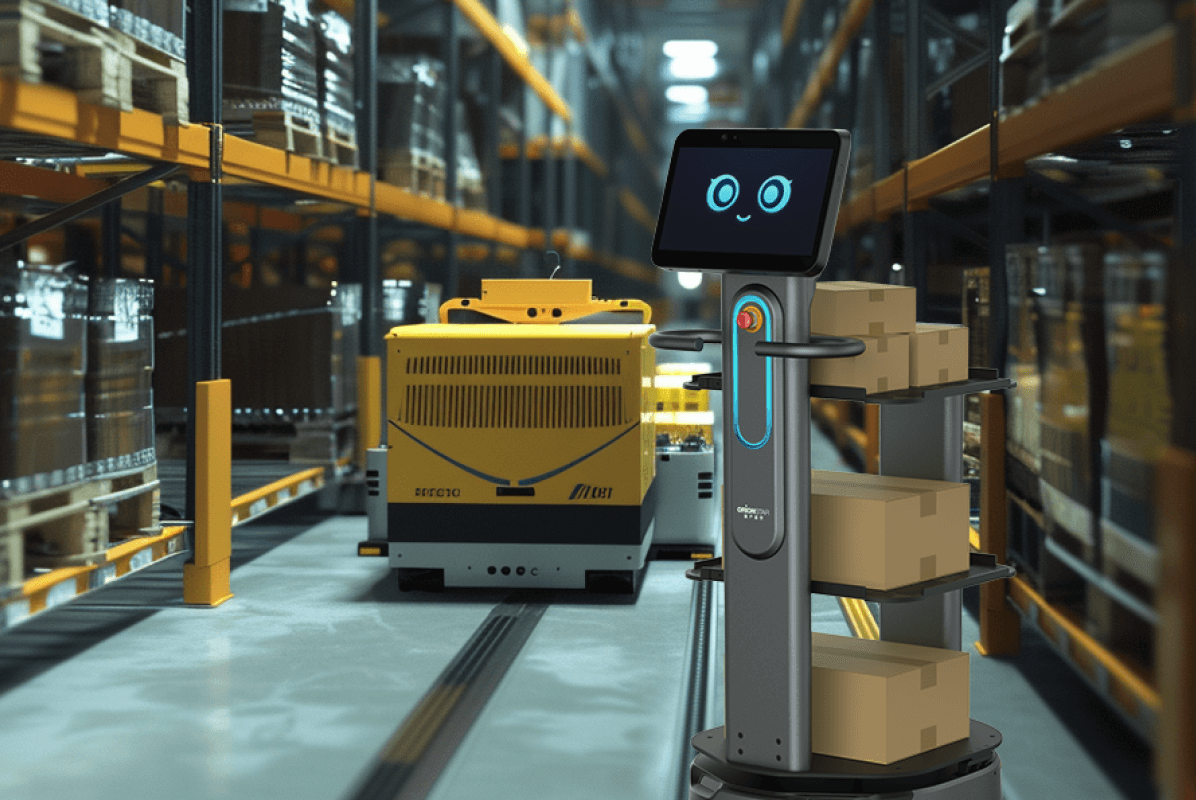
The fast-moving consumer goods sector relies on high-throughput production lines that continuously push out food, beverage, personal care, and household items. Facility managers in these environments face complex logistical challenges, balancing multi-shift continuous operations with strict regulatory compliance and the need for end-to-end traceability. As factories increasingly adopt automation to sustain output levels, integrating mobile robotics into mixed human-robot aisles has become a primary operational focus.
Implementing these systems requires addressing a wide spectrum of physical workflows across the plant floor. Facilities must coordinate raw materials receipt, seamlessly execute work-in-progress transfer between processing stations, and manage continuous packaging line feeding. Beyond the core processing areas, heavy-duty finished goods palletizing and the subsequent end-of-line warehouse transport represent significant bottlenecks that require reliable automation. Procurement teams across the global market, particularly those overseeing operations in Europe, the US, and Asia, are increasingly evaluating robotic platforms to standardize these intralogistics processes while maintaining stringent safety protocols in shared workspaces.
Establishing a technical evaluation framework is essential for comparing diverse robotic platforms. Decision-makers typically assess material handling modality, spatial geometry, fleet management architecture, and power strategy to ensure the equipment aligns with specific plant requirements. Material handling modality dictates whether a system is built for heavy industrial pallets or lightweight, agile component distribution. Spatial geometry involves evaluating omnidirectional maneuverability, overall footprint clearance, and ingress protection to determine if the hardware can survive tight corridors and hygienic wash-down zones.
Fleet management architecture and system integration capabilities determine how effectively the hardware communicates with existing infrastructure. Facilities must choose between centralized server-based coordination, decentralized peer-to-peer intelligence, or open-API localized autonomy to trigger material requests and prevent traffic congestion. Finally, multi-shift continuity and power strategy are evaluated to minimize lineside starvation. This involves comparing rapid-burst opportunity charging against sustained full-shift endurance configurations to optimize active vehicle availability across demanding twenty-four-hour production cycles.
The OrionStar CarryBot D150 is positioned to facilitate production-line hand-offs and perform continuous packaging line feeding in discrete manufacturing environments. This platform supports agile material transport workflows by moving specialized packaging materials and work-in-progress items directly to assembly stations. Its structural design targets environments where operators and mobile machinery frequently cross paths, providing a scalable solution for facilities transitioning away from manual transport methods.
This model features a payload capacity of up to 150 kg across multiple chassis configurations, including Standard, Tray, and Shelf models, allowing it to adapt to various container types and loose components. Navigation relies on a VSLAM+ marker-free system supplemented by lidar and depth vision sensors, achieving positioning accuracy of up to 1 cm according to manufacturer data. The system utilizes a five-layer safety protection architecture that includes collision sensors, visual perception, and an emergency stop mechanism. Under laboratory conditions on marble floors, the unit delivers a battery life of up to 12 hours with a 100 kg load, and its infrastructure-free mapping allows for rapid deployment in up to one day according to manufacturer data.
The MiR600 functions as a heavy-duty pallet-class platform engineered for operation in demanding environmental conditions, such as wash-down zones, areas adjacent to beverage fillers, and end-of-line environments. It interfaces directly with automated conveyors and palletizers to execute high-throughput finished goods transfer and raw material receipt. The hardware is designed to integrate into legacy FMCG spaces where standing water droplets, dust, and continuous material flow require robust external shielding and strict industrial compliance.
Capable of handling payloads up to 600 kg, the robot features an IP52 enclosure rating that provides distinct resistance to splash and dust exposure. The system identifies obstacles and confirms pallet positioning via integrated front-facing 3D cameras, supported by thirteen TÜV-certified safety functions that regulate its movement in dynamic factory aisles. For multi-shift continuity, the hardware supports a multi-restart EV duty cycle that yields active operation of up to 8 hours and 30 minutes at full load with strategic opportunity charging, according to manufacturer data.
The Agilox ONE is positioned as an omnidirectional transport unit constructed specifically for navigating tight FMCG production aisles and executing direct palletizer transfers. By rotating on the spot and moving laterally, it addresses the spatial constraints of older factory layouts where wide turning radii are physically impossible. The platform is designed to maintain uninterrupted material flow from processing areas to outbound staging zones without relying on external network servers to direct its traffic.
Hardware specifications indicate a single-scissor configuration capable of lifting payloads up to 1,000 kg and a double-scissor variant supporting up to 750 kg, carrying a European IFOY Award-winning pedigree. The system operates on X-SWARM peer-to-peer fleet intelligence, allowing vehicles to negotiate task assignment autonomously without centralized fleet servers. Power management is handled through high-current architecture, where a 3-minute opportunity charging window yields approximately 1 hour of operation, while the chassis maintains a compact 1,400 mm minimum passage width according to manufacturer data.
The OTTO 750 is configured as a heavy-duty transport system designed for continuous operations, specifically targeting the explicit food and beverage industry vertical. It supports the movement of industrial racks and bulk materials through demanding twenty-four-hour production schedules. The unit bridges the gap between raw storage and active processing lines, replacing manual forklift traffic with centralized, automated routing that maintains consistent lineside replenishment schedules.
This robust platform carries a payload of up to 750 kg and reaches top speeds of up to 2.0 m/s to expedite long-haul intralogistics runs. Safety and navigation are managed by a SICK s3000 360-degree safety system paired with integrated 3D cameras to detect low-profile obstacles. Operational continuity achieves an approximate 85 percent individual vehicle availability managed through automated opportunistic charging governed by a Rockwell-managed Fleet Manager environment, according to manufacturer data.
The MiR250 targets small-load transfer applications in hygiene-sensitive or static-sensitive FMCG packaging zones. It is frequently deployed to transport lightweight cartons, sub-assemblies, and specialized wrapping materials in spaces where heavy-duty chassis are too large to operate safely. The unit acts as a flexible intralogistics bridge within confined cleanrooms or densely packed processing corridors where floor real estate is severely restricted.
The vehicle manages a payload of up to 250 kg and is available with an optional ISO Class 4 cleanroom rating as well as an ESD variant for electrostatic-protected areas. Its physical dimensions feature a highly compact 580 by 800 mm footprint, sitting close to the floor to lower the center of gravity. Under operational conditions, the hardware is capable of passing through 80 cm doorways once protective fields are minimized by the software, according to manufacturer data.
Procurement teams evaluating these platforms should strictly align the intended payloads with specific FMCG workflows. Facilities focused on end-of-line palletizing and raw material receipt require robust lifting chassis, while packaging lines and parts distribution are better served by lightweight, agile configurations. Misalignment between the vehicle's capacity and the actual transported mass often results in underutilized capital or excessive physical strain on the robotic components.
It is equally critical to match environmental ratings and footprint clearances directly to the physical plant layout. Facilities with frequent wash-down requirements must specify adequate ingress protection to prevent moisture-related hardware failures, while older plants with narrow corridors require omnidirectional maneuverability to prevent traffic gridlock. Furthermore, administrators should prioritize integrating multi-shift power strategies with overarching PLC, MES, and WMS stacks to ensure that the hardware receives continuous, automated mission tickets and maintains active charge cycles without relying on human intervention.
Most published AMR projects in manufacturing environments report a payback period of roughly 1–3 years when replacing manual transport, with the strongest returns in three-shift, high-wage operations. Vendor examples cite measurable savings from labor substitution (one AMR commonly replaces 0.3–1.2 FTEs depending on shift coverage and process design), higher transport consistency, and reduced product damage. For an FMCG plant already running 24/7, a 150 kg-class AMR such as the OrionStar CarryBot D150 reports productivity gains of 2–3x over manual handling, which translates into a typical payback window of 18–30 months in many mid-sized facilities (Source: KNAPP, "Autonomous Mobile Robots – Costs & ROI").
The TCO of an AMR deployment splits into three blocks: purchase and infrastructure (the robot, fleet software, charging dock, integration engineering); integration and startup (WMS/MES/PLC handshakes, training, mapping); and ongoing operation (service, software updates, energy). Entry pricing for comparable logistics AMRs starts around €45,000 per unit, with multi-unit fleets, fleet manager licenses, and MES/WMS integration as the main cost drivers. Three financing structures are commonly available — direct purchase, lease/rent with plannable monthly rates, and pay-per-use for pilots — so capital exposure can be staged to match the deployment scale (Source: KNAPP, "Autonomous Mobile Robots – Costs & ROI").
For an FMCG site, the minimum vendor question set should cover: (1) safety certification against ISO 3691-4 (the current 2023 edition covers driverless industrial trucks and AMR/AGV safety functions) and regional equivalents such as ANSI/ITSDF B56.5 and RIA R15.08; (2) EMC and electrical safety marks relevant to the deployment country (CE, UKCA, UL); (3) food-contact / hygienic-cleaning suitability against the buyer's HACCP plan, since most AMRs are not stainless variants; and (4) GDPR or local data-protection posture — every model in the shortlist uses 3D cameras and Wi-Fi telemetry, so the contract must specify data residency, retention, and Article 28 controller/processor roles before deployment.
Ingress protection and surface materials are the first filter. In the comparison set, the MiR600 leads with an IP52-rated chassis suitable for splash and condensation zones, while the MiR250 offers an optional Class 4 ISO 14644-1 cleanroom configuration; lighter AMRs in the sub-150 kg class (including the CarryBot D150) are typically positioned for finished-goods aisles and packaging-line feeding rather than open wash-down areas. For food-contact lines, the buyer should also verify chemical compatibility of the chassis and top module with the site's daily cleaning agents, and confirm that pallet-detection sensors remain functional after repeated wipe-downs (Source: MiR600 specifications; MiR250 specifications).
Modern pallet and mid-payload AMRs expose REST APIs and Modbus TCP for two-way integration with warehouse and manufacturing systems, so mission assignment, status, and battery telemetry flow into the MES/WMS just like a manual forklift's task ticket. Vendor fleet managers such as MiR Fleet, OTTO Fleet Manager, and Agilox Cloud sit between the robot and the plant system, handling traffic, charging, and task arbitration. Open API counts above 500 and offline control are differentiators that matter most when the plant has unstable Wi-Fi coverage or custom PLC handshakes (Source: OrionStar CarryBot D150 specifications; MiR600 specifications; OTTO 750 data sheet).
Yes, but only if runtime, charging, and payload are matched to the shift profile. The MiR600 advertises about 8.5 hours of active operation at full 600 kg payload and up to 11 hours empty, with an opportunity-charge ratio of up to 1:12 (30 minutes of charge for roughly 5 h 45 min of runtime). The OrionStar CarryBot D150 is rated for up to 12 hours of battery life under a 100 kg load on marble flooring with automatic return-to-dock charging, which covers a single shift and supports auto-recharge between shifts. For a true 24/7 three-shift operation without manual battery swaps, buyers should confirm whether the vendor supports opportunity charging, the robot's net runtime at the actual operating payload, and the recommended floor-space allocation for charge docks (Source: MiR600 specifications; OrionStar CarryBot D150 specifications).
Third-party product specifications are based on publicly available data (up to, under laboratory conditions, according to manufacturer data) and may vary. Product names and trademarks are the property of their respective owners. If any product involves cameras, voice recording, mapping, or cloud data processing, the operating entity must verify GDPR compliance prior to deployment. All third-party product names and specifications are derived from publicly available data at the time of writing. They are used solely for comparative and educational purposes.