

REQUEST DEMO
Robot CATALOG will be sent to your mailbox immediately after submission.
SUBMIT
For retail facility managers, shopping centre operations managers, and contract cleaning providers, maintaining a high standard of cleanliness is a daily operational hurdle. Retail centers operate with long hours, high footfall, and a complex mix of anchor tenants, specialty retailers, and food-and-beverage operators.
Behind the visible demand for pristine floors lies a structural labor challenge. The commercial cleaning industry currently faces roughly $1 billion in annual losses directly attributed to turnover and unfillable vacancies. With janitorial turnover rates frequently exceeding 200 percent annually, managers are often forced to replace their entire workforce more than twice a year.
To bridge this gap, commercial cleaning robots are increasingly deployed to automate repetitive floor care. This guide evaluates how the OrionStar CleaniBot C5 aligns with the specific environmental and operational demands of a retail center, helping decision-makers determine its viability for their portfolios.
When staffing levels drop, facility supervisors often fall back on fixed patrols. This leads to the "Ghost Cleaning" pattern: a janitor might spend two minutes checking a restroom or service corridor that requires no immediate attention. Repeated across 30 locations per shift, this creates a full hour of lost productivity per worker—a waste that becomes critical when operating with reduced headcount.
Furthermore, high workloads combined with low retention often result in "pencil whipping," where cleaning logs are marked complete without the work actually being done. This erodes cleaning consistency across highly visible areas like entrance atriums and main concourses, directly threatening the retail center's brand reputation and tenant satisfaction.
By automating wide-area floor care, commercial cleaning robots provide a predictable baseline of cleanliness, allowing human staff to be redeployed to high-touch, detail-oriented tasks.
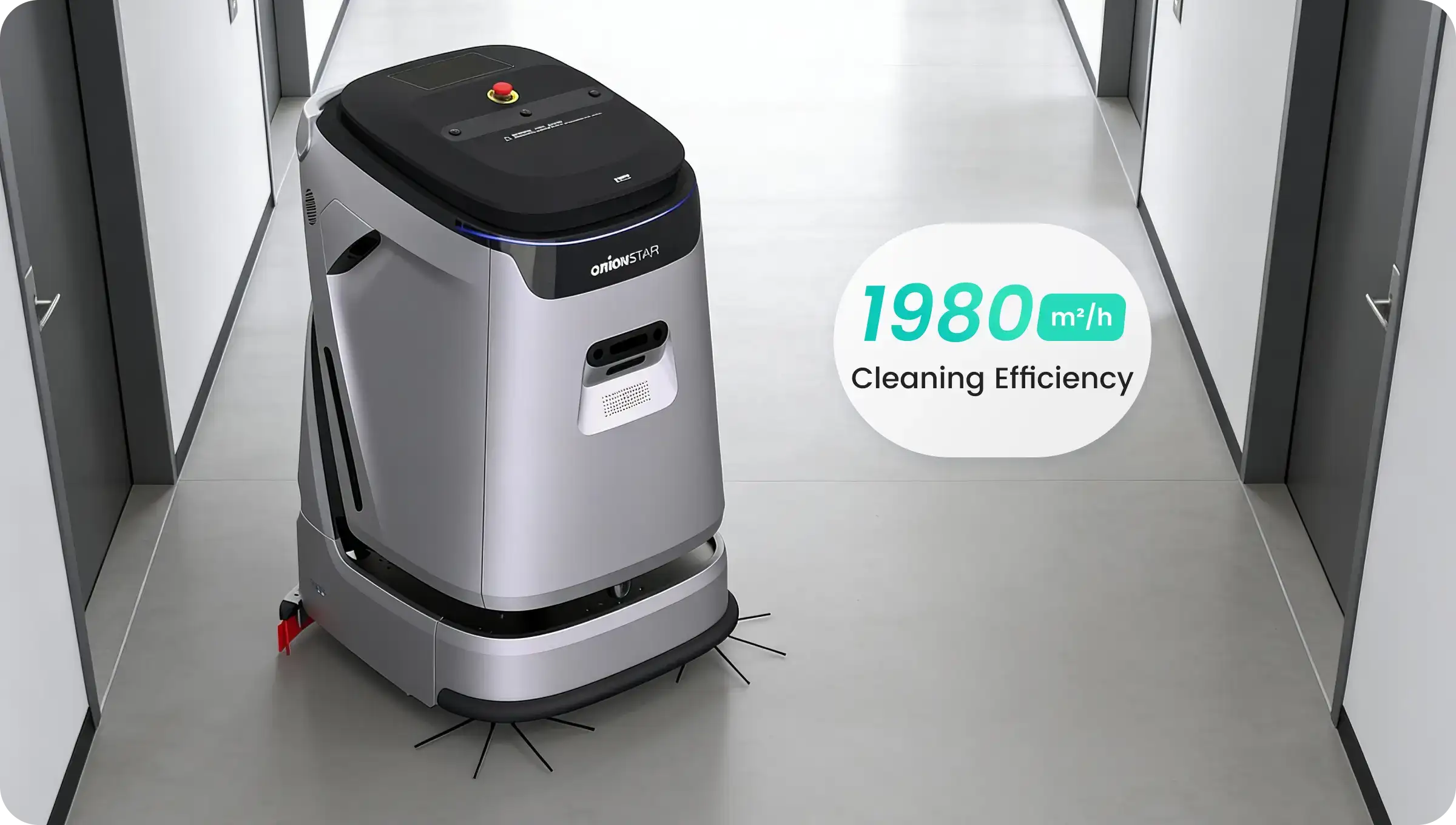
The OrionStar CleaniBot C5 is an industrial-grade autonomous floor-scrubber designed to handle the scale and variable soil levels found in large commercial environments. Its specifications address several distinct retail center sub-spaces:
Entrance Atriums and Main Concourses These sprawling, high-traffic zones require consistent, daily coverage. The OrionStar CleaniBot C5 features a 550 mm main brush and delivers a maximum cleaning area capacity of up to 1,980 m² per hour. To minimize downtime during shifts, it is equipped with a combined 90 L water-tank system (45 L clean water and 45 L waste water). Its battery supports a scrubbing runtime of about 3 hours and a mopping runtime of up to 8 hours under typical configuration, allowing it to cover vast concourses efficiently.
Food Courts and Back-of-House Service Corridors Food courts and service corridors are prone to heavy spills, grease, and stubborn stains. To address this, the C5 utilizes a dual-rolling-brush system that applies up to 25 kg of downward scrubbing pressure. This enables the one-pass removal of heavy oil and grime, achieving a reported dirt-cleaning rate of about 95% according to manufacturer data. It can also pick up solid debris up to about 3 cm in height, storing it in a 1.8 L dust bin, which is highly practical for back-of-house logistics corridors where packaging debris is common.
Redeploying Staff to Restrooms While the robot handles the repetitive scrubbing of wide-open concourses and corridors, shopping centre operations managers can redirect their scarce human workforce to where manual dexterity is indispensable: restrooms. This division of labor eliminates the inefficiency of ghost cleaning and ensures that complex, hygienic sub-spaces receive the necessary human attention.
A common pitfall with automated equipment is that staff spend more time maintaining the machine than it saves them in cleaning. The OrionStar CleaniBot C5 mitigates this through its fully autonomous workstation.
Once deployed, the robot automatically docks at its station for clean-water refilling, waste-water discharge, and battery charging (requiring around 1.5 hours for a fast charge). Crucially for odor control in enclosed retail spaces, the workstation performs high-pressure internal tank rinsing, allowing the waste-water tank to self-clean in roughly 4 minutes.
For operation during trading hours, the robot maintains a noise level of less than 68 dB(A), reducing disturbance to shoppers. It features a minimal passing width of approximately 880 mm, allowing it to navigate through standard doorways and typical service corridors, and utilizes a smart obstacle-avoidance system to operate safely around pedestrians and mall kiosks.
Enterprise retail buyers require documented proof of service to demonstrate SOP compliance to brand partners and to combat the risk of pencil-whipped logs. Autonomous cleaning platforms replace manual logs with cloud-based dashboards that track coverage, routes run, and operational runtime. The C5 can map areas of up to 10,000 m² and plan optimal cleaning paths.
Important Legal and Compliance Notice: Because the OrionStar CleaniBot C5 utilizes multiple sensors for navigation, mapping, and smart obstacle avoidance, and transmits operational telemetry to management dashboards, retail center operators and contract cleaning providers must thoroughly verify compliance with the GDPR and any applicable local data protection laws. Procurement teams should consult with the vendor regarding data residency, role-based access controls, and whether visual data is processed locally or in the cloud to ensure all data-security expectations are met.
Different architectural layouts demand different form factors. While the C5 is engineered for medium-to-large environments requiring heavy-duty scrubbing, the broader OrionStar CleaniBot series includes various models designed to meet the specific spatial and operational constraints of different facilities, enabling operators to standardize their robotics program across a diverse retail portfolio.
Does deploying the workstation require extensive building plumbing modifications? According to manufacturer specifications, flexible deployment is supported via optional mobile water tanks, meaning that extensive plumbing modifications to the retail center's existing infrastructure are not strictly required for setup.
Can the robot transition between different floor levels or handle uneven surfaces? The OrionStar CleaniBot C5 is designed with a maximum operating speed of about 1.2 m/s and has the ability to climb obstacles up to 15 mm. It can also manage slopes up to 5° when loaded and 8° when unloaded, allowing it to navigate minor architectural transitions on a single floor. Movement between different floors would still require human intervention or elevator integration.
Will the robot operate effectively if the retail center changes its kiosk layouts frequently? Yes. The robot utilizes "Cloud Learning"-style optimization to map and adapt to its environment. Its multiple sensors and smart obstacle-avoidance system allow it to navigate safely around temporary pop-up shops, seasonal decorations, and shifting crowd patterns.