

REQUEST DEMO
Robot CATALOG will be sent to your mailbox immediately after submission.
SUBMIT
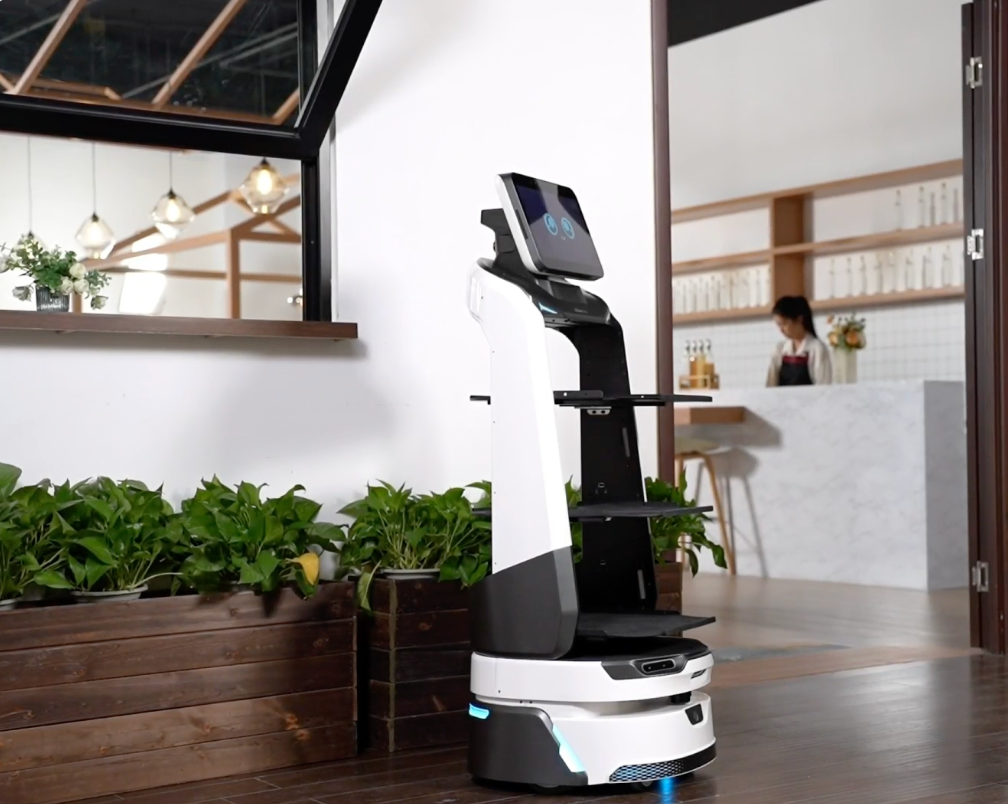
Full service restaurant operators face a structural labor challenge: median labor costs have reached 36.5% of sales, while the accommodation and food services sector maintains an elevated 7.2% job openings rate. With an estimated 1.5 million unfilled positions across the global hospitality sector, general managers and owners are evaluating automated solutions to sustain service levels.
Unlike quick service formats, full service environments rely heavily on human interaction and complex table pacing. Waitstaff log miles of walking per shift between kitchen expediting lines and dining room seating areas. This product guide examines how the [OrionStar LuckiBot Pro](https://en.orionstar.com/lucki-pro.html) operates as a food delivery robot to alleviate these specific physical workflows, allowing front-of-house staff to focus on guest experience and revenue-generating interactions.
A primary operational bottleneck in full service layouts is the repetitive kitchen run. Transporting heavy multi-course meals, multiple beverage orders, and clearing tables physically strains staff and pulls them away from the dining floor.
The OrionStar LuckiBot Pro addresses this by functioning as an autonomous runner. According to manufacturer data, the unit supports an up to 60 kg total payload, accommodating up to 15 kg on each of its three standard trays (adjustable up to four layers). This capacity allows the serving robot to transport multiple orders simultaneously from the kitchen to strategically placed server stations. Staff can then perform the final table handoff, preserving the human element of hospitality while eliminating the long-distance walking.
For specialized menu items, the unit includes a Soup Delivery Mode designed for stable, low-vibration transport. This is highly relevant when moving liquids across long distances, such as from the kitchen to private dining rooms or distinct bar and lounge sections, reducing the risk of spills and lost product.
Full service restaurants present dynamic, unpredictable environments. Unbooked large table settings, guests moving near the host stand, and dropped items require precise environmental perception.
The OrionStar LuckiBot Pro utilizes visual SLAM mapping paired with a sensor array that includes one LiDAR sensor, three RGBD depth vision sensors, a fisheye camera, and an infrared camera. Under typical configurations, this hardware provides 240-degree 3D all-around obstacle recognition, enabling the unit to calculate optimal paths and respond to small obstacles safely.
Floor transitions are another common friction point. The unit features a quasi-circular chassis and a Torsion Bar Suspension system designed to adapt to uneven ground. This hardware setup aids passability in tight aisles and assists with stability when the robot transitions from indoor flooring to outdoor patios.
Industry deployments of autonomous delivery solutions point to measurable operational returns. Benchmark case studies replacing manual kitchen-to-floor running tasks with robotic assistance have recorded up to an 80% ROI over a three-year period, with total labor-cost savings reaching approximately $60,000 for specific venues. Furthermore, operators report that expediting food delivery and table clearing contributes to a 15–20% increase in table turnover rates.
To support full-shift operations, the OrionStar LuckiBot Pro delivers up to 12 hours of cruising time on a single charge under defined test conditions, with a 4.5-hour recharge cycle via an automatic charging dock or cable. For venues evaluating automated deployments, the broader OrionStar LuckiBot series provides multiple models to align with varying floor plan scales and payload requirements.
Modern restaurant operators require integration with existing IT infrastructure. The OrionStar LuckiBot Pro operates on a deep-customized RobotOS (based on Android 9) and features an open SDK with hundreds of APIs. This modular architecture allows system integrators to tie the robot's dispatch commands directly to point-of-sale or kitchen display systems, facilitating automated order-to-table workflows.
Deploying a restaurant robot with camera and voice capabilities also requires strict attention to data privacy, particularly in European markets governed by GDPR. While LiDAR navigation relies on spatial data that typically avoids capturing personal identifiers, the unit's RGBD cameras, 6-microphone array, and cloud-based remote monitoring functions process environmental data. FSR operators must independently verify applicable local data protection laws, establish clear data-processing agreements with vendors, define retention windows for any voice or video capture, and ensure their deployment respects guest and employee privacy rights.
Yes. Operators can utilize the Collection Mode, dispatching the robot to table-bussing zones. Bussers load used tableware onto the unit's trays for transport back to the dish pit, allowing staff to remain on the floor to reset tables faster.
The robot maps existing floor plans without the need for ceiling markers or track installations. However, operators should evaluate physical barriers such as stairs, narrow doorways, or steep doorsteps during early facility planning to ensure an accessible operating route.
The Pro model incorporates a 14-inch 1080P full HD display and AI voice recognition capable of functioning in up to 75 dB of environmental noise (according to manufacturer test conditions). Operators can configure the unit in Guidance Mode to lead guests from the host stand to their tables, or use Promotion Mode to display dynamic marketing media.