

REQUEST DEMO
Robot CATALOG will be sent to your mailbox immediately after submission.
SUBMIT
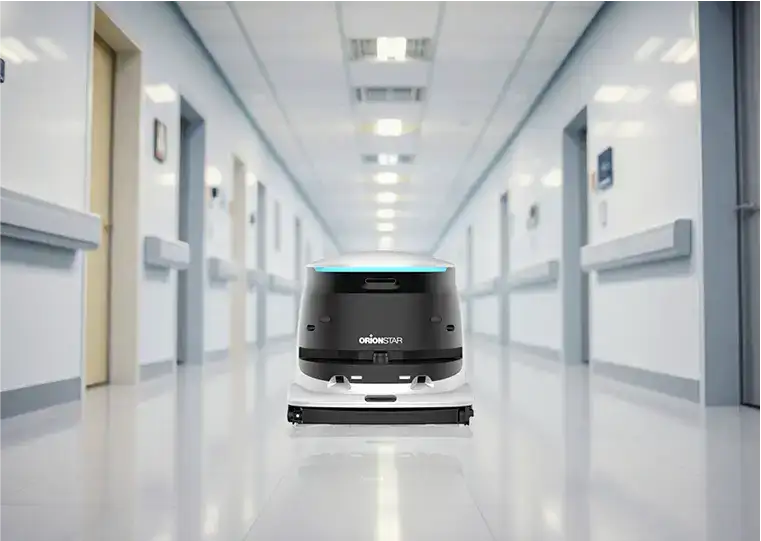
Hospital management teams face an increasingly complex operational environment when maintaining main lobbies, balancing the continuous influx of pedestrian traffic with stringent infection prevention requirements, persistent staffing shortages, and tightening facility budgets. As environmental services departments struggle with high turnover and the physical demands of large-scale floor maintenance, facility managers are exploring new technological solutions to maintain baseline cleanliness and accreditation standards. Autonomous floor scrubbers have emerged as a practical response to these challenges, offering a way to mechanize repetitive floor care, provide auditable proof of cleaning compliance, and allow retained staff to focus on high-touch, critical disinfection tasks throughout the facility.
Environmental services directors must manage annual staff turnover rates that routinely run between 40% and 80%, driving up recruitment costs and leaving night shifts critically understaffed.
Infection prevention teams face the challenge of hospital floors accumulating heavy soil and environmental contaminants, which can be tracked across zones via staff footwear and equipment.
Hospital facility managers struggle to maintain consistent cleanliness in main lobbies due to continuous pedestrian traffic, frequent outdoor pathogen introduction, and continuous equipment movement.
Compliance stakeholders risk accreditation citations under Joint Commission standards when relying on inconsistent manual paper logs that fail to provide verifiable proof of environmental cleaning.
LiDAR navigation and autonomous path planning enable equipment to systematically cover large floor areas while adapting to the dynamic movement of patients, carts, and staff.
Multi-sensor obstacle avoidance systems allow machines to safely navigate complex environments by detecting unexpected obstacles, drop-offs, and tight clearances in real time.
Zone-based cleaning modes provide the flexibility to automatically adjust water usage, brush pressure, and vacuum power based on specific floor types and localized soil levels.
Auto-charging and docking capabilities support extended operational shifts with minimal manual intervention, ensuring floor care tasks proceed even during severe staffing shortages.
Because real-time monitoring and cloud data processing often rely on integrated cameras and spatial mapping, operators must verify that equipment data-handling protocols align with regional privacy frameworks such as GDPR.
The OrionStar CleaniBot S55 Pro illustrates how these autonomous capabilities are integrated into a single commercial platform for routine facility maintenance. Utilizing a multi-sensor array that includes LiDAR, stereo cameras, and ultrasonic sensors, the robot handles dynamic path planning and obstacle avoidance in busy environments. According to manufacturer data, it provides up to 1,197 square meters per hour of cleaning efficiency in scrubbing modes and features an ECO vacuum mode capable of operating for up to 19.5 hours, supporting extensive coverage with fewer charging interruptions. By utilizing zone-based mode switching and a minimal passing width of 700 millimeters, the unit can navigate commercial layouts and shift between hard-floor washing and quiet dust mopping without requiring manual tool changes.
Labor reallocation: By absorbing repetitive floor maintenance, robots allow departments to redeploy custodial staff to higher-value tasks such as patient-room turnover and high-touch surface disinfection.
Quantifiable ROI: Healthcare facilities typically observe a payback period of 12 to 18 months, driven by reductions in loaded labor costs, overtime premiums, and turnover expenses.
Auditable compliance: Digital session logs provide timestamped, uneditable route completion data, directly supporting Joint Commission and CMS survey readiness by proving objective cleaning compliance.
Quiet operation: Modern hospital-grade scrubbers can operate at noise levels as low as 55 to 65 decibels, allowing night-shift cleaning to proceed without disturbing sleeping patients or staff.
Infection control support: Mechanized cleaning systems help decrease airborne dust and reduce physical soil and organic loads from floor surfaces, mitigating the risk of cross-zone pathogen transmission.
These high-traffic transition zones accumulate outdoor dirt, moisture, and potential pathogens brought in continuously by visitors and staff. Autonomous scrubbers can be scheduled for high-frequency hard-floor washing in these areas, ensuring a consistent removal of debris before it is tracked deeper into the clinical environment.
Main lobby waiting areas are often filled with clustered seating, charging stations, and lingering visitors, creating complex navigation challenges for environmental services staff. Using multi-sensor obstacle avoidance, robots can navigate safely around occupants and clean close to furniture edges without disrupting the space.
The main arteries connecting the lobby to clinical wings require minimum clear widths and are heavily utilized by crash carts, wheelchairs, and transport stretchers. Autonomous path planning allows floor scrubbers to adapt their routes in real time to bypass moving equipment, maintaining consistent coverage without creating bottlenecks.
Areas surrounding elevators experience concentrated bursts of foot traffic and serve as primary vectors for spreading floor contaminants between the lobby and patient wards. Zone-based cleaning modes enable a machine to switch to higher-intensity scrubbing right at the elevator threshold, addressing heavy soil buildup precisely where it is most critical.
Autonomous floor scrubbers are increasingly designed to integrate with the broader smart hospital ecosystem, transforming isolated cleaning tasks into data-driven facility operations. By connecting with Computerized Maintenance Management Systems (CMMS) and centralized IoT platforms, facility managers can oversee robotic fleets across multiple sites through a single cloud interface, pushing schedule adjustments, monitoring hardware wear, and receiving instant alerts if a unit encounters an error. Furthermore, as Building Management Systems (BMS) evolve to orchestrate hospital environments, the data generated by automated floor cleaners can contribute to a unified framework, aligning routine maintenance schedules with real-time occupancy data and automated infection-control protocols.
Automated scrubbers optimize resource efficiency by utilizing advanced fluid control systems, which can significantly reduce water and chemical consumption during standard operation.
The transition to mechanical, consistent scrubbing reduces the reliance on harsh chemical strippers and frequent burnishing, extending the lifespan of hard resilient floors.
Detailed digital reporting of water savings, chemical reductions, and verifiable cleaning coverage provides objective data that can contribute toward green building certifications like LEED for Healthcare.
Facility operations that incorporate autonomous cleaning technology inherently support broader ESG objectives by establishing more sustainable, resource-efficient, and highly documented maintenance practices.
The integration of autonomous floor scrubbers is fundamentally changing how hospital management approaches the maintenance of main lobbies, shifting the focus from labor-intensive reactive cleaning to consistent, automated facility care. By addressing systemic challenges such as environmental services turnover, infection prevention mandates, and operational budget constraints, these machines provide a reliable foundation for modern hospital maintenance. As facilities evaluate their specific spatial constraints and daily traffic patterns, the OrionStar CleaniBot series offers multiple models suited to different scenarios, providing healthcare administrators with varied options to align automated cleaning capabilities with their unique operational requirements.