

REQUEST DEMO
Robot CATALOG will be sent to your mailbox immediately after submission.
SUBMIT
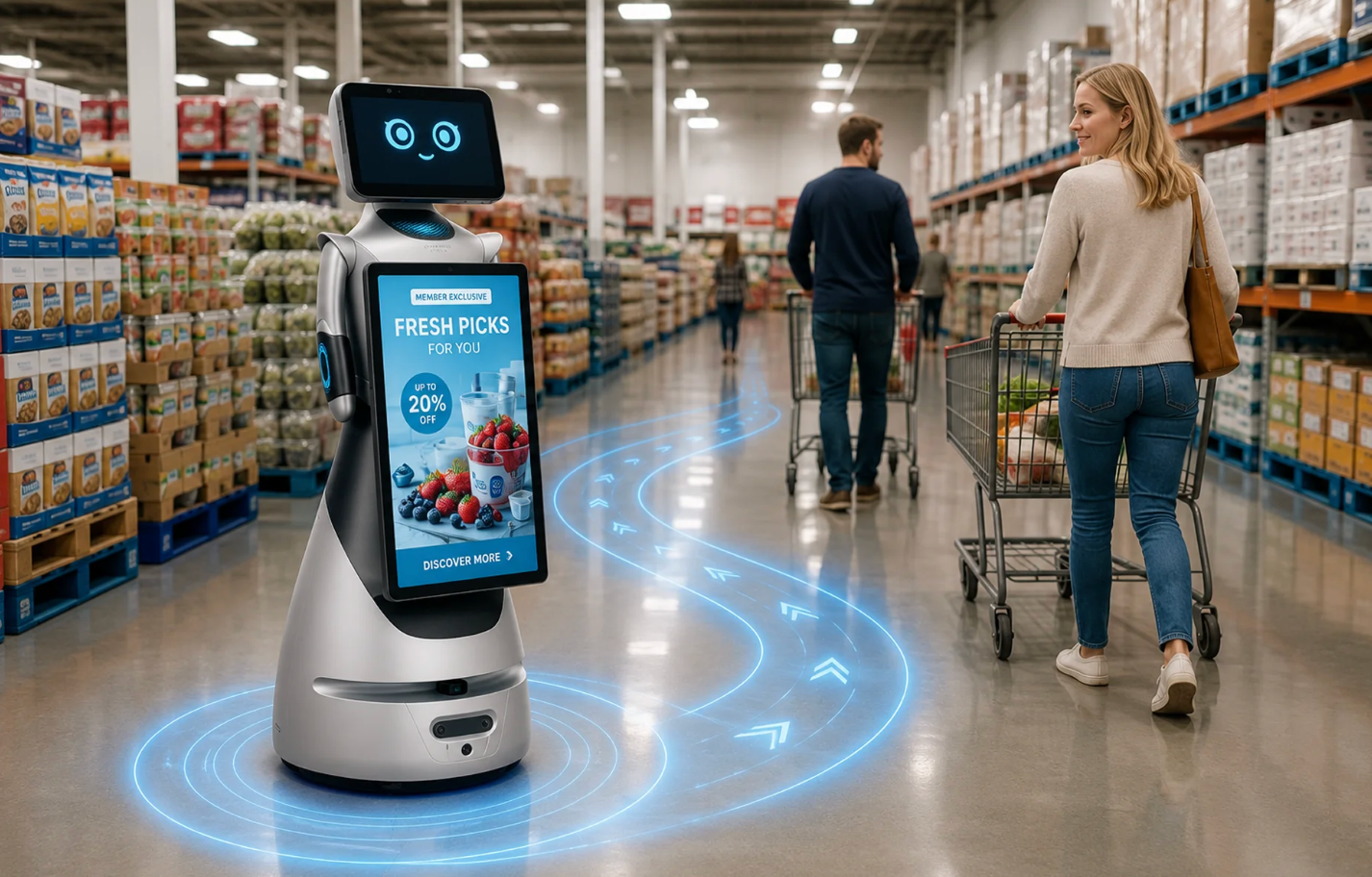
For retail store managers and retail experience managers, maintaining consistent front-of-house service has become an acute operational challenge. The brick-and-mortar retail sector faces an average turnover rate of 4.0%, significantly higher than the cross-sector average, with nearly 82% of frontline staff reporting burnout. As "buy online, pick up in store" (BOPIS) and omnichannel fulfillment pull associates away from entrances to handle operational tasks, the storefront is often left unstaffed.
The financial impact of these staffing gaps is measurable. Industry data indicates that up to 14.5% of shoppers abandon intended purchases when faced with long lines or insufficient service. Operating on thin net margins—sometimes as low as 1–3% in grocery segments—retailers are evaluating automated solutions to bridge this gap.
This guide examines how the OrionStar GreetingBot AD serves as a reception robot in retail stores, helping store operators maintain consistent customer greeting, wayfinding, and promotional visibility without adding to daily headcount pressures.
In retail stores, reception workloads—greeting customers, pointing out current promotions, and directing foot traffic to specific departments—are highly repetitive but essential for establishing brand experience. The OrionStar GreetingBot AD is an AI-powered commercial service robot designed specifically to unify proactive greeting and mobile digital signage.
Instead of acting as a direct replacement for complex human sales roles, the robot functions as a reliable, always-on digital touchpoint. By absorbing routine inquiries at the entrance or near customer service desks, it frees up human associates to focus on high-value tasks such as personalized selling, inventory management, or processing BOPIS orders.
Industry benchmarks indicate that deploying mobile service robots in product zones can yield a 20% to 40% increase in customer engagement time compared to static promotional displays. By combining physical mobility with dynamic content, the OrionStar GreetingBot AD targets these specific interaction metrics.
Evaluating the OrionStar GreetingBot AD requires looking past basic hardware specifications to understand how its features address the spatial and interactive realities of brick-and-mortar retail.
In bustling retail spaces, an interactive kiosk is easily ignored if it remains static. The GreetingBot AD features a dual-screen configuration suited for different phases of customer interaction:
Note for store operators: To prevent physical interference with the large 21.5-inch chest display, the manufacturer ships the robot with arm motion disabled by default. This ensures the continuous visibility and safety of the promotional screen during operation.
Storefronts and checkout areas are acoustically complex. To manage ambient noise, the robot utilizes a 6-microphone circular array featuring 360° sound source localization, enabling it to determine which customer is speaking in a busy lobby. Visual interaction is supported by a 2 MP wide-angle camera and a 13 MP high-definition camera, paired with a dedicated head pitch motor that allows the screen to physically tilt from −15° to +40°, creating a more natural eye-level engagement for customers of varying heights.
Navigating dynamic retail stores requires precise obstacle avoidance. Using a combination of LiDAR, wheel odometers, IMU, and depth cameras, the robot achieves centimeter-level positioning. According to manufacturer data, it requires a minimum corridor clearance of 60–65 cm, allowing it to move smoothly through standard supermarket aisles and around temporary pop-up zones. The system can map retail spaces up to 50,000 m² and safely traverse floor seams up to 20 mm.
Retail shifts are long, and a powered-down robot in the middle of a trading day creates a negative impression. To support the power draw of the large 21.5-inch display, the OrionStar GreetingBot AD is equipped with a 20 Ah (25.2 V) lithium ternary battery. Under typical configurations and workloads, this delivers approximately 8 to 10 hours of runtime. When the battery runs low, the robot autonomously returns to its charging dock (which features an upgraded 8 A adapter to accommodate the larger battery), requiring roughly 6 hours to fully charge while powered on.
Deploying a greeting robot effectively requires mapping its capabilities to specific zones within the store.
Because the OrionStar GreetingBot AD relies on microphone arrays, cameras, LiDAR, and cloud processing for navigation and interaction, its deployment falls directly under the jurisdiction of data protection frameworks like the GDPR in Europe and the CCPA in the United States.
Incidental image capture of shoppers, voice recordings for query handling, and location data can all constitute personal data. For retail managers and corporate IT teams, compliance is a mandatory step, not an afterthought: 1. Data Controller Responsibilities: The retail operator is the Data Controller. It is the retailer's responsibility to establish a lawful basis for data collection, conduct a Data Protection Impact Assessment (DPIA) prior to deployment, and post clear physical signage at the storefront informing customers that an AI-powered robot is in operation. 2. Data Minimization: Operators must configure the system to minimize the retention of personal data, working with the vendor to understand exactly where data is processed (e.g., edge vs. cloud) and ensuring any international data transfers utilize appropriate safeguards.
The OrionStar GreetingBot AD represents a highly visible layer of retail automation, functioning alongside the inventory scanners and autonomous floor scrubbers increasingly found in large-format stores. For operators looking to standardize the customer experience across various store layouts, it is worth noting that this model is part of the broader OrionStar GreetingBot series, which offers multiple configurations to suit different spatial constraints and use cases.
By starting with a 60- to 90-day pilot in a defined zone—measuring metrics like promotional screen impressions and associate time saved—retail experience managers can build a concrete business case for stabilizing their front-of-house operations against ongoing labor market pressures.
How does a greeting robot manage narrow retail aisles? The OrionStar GreetingBot AD requires a minimum passing width of 60 to 65 cm. While it is capable of navigating standard retail aisles, store operators should carefully map deployment zones to avoid high-congestion areas where end-caps or temporary displays might reduce aisle width below this threshold.
Can the robot update its promotional content dynamically? Yes. Through its digital management backend, retail operators can remotely push content to the 21.5-inch chest display. This aligns with modern digital signage expectations, allowing marketing teams to update daily specials or limited-time offers over-the-air (OTA) across multiple store locations.
Does the robot require a dedicated network? The robot supports Wi-Fi 6 (2.4 GHz / 5 GHz dual-band) and comes standard with a 4G module (TDD-LTE/FDD-LTE). In large retail venues with spotty Wi-Fi coverage, the 4G capability ensures uninterrupted connectivity for voice processing and remote monitoring.
What happens if the robot encounters a spill or a floor transition? The robot's sensor suite allows it to avoid static obstacles and cross ground bumps up to 10 mm and floor seams up to 20 mm. However, it is not a cleaning robot; it is designed to operate on hard, dry indoor surfaces like wood, cement, marble, or low-pile hard carpet, and relies on its visual sensors to path around larger hazards.