

REQUEST DEMO
Robot CATALOG will be sent to your mailbox immediately after submission.
SUBMIT
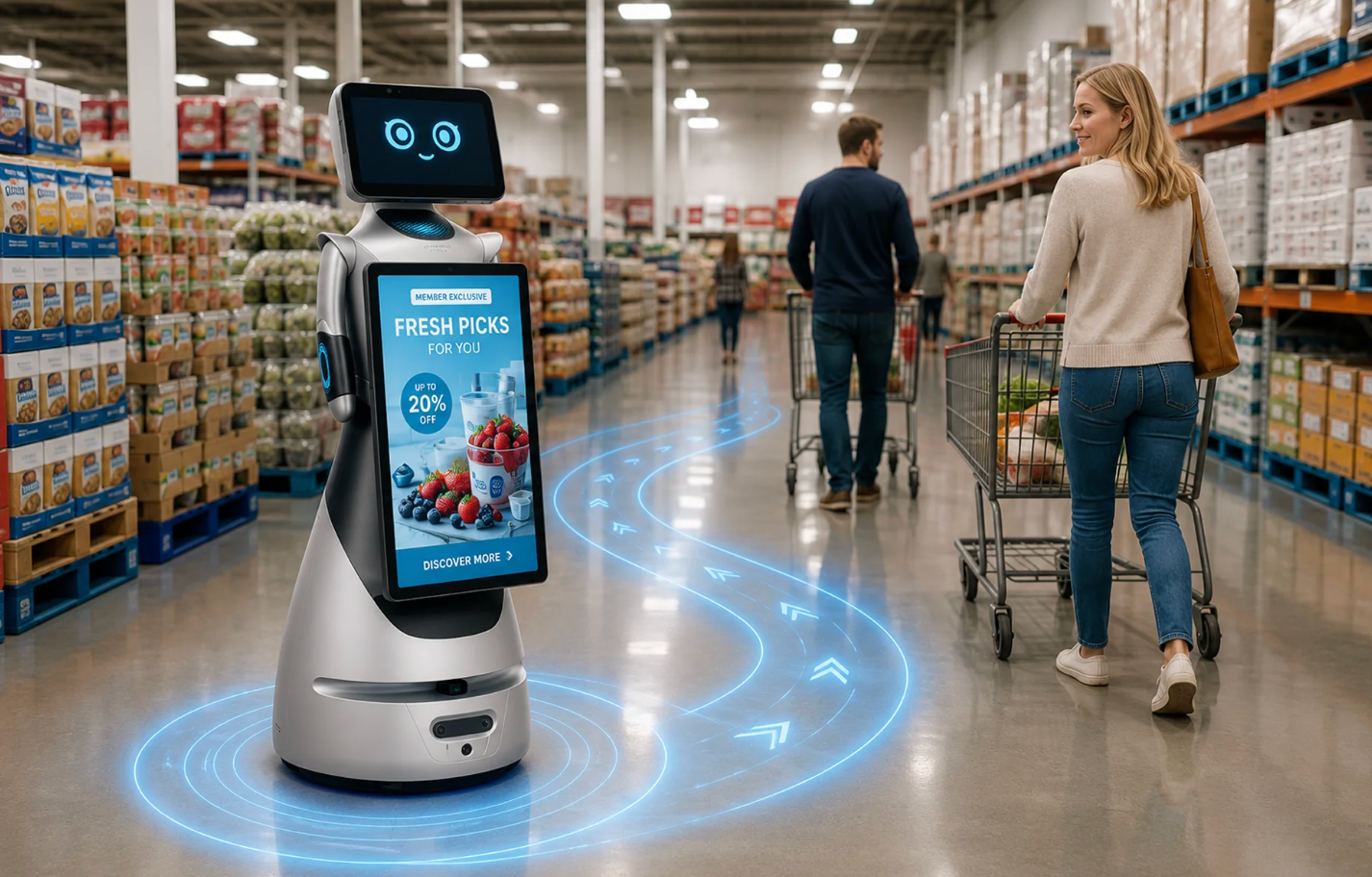
Retail store managers, store operators, and retail experience managers face a systemic challenge: customer expectations for in-store service are rising precisely as frontline staffing capacity shrinks. With industry data indicating a 60.5% turnover rate in the U.S. retail sector and a 63% frontline employee deficit across major global markets, maintaining a consistent brand presence on the shop floor has become a logistical strain.
When human staff are bogged down by the manual logistics of queue management or repetitive wayfinding, a phenomenon known as the "Interaction Gap" emerges. Research indicates that 14.5% of shoppers leave stores without purchasing simply due to unmanaged queues, and 40% exit when they cannot locate an associate. In an environment where grocery and general retail net margins hover around 1-3%, an empty storefront is a measurable financial liability.
Deploying a reception robot is a pragmatic strategy to address these operational pain points. By taking over the first 30 to 60 seconds of a customer interaction—greeting, initial triage, and basic wayfinding—automation ensures that human associates can redirect their cognitive bandwidth toward higher-value tasks, such as styling advice or complex customer service.
The primary function of a reception robot is not to replace store associates, but to manage initial foot traffic at the storefront and provide immediate digital assistance.
Frontline reception roles are highly exposed. Data from the British Retail Consortium highlights an average of 1,300 daily incidents of abuse against shop workers, often triggered by long wait times and frustration at the entrance. Deploying a greeting robot as the first point of contact provides a neutral, consistent presence. It handles the repetitive inquiries that often lead to friction, smoothing the order flow before human intervention is required.
Furthermore, consumer expectations regarding product transparency are evolving. In regions implementing frameworks like the EU Digital Product Passport (DPP), physical stores require accessible digital channels to surface sustainability and sourcing information at the point of purchase. A multi-modal robot serves as a mobile digital touchpoint to bridge this gap between physical merchandise and digital data.
The OrionStar GreetingBot AD is designed for commercial venues requiring both proactive AI interaction and rich visual content delivery. It operates on the Agent OS (customized on an Android 13 foundation) and is powered by a Qualcomm 8-core processor, supporting simultaneous voice, video, and navigation workloads.
The defining hardware feature of the OrionStar GreetingBot AD is its dual-display architecture. It combines a 14-inch 1080P capacitive touch screen on the head with a 21.5-inch FHD display mounted on the chest.
For retail experience managers, this split functionality is highly practical. The head screen facilitates one-on-one interactive tasks—such as a customer searching for an item at customer service desks—while the larger chest screen acts as mobile digital signage. In promotional aisles or pop-up zones, the 21.5-inch display can broadcast dynamic menus, daily offers, or required DPP information. Because the robot's built-in Content Management System (CMS) allows non-technical store teams to update promotional content remotely, it functions as a highly adaptable marketing asset. (Note: To accommodate the chest display, the manufacturer ships the robot's arm motion disabled by default to prevent physical interference).
In busy environments, an automated assistant must move predictably. The OrionStar GreetingBot AD uses a multi-sensor suite comprising LiDAR, wheel odometers, an IMU, a Mono camera, and a TOP IR sensor. This configuration provides centimeter-level positioning and mapping for areas up to 50,000 square meters.
With a required passability of 60 to 65 cm, the robot is scaled to operate efficiently within main retail aisles, checkout areas, and pathways leading to fitting rooms. It can adjust its movement speed between 0.5 and 1.2 m/s, safely leading customers to specific departments while traversing typical indoor obstacles like 10 mm ground bumps and 20 mm floor seams.
Retail storefronts and lobbies are acoustically complex. To manage this, the robot features a 6-microphone circular array with 360-degree sound source localization, paired with dual 5W speakers. This allows the unit to accurately identify the direction of a speaking customer, while a dedicated pitch motor allows the head to tilt from −15° to +40° for more natural, face-to-face engagement.
To offset the power draw of the continuous 21.5-inch display, the OrionStar GreetingBot AD is equipped with a 20 Ah (529.2 Wh) lithium ternary battery. According to manufacturer data, this yields a runtime of up to 8 to 10 hours under typical workloads. The provided 29.4 V / 8 A charging dock utilizes LiDAR-based alignment for autonomous docking, taking approximately 5 hours to recharge when powered off.
Transitioning from fixed digital kiosks to mobile reception robots changes the financial dynamics of store hardware. Industry analyses of customer-facing retail robots indicate that well-managed deployments often achieve a positive operational return within roughly 12 to 24 months.
These returns are driven by several factors. First, the consistent coverage at storefronts prevents the 14.5% walk-out rate associated with unmanaged queues. Second, mobile advertising screens actively highlight promotions to shoppers already in the buying mindset, with historical retail robotics deployments (such as early humanoid implementations in electronics and grocery) generating reported sales lifts of 5% to 15% on featured items. Finally, by offloading routine stock inquiries and wayfinding, human staff hours are recovered and redirected to closing sales and managing inventory.
Because the OrionStar GreetingBot AD relies on a 2 MP wide-angle camera, a 13 MP high-definition camera, LiDAR, and cloud connectivity (via Wi-Fi 6 or standard 4G LTE) for navigation and interaction, buyers must carefully evaluate data privacy. OrionStar prioritizes data privacy. The GreetingBot AD processes navigation data locally on the edge. Any ambient visual or audio data collected for real-time interaction is not permanently stored by default unless explicitly configured by the store operator in compliance with local regulations (e.g., GDPR, CCPA).
Deploying this equipment in public-facing retail stores falls under the jurisdiction of regional data protection laws, most notably the GDPR in Europe. Store operators must verify their lawful basis for any incidental image or voice capture. Retailers are responsible for obtaining necessary consumer consents and displaying adequate surveillance signage. Establishing a Data Protection Impact Assessment (DPIA) and configuring data-retention rules within the fleet management dashboard are mandatory steps before moving from a pilot to a chain-wide rollout.
Industry standard practice dictates starting with a 60- to 90-day pilot in a single location—typically zoning the robot for the entrance and one main promotional aisle. This allows store operators to measure concrete KPIs, such as screen impressions, interaction volume, and customer feedback, before scaling to multiple branches.
Yes. The OrionStar GreetingBot series includes multiple configurations to suit different operational footprints. If a 21.5-inch chest display is unnecessary, or if the store requires smaller chassis dimensions for tighter aisles, store managers can evaluate other standard or delivery-focused models within the broader product family.
The OrionStar GreetingBot AD utilizes an edge-and-cloud hybrid processing model, meaning core autonomous navigation functions operate independently of immediate cloud access. Additionally, the device comes standard with a 4G module (supporting TDD-LTE and FDD-LTE), providing a fallback cellular connection to ensure real-time fleet coordination, CMS updates, and OTA software patches remain functional even if the local store network is unstable.