

REQUEST DEMO
Robot CATALOG will be sent to your mailbox immediately after submission.
SUBMIT
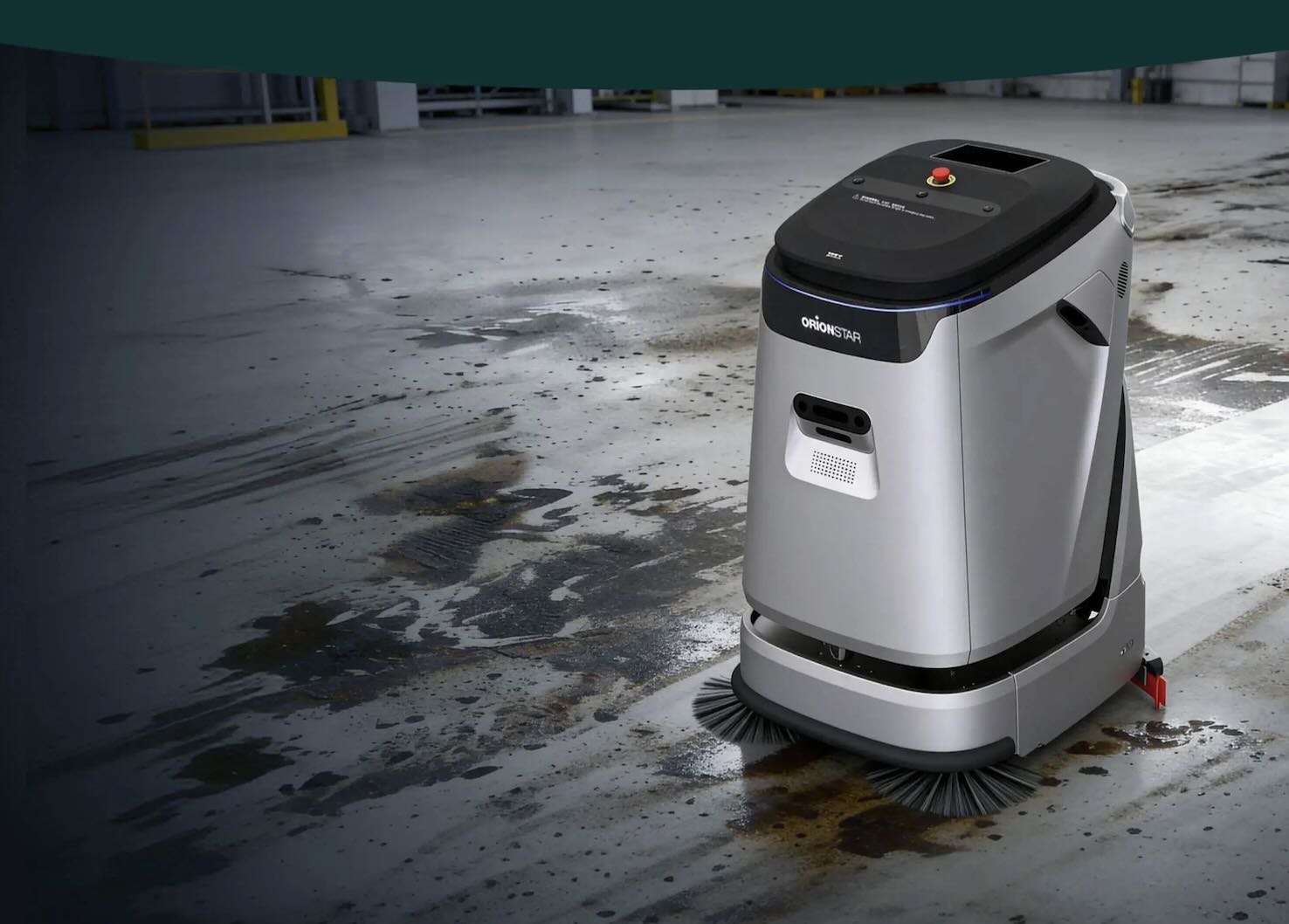
For facility managers, catering operations managers, and canteen supervisors, maintaining hygiene in factory canteens presents a compounding operational challenge. Unlike corporate cafeterias, industrial dining halls experience a heavy, convergent soil load: kitchen back-of-house grease meets sticky beverage spills around tray return stations, combined with sand, mud, and debris tracked in directly from the manufacturing floor by workers in heavy boots. When these facilities operate on multi-shift global manufacturing schedules, floor maintenance is often compressed into narrow windows between meal periods, pushing traditional manual cleaning methods to their breaking point.
This guide examines the operational realities of industrial catering spaces and evaluates how commercial cleaning robots, specifically focusing on the OrionStar CleaniBot C5, can address severe labor constraints while meeting strict sanitation standards.
Labor remains the single largest cost driver in any cleaning budget, representing 60% to 80% of total floor maintenance expenses. Industry data indicates that the fully loaded hourly cost of a commercial cleaner—factoring in shift premiums, benefits, and supervision overhead—runs between $25 and $31. However, securing and retaining this labor is increasingly difficult.
The structural labor shortage in the janitorial sector has driven annual turnover rates to 50% in many regions, with one in five cleaning firms replacing more than half of their staff yearly. Unfilled vacancies translate directly to delayed cleaning schedules and degraded hygiene standards. In high-stakes environments like catering services, inconsistent floor maintenance leads to food-safety nonconformities, poor allergen control, and compliance gaps in HACCP documentation.
For a factory canteen supervisor, relying solely on manual walk-behind scrubbers—which realistically cover only 6,000 to 9,000 square feet per hour after accounting for obstacles, serving lines, and rest breaks—is becoming an unsustainable strategy both financially and operationally.
Autonomous floor scrubbers shift the operational model from labor-dependent reactive cleaning to automated, predictable maintenance. By deploying commercial cleaning robots, facility managers can reallocate their limited human workforce to high-touch tasks, such as wiping down dining tables and sanitizing food contact surfaces, while the robot handles the repetitive, heavy-duty floor scrubbing.
Industry benchmarks for daily-use facilities with over 50,000 square feet of hard-floor coverage demonstrate a typical payback period of 9 to 18 months for mid-sized autonomous scrubbers. While a full-time manual cleaner carries an annual loaded cost of $40,000 to $55,000, the amortized hourly cost of an autonomous unit typically falls between $1.50 and $3.00. Beyond immediate labor savings, these systems provide precise, timestamped digital logs of every cleaning session, offering the audit-ready documentation required by ISO 22000 standards and internal hygiene inspections.
When assessing equipment for complex catering environments, specifications must align with the physical realities of the space. The OrionStar CleaniBot C5 is an industrial-grade autonomous floor scrubber designed to address the specific soil types and spatial layouts of medium-to-large facilities.
Tackling Grease and Tracked Debris In kitchen back-of-house areas and busy dining halls, the primary challenge is removing stubborn oil and industrial grit in a single pass. According to manufacturer data, the OrionStar CleaniBot C5 utilizes a dual-rolling-brush system that applies 25 kg of downward scrubbing pressure. Under defined test conditions, this configuration achieves a dirt-cleaning rate of about 95% on heavy oil and grime. Furthermore, the unit is designed to pick up dry debris up to 3 cm in height, which minimizes the need for staff to manually pre-sweep dropped food or manufacturing debris before the scrubbing cycle begins.
Coverage and Runtime During Shift Changes Cleaning windows in multi-shift factories are extremely tight. The CleaniBot C5 offers a maximum theoretical cleaning capacity of up to 1,980 square meters per hour. It features a combined 90-liter water tank system (45 L clean, 45 L waste) and a 24V, 80 Ah battery that delivers approximately 3 hours of active scrubbing runtime. This capacity allows the robot to cover expansive dining halls and long staff corridors continuously without requiring manual intervention for refilling or recharging mid-route.
Navigating High-Density Layouts Factory canteens are dense environments filled with chairs, tables, and queuing infrastructure. The CleaniBot C5 requires a minimal passing width of approximately 880 mm. This compact profile enables it to navigate tight serving lines, crowded queueing zones, and narrow transit corridors safely. Additionally, its operating noise level is rated at less than 68 dB(A) under typical configurations, ensuring it can operate during overlapping shift periods without disrupting workers on their meal breaks.
Self-Cleaning Dock for Odor Control A critical requirement in food service settings is preventing the cleaning equipment itself from becoming a source of cross-contamination or foul odors. The C5 pairs with an automated workstation that handles clean-water refilling and waste-water discharge. Crucially, the dock performs a high-pressure internal tank rinse in roughly 4 minutes, mitigating the risk of waste-water stagnation and odor buildup near tray return stations.
Deploying autonomous robotics in a factory setting introduces strict data governance and food-safety compliance requirements.
Data Privacy and GDPR Because commercial cleaning robots utilize cameras, LiDAR, and smart obstacle-avoidance sensors to map up to 10,000 square meters of floor space, facility managers must verify compliance with GDPR and applicable local data protection regulations. The OrionStar CleaniBot C5 is engineered to process navigation data and visual inputs locally in real time. To support privacy compliance, personal visual data is not recorded, stored, or transmitted to the cloud, ensuring that the movements of canteen staff and factory workers are not subjected to surveillance.
HACCP and Food Safety While autonomous scrubbers operate on the floor and do not directly handle food, they must integrate into the facility's overall sanitation plan. Cloud-connected commercial cleaning robots provide automated reports detailing route coverage, duration, and completion times. Catering operations managers can directly fold these automated digital logs into their HACCP sanitation records, proving to auditors that dining halls and serving lines were consistently sanitized according to the required schedule.
To accommodate different floor plans and operational scales across various industrial sites, the OrionStar CleaniBot series includes multiple models, allowing operators to match specific machine footprints and tank capacities to their exact facility requirements.
Can commercial cleaning robots fully replace manual cleaning staff in a factory canteen? No. Autonomous scrubbers are designed to automate wide-area floor maintenance. Human staff remain essential for high-level cleaning, sanitizing food prep surfaces, wiping tables, and handling localized, complex spills requiring immediate manual intervention. The goal is labor reallocation, not total replacement.
Do these robots meet specific food-safety certifications? Currently, commercial floor-cleaning robots on the market do not carry specific food-contact certifications (such as NSF/ANSI) because they are restricted to floor maintenance. However, when used with food-safe cleaning solutions and paired with their digital timestamped reporting, they actively support compliance with HACCP sanitation monitoring and ISO 22000 requirements.
How does the robot manage sudden obstacles like dropped chairs or moving workers in the queueing zones? Modern scrubbing robots employ a suite of local sensors, including LiDAR and vision systems, to detect dynamic obstacles in real time. If a worker steps into the robot's path or a chair is pushed out into a serving line, the robot's smart obstacle-avoidance system will either halt safely or automatically calculate a route around the obstruction to continue its cleaning cycle.