

REQUEST DEMO
Robot CATALOG will be sent to your mailbox immediately after submission.
SUBMIT
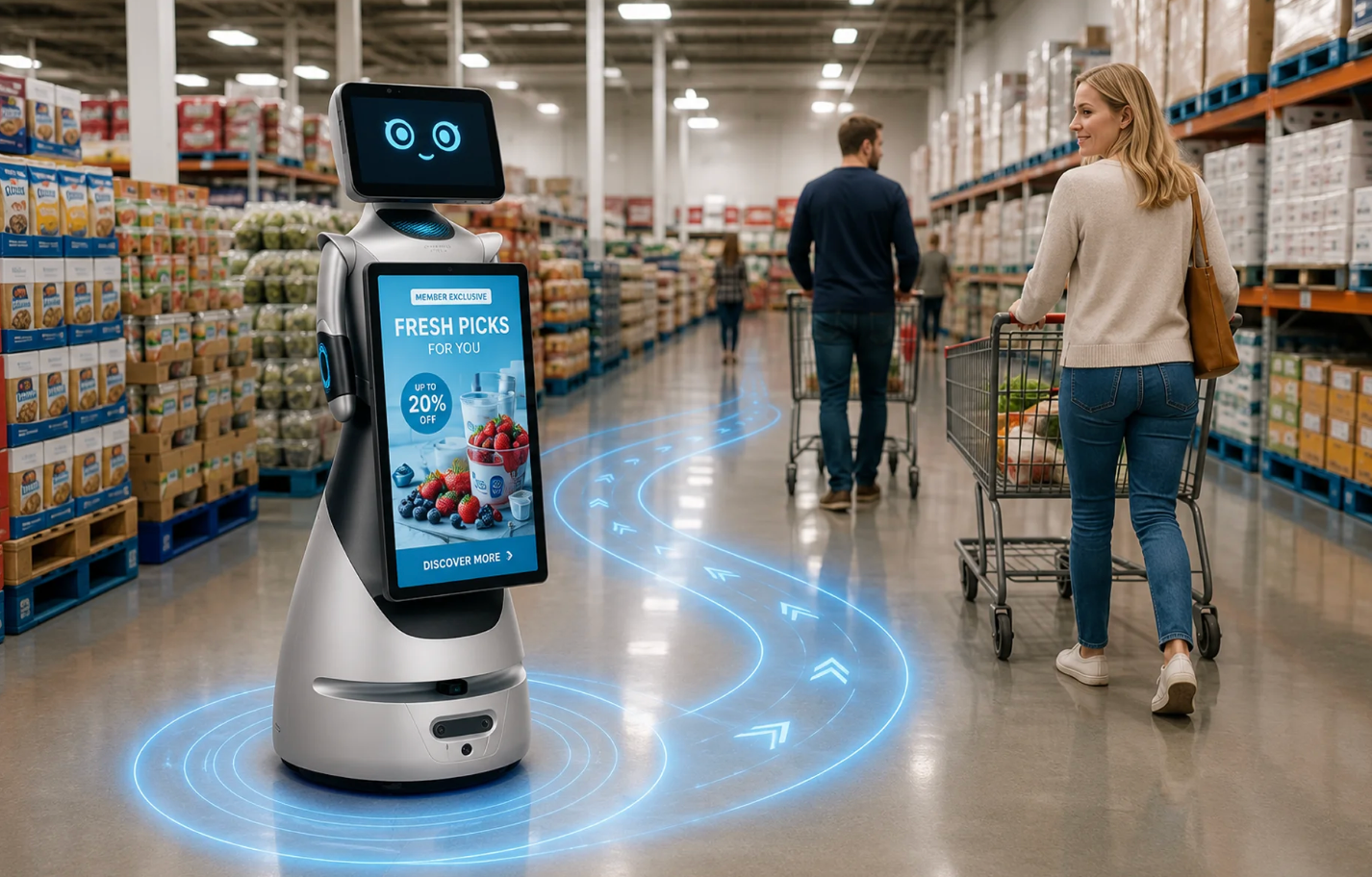
Grocery retail operators managing supermarkets face relentless operational and customer experience challenges, particularly within the highly sensitive fresh food sections where volatile labor availability, strict hygiene compliance, and significant inventory shrink heavily impact razor-thin profit margins. As retail turnover rates frequently exceed 50% annually and food waste accounts for substantial financial losses, traditional staffing models are struggling to maintain consistent shelf replenishment, cold-chain integrity, and in-store shopper guidance. To address these operational gaps, retail service robots are emerging as a practical, technology-driven solution capable of bridging labor shortages, enhancing real-time customer engagement, and ensuring predictable execution in the most demanding supermarket environments.
The OrionStar GreetingBot AD illustrates how these category capabilities are implemented in a physical deployment through its dual-screen design, featuring a 14-inch head touch screen for direct interaction and a 21.5-inch full high-definition chest display for mobile promotion delivery. According to manufacturer specifications, the unit utilizes a combination of LiDAR and camera sensors to achieve centimeter-level positioning for autonomous wayfinding across store maps spanning up to 50,000 square meters. Furthermore, a high-capacity 20 Ah battery supports up to 8 to 10 hours of runtime, allowing the robot to perform continuous customer guidance and in-aisle product information delivery throughout a standard retail shift without requiring frequent mid-day recharging.
Produce aisles experience high inventory velocity and severe shrink risks driven by overstocking and consumer preferences for visually perfect items. Retail service robots can navigate these aisles to deliver mobile promotions on near-expiration items, encouraging faster sell-through while helping shoppers locate specific seasonal fruits and vegetables.
These service-heavy zones often suffer from long customer queues and peak-hour staffing constraints that degrade the overall shopper experience. Robots stationed near these counters can display digital menus, manage queue expectations, and answer basic ingredient questions, allowing human staff to focus entirely on order fulfillment and food preparation.
Specialty protein counters require strict temperature compliance and often necessitate detailed customer consultation regarding cuts and preparation methods. By leveraging video consultation and in-aisle product information displays, autonomous robots can connect shoppers with culinary experts or display recipes without requiring additional specialized staff behind the glass.
Prepared food areas face intense omnichannel pressure, with both in-store shoppers and online order pickers converging in the same tight spaces. Retail service robots assist by safely navigating these congested zones to broadcast real-time availability of hot items and intelligently routing foot traffic to minimize bottlenecks.
To maximize their utility, retail service robots must integrate seamlessly into the existing supermarket IT infrastructure rather than operating as isolated standalone devices. When synchronized with the store's central content management systems and electronic shelf labels, a robot acting as mobile signage can dynamically update its promotional displays to match real-time point-of-sale pricing and inventory levels, ensuring shoppers are never guided toward an out-of-stock item. Furthermore, these robotic platforms can interface with customer relationship management and loyalty systems to present personalized, opt-in offers, while simultaneously feeding anonymized traffic data back into enterprise resource planning software to assist demand-sensing platforms in optimizing fresh food replenishment.
These automated capabilities allow grocery retail operators to tangibly advance their zero food waste commitments and broader corporate sustainability objectives.
Retail service robots are fundamentally changing the way the grocery retail industry maintains operational consistency and customer experience across supermarkets, particularly within highly sensitive fresh food sections. By merging autonomous navigation with digital information delivery, these platforms address systemic labor, shrink, and engagement challenges that traditional methods struggle to resolve. For organizations exploring how to integrate this technology into their own floor plans, the OrionStar GreetingBot series offers multiple configurations designed to accommodate a diverse range of spatial and operational requirements.
Privacy Disclaimer: Voice and facial data processing must be configured by the operator in accordance with local privacy laws (e.g., GDPR, PIPL). OrionStar strongly recommends obtaining necessary visitor consent or utilizing localized/anonymized processing modes.