

REQUEST DEMO
Robot CATALOG will be sent to your mailbox immediately after submission.
SUBMIT
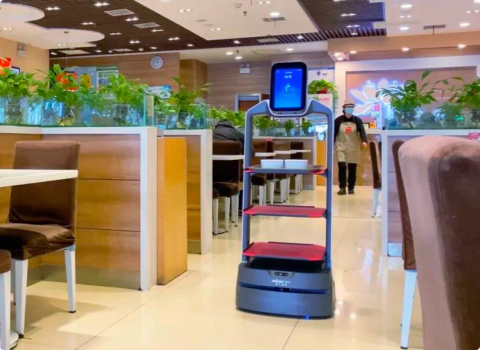
The food and beverage industry is currently navigating a structural labor deficit. According to recent data from the National Restaurant Association, 47% of operators report job openings that are difficult to fill, while labor costs routinely consume 36.5% of sales in full-service operations. High turnover exacerbates this pressure; the average annual turnover rate in the restaurant sector sits near 75%, with replacement costs averaging USD 5,864 per worker.
These labor shortages directly impact service consistency and table-turnover rates. In a typical bistro, servers can walk up to 3.5 miles per shift carrying heavy trays, leading to physical fatigue and slower delivery during peak hours. As a category, serving robots address these bottlenecks by automating the repetitive transport of food, beverages, and bussed dishes. Documented operational cases show that deploying service automation can reduce server walking distance by approximately 49% and improve table turnover by over 50%.
For restaurant operators evaluating automation, the OrionStar LuckiBot serves as a dedicated hardware solution tailored for hospitality environments. As part of the broader OrionStar LuckiBot series—which offers multiple models to accommodate different venue sizes and payload requirements—the standard LuckiBot is positioned as an entry-to-mid-range unit designed to ease labor constraints and optimize floor efficiency.
The OrionStar LuckiBot is designed to operate seamlessly across different zones within a restaurant, adapting its functions from high-capacity transport to guest interaction.
Moving orders efficiently from the kitchen to the floor is the primary constraint on table turnover. Deployed as a food delivery robot, the LuckiBot supports a total payload of up to 40 kg across three or four adjustable trays, with each tray capable of holding up to 10 kg. According to manufacturer data, the unit can manage up to 400 deliveries per day and serve up to four tables in a single trip. Trays feature 360-degree open access, allowing kitchen staff and expediters to load plates rapidly. To accommodate uneven flooring or transitions between kitchen tile and dining room carpets, the robot utilizes a multi-link self-levelling suspension system designed to keep liquids and soups stable during transit. For venues handling takeaway orders or maintaining strict hygiene protocols, an optional Sealed Food Protector accessory provides enclosed transport.
Dining rooms present a complex navigational challenge due to unpredictable human movement, pulled-out chairs, and narrow aisles. The LuckiBot utilizes a dual SLAM (Simultaneous Localization and Mapping) solution, combining a 210-degree LiDAR sensor with an RGBD depth camera for 3D depth detection. This sensor array allows the robot to achieve an obstacle response time as short as 0.5 seconds. The chassis integrates a 3D omnidirectional obstacle-avoidance sensor to prevent collisions with moving guests or staff. In high-traffic dining rooms utilizing multiple units, the robots support multi-robot cooperation; they can autonomously navigate intersections and yield to one another based on internal priority rules without requiring human intervention.
Beyond physical transport, the robot can support front-of-house staff at host stands and bar areas. Using its Guidance and Greeting modes, the LuckiBot can proactively detect arriving guests, display digital menus or promotions on its 10.1-inch touchscreen, and escort patrons to their tables while playing background music. For noisy bar environments, the robot is equipped with a 6-microphone ring array that provides 360-degree audio coverage with a 5-meter effective pickup range. According to manufacturer specifications, the AI voice recognition maintains up to 97% accuracy in ambient noise environments up to 75 dB, allowing it to interact reliably with guests even during busy service hours.
Modern restaurant automation requires robust digital oversight. The LuckiBot operates on a customized Robot OS (based on Android 9.0) and connects via 4G or Wi-Fi. It supports over-the-air (OTA) updates, allowing operators to push firmware updates, menu changes, and new navigation maps centrally without on-site technician visits. A cloud dashboard provides remote monitoring, giving managers real-time visibility into the robot's location, battery health, and daily delivery throughput.
Because the OrionStar LuckiBot relies on RGBD cameras for visual positioning, LiDAR for environmental mapping, microphone arrays for voice interaction, and cloud infrastructure for multi-robot orchestration, restaurant operators must evaluate data-privacy compliance. Businesses deploying these units in regions regulated by the General Data Protection Regulation (GDPR) or similar local data-protection laws must ensure that any visual, audio, or telemetry data processed by the robot meets lawful basis requirements. Operators should verify vendor data-retention policies and ensure that cross-border data transfer protocols align with local compliance obligations.
Note: All visual and audio data processed for navigation and voice interaction is anonymized or processed locally on the device, ensuring compliance with global privacy standards including GDPR.
Serving robots are designed to augment human staff, not replace them. By handling the repetitive, heavy lifting of running food and bussing tables, the robot reduces the miles servers walk per shift. This allows your front-of-house staff to remain in their designated sections, focusing on upselling, answering menu questions, and elevating the guest experience.
Under defined test conditions for typical cruising scenarios, the LuckiBot provides up to 10 hours of continuous operation. The system requires approximately 4.5 hours to reach a full charge while powered off, making it capable of covering standard lunch and dinner service periods on a single daily charging cycle.
Yes. The LuckiBot's dual SLAM navigation incorporates LiDAR mapping and can recognize installed location markers in the ceiling. This allows the system to continuously correct its route and prevent navigation deviations, ensuring reliable delivery even in dimly lit dining rooms or during evening operations.