

REQUEST DEMO
Robot CATALOG will be sent to your mailbox immediately after submission.
SUBMIT
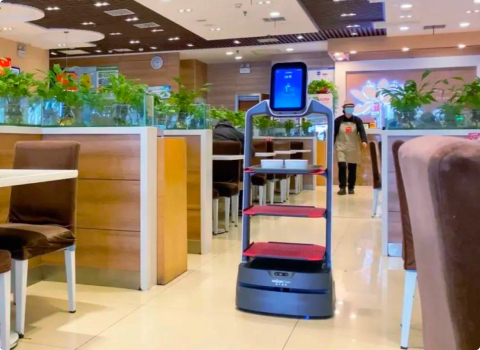
The quick service restaurant (QSR) sector faces structural, rather than cyclical, staffing challenges. With annual front-of-house employee turnover frequently exceeding 130% and sometimes peaking at 150%, operators are caught in a continuous cycle of recruiting, hiring, and training. Replacing a single hourly employee costs an estimated $5,800 in direct and indirect expenses, while constant churn degrades order accuracy and speed of service—the primary competitive metrics in a fast-paced environment.
To protect margins, counter and floor managers are looking to automate the most repetitive, physically taxing tasks. By delegating tray running, bussing, and expediting to automated systems, operators can reduce the physical strain on staff and optimize front-of-house throughput. This guide evaluates how the OrionStar LuckiBot, deployed as a food delivery robot, addresses the operational realities of quick service restaurants.
Quick service restaurants are characterized by high foot traffic, narrow clearances, and overlapping workflows. A food delivery robot must navigate these constraints without disrupting staff or guests. The OrionStar LuckiBot offers a compact 530 mm x 500 mm footprint, making it suitable for venues where aisle space is at a premium.
To maximize utility, shift supervisors typically integrate the robot into specific high-volume sub-spaces:
In environments handling large volumes of dine-in and takeout orders, runners expend significant energy moving finished orders from the kitchen pass to the front counter. The LuckiBot features three or four adjustable trays, carrying a total payload of up to 40 kg (maximum 10 kg per tray). Kitchen staff can load multiple orders simultaneously, allowing the robot to transport heavy food batches to counter pickup zones. This keeps human staff stationed at the counter to focus on customer service and payment processing.
Clearing tables quickly is essential for maintaining high table turnover in quick service models with low average check sizes. Using its Cruise Mode, the LuckiBot can travel along a configured route through dine-in seating areas. Floor managers can dispatch the unit to collect used tableware or allow guests to place their own finished trays onto the robot before it routes back to the dishwashing station.
During peak hours, drive-thru staging areas often become bottlenecks. The robot can be utilized to run heavy supply restocks—such as cups, lids, and sauces—from the back-of-house directly to drive-thru pass-throughs or public condiment stations, reducing the number of times counter staff must step away from their stations.
When evaluating a serving robot for a fast-paced dining environment, operators must look past baseline features to understand how the machine handles peak-hour chaos.
In a crowded QSR, guests move unpredictably. The LuckiBot utilizes a dual SLAM navigation solution (LiDAR combined with visual SLAM) supported by an RGBD depth camera and 3D omnidirectional sensors. According to manufacturer data, its obstacle response time is as short as 0.5 seconds, allowing it to stop or route around guests safely. A multi-link self-leveling suspension helps maintain tray stability, preventing spills when traversing uneven or greasy floors common in food service environments.
Quick service dining rooms routinely reach high ambient noise levels. The LuckiBot is equipped with a 6-microphone ring array providing 360-degree coverage and an effective voice pickup range of 5 meters. Its AI voice recognition is rated to maintain up to 97% accuracy in ambient noise up to 75 dB, enabling reliable interaction when staff or guests use voice commands to pause the robot or confirm an order pickup.
A typical QSR shift requires continuous equipment availability. The LuckiBot provides up to 10 hours of cruising time under typical usage conditions, covering a full standard shift on a single charge. It requires 4.5 hours to recharge when powered down. In restaurant settings, the system can manage up to 400 deliveries per day, serving up to four tables per single trip.
Industry data indicates that a well-integrated restaurant robot can save operators at least 20 labor hours per week, helping to stabilize schedules against unpredictable call-outs.
For operators calculating ROI, the break-even threshold for service automation is frequently modeled against an $18 per hour fully loaded labor rate. At this rate, the operational savings typically yield a payback period of 18 to 24 months, assuming the robot enables human staff to cover 30% to 50% more tables or handle equivalent upticks in counter volume. By reallocating the physical load of carrying trays to the LuckiBot, quick service venues can reduce staff fatigue—a primary driver of the sector's exceptional turnover rates.
As operations scale, the OrionStar LuckiBot series provides hardware flexibility. The base LuckiBot serves as a cost-efficient entry point, while multi-robot cooperation allows multiple units to navigate the same venue autonomously, yielding right-of-way at intersections without human intervention. For venues requiring larger screens or higher 60 kg payload capacities, operators can look to other models in the series, such as the LuckiBot Pro, to meet specific site demands.
Deploying connected, sensor-equipped hardware in public-facing commercial spaces requires strict adherence to regional data protection laws, particularly for operators expanding in the European market.
Because the LuckiBot relies on RGBD depth cameras, LiDAR, and a 6-microphone array to map environments and interact with users, it processes environmental data. Operators must evaluate their specific deployment against the General Data Protection Regulation (GDPR). To minimize compliance friction, operators are advised to configure the robot's sensing strictly for navigation and obstacle avoidance. Ensuring the system does not utilize facial recognition, biometric matching, or retain camera imagery of identifiable individuals materially reduces the GDPR footprint.
Furthermore, buyers should verify the data sovereignty of the robot’s cloud services (which manage OTA updates, the Q&A database, and multi-robot coordination) to ensure telemetry and network traffic meet local cybersecurity expectations and the forthcoming EU Cyber Resilience Act requirements.
The OrionStar LuckiBot has a physical footprint of 530 mm x 500 mm. However, industry guidelines recommend a minimum aisle width of 36 inches (approx. 914 mm) for reliable navigation, with 4 feet preferred in high-traffic areas to allow guests to pass the robot comfortably. Operators should measure their counter pickup zones and dine-in seating areas prior to deployment.
To address cross-contamination and hygiene concerns, operators can equip the LuckiBot with a Sealed Food Protector accessory. This enclosure provides up to 80% airtightness according to manufacturer testing, ensuring that orders remain shielded from airborne particles as the robot moves from kitchen expediting lines to guest-facing areas.
No. The system supports autonomous multi-robot cooperation. If two or more LuckiBots encounter each other at an intersection, they follow pre-programmed priority rules based on their assigned robot numbers to yield and navigate around one another without manual staff intervention.
Industry deployment cases suggest a 2-4 week "J-curve" where productivity temporarily dips as staff adjust to the new workflow. Operators are advised to run a one-week co-working orientation, teaching staff how to load the trays and utilize the 10.1-inch touchscreen before fully integrating the unit into peak-hour counter service.