

REQUEST DEMO
Robot CATALOG will be sent to your mailbox immediately after submission.
SUBMIT
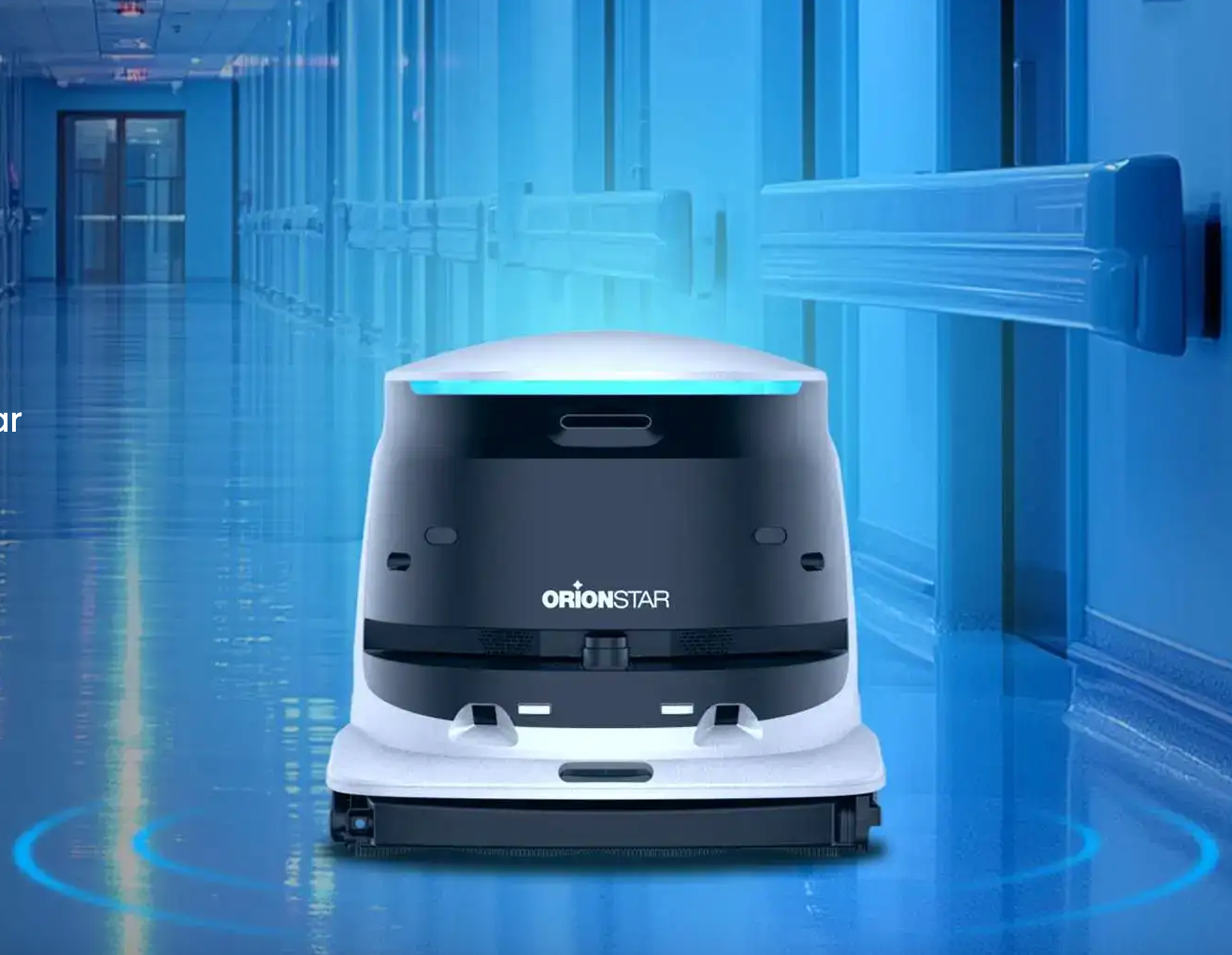
Hospital management in outpatient departments faces immense cleaning challenges driven by critical staffing shortages, tight operational budgets, and increasingly stringent compliance requirements for infection prevention. As patient throughput rises and environmental services teams are stretched thin, commercial cleaning robots are emerging as a strategic solution to automate repetitive floor care, maintain consistent hygiene standards, and alleviate the heavy operational burden on healthcare facilities.
The OrionStar CleaniBot S55 Pro illustrates how these autonomous capabilities function in a physical hospital environment. The unit utilizes a multi-sensor system to support autonomous map construction for areas up to 10,000 square meters while avoiding dynamic obstacles safely. According to manufacturer data, it provides up to 1,197 square meters per hour of cleaning efficiency in its scrubbing modes, allowing it to manage large spaces efficiently. Additionally, it offers specialized noise-sensitive settings, operating at 45 decibels during dust mopping, which minimizes disruption for patients and medical staff during daytime maintenance.
These high-traffic zones experience constant footfall and accumulate debris rapidly throughout the day. Commercial cleaning robots can deploy quiet vacuuming or mopping modes during operating hours to maintain cleanliness without disturbing waiting patients.
Long hallways connecting patient rooms and doctor offices require frequent, systematic scrubbing to prevent the build-up of floor contaminants. Autonomous units can navigate these straight but busy paths efficiently, using obstacle avoidance to safely bypass walking staff, stretchers, and medical carts.
The main entrance and registration areas form the first impression of a facility and demand pristine hard-floor maintenance. Robots equipped with heavy-duty scrubbing capabilities can handle the high volume of dirt tracked in from outdoors, ensuring a hygienic and professional environment.
The spaces immediately outside clinical rooms require precise edge cleaning to maintain stringent infection-control standards. Using line lasers and close-to-wall navigation, robots can effectively capture dust and contaminants along the baseboards before they are tracked into sterile examination areas.
In modern hospital environments, commercial cleaning robots increasingly function as active nodes within the broader smart building ecosystem. By connecting via standard IoT protocols, the robots can share battery telemetry, fault alerts, and cleaning session logs directly with Computerized Maintenance Management Systems (CMMS) to automatically generate maintenance workflows. Furthermore, this operational data can feed into central Building Management Systems (BMS), allowing infection prevention teams to cross-reference robotic floor cleaning timestamps with real-time occupancy sensors and HVAC ventilation events for a closed-loop approach to facility hygiene.
Ultimately, integrating robotic automation transforms routine infection prevention from a basic operational necessity into a measurable contributor to a healthcare organization's environmental, social, and governance commitments.
Commercial cleaning robots are fundamentally changing how hospital management maintains outpatient departments, shifting the focus from labor-intensive manual upkeep to consistent, data-driven facility care. By automating repetitive floor maintenance, these systems help healthcare facilities balance the competing demands of high patient throughput, tight budgets, and stringent infection control. For organizations evaluating their automation strategies, the OrionStar CleaniBot series offers various models designed to adapt to the diverse spatial and operational requirements of modern healthcare environments.
Data Processing Notice: OrionStar CleaniBot S55 Pro utilizes spatial mapping and sensor data strictly for navigation and operational reporting. Visual and LiDAR data are processed locally in real-time for obstacle avoidance without recording personally identifiable information (PII). Cloud-based fleet management and reporting features comply with standard data protection regulations; however, facility administrators are responsible for ensuring local deployment aligns with applicable privacy laws (e.g., GDPR, HIPAA, PIPL).
