

REQUEST DEMO
Robot CATALOG will be sent to your mailbox immediately after submission.
SUBMIT
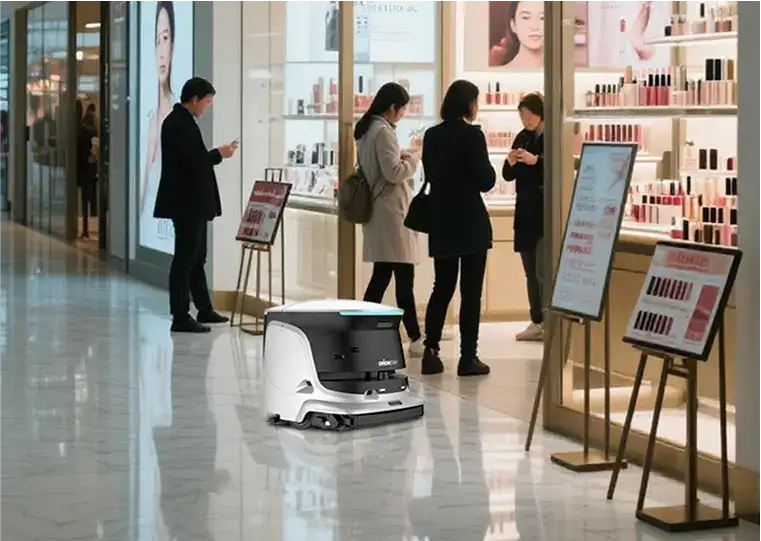
Facility Management teams operating in shopping malls are increasingly constrained by unprecedented labor turnover, escalating operational costs, and the strict compliance demands of maintaining expansive retail environments. As the gap between tenant hygiene expectations and available manual labor widens, commercial cleaning robots are emerging as a practical, scalable solution to maintain consistent floor care standards while mitigating operational risks.
Translating these autonomous capabilities into daily operations, the OrionStar CleaniBot S55 Pro functions as a versatile floor-care platform designed for expansive public spaces. According to manufacturer data, the unit can map environments of up to 10,000 square meters using its integrated LiDAR and stereo camera systems, allowing it to navigate safely around changing mall obstacles. It supports diverse maintenance routines through multiple modes—delivering cleaning efficiency of up to 1,368 square meters per hour in sweeping and vacuuming modes—while providing up to 28 hours of runtime on a single charge during low-noise dust mopping, ensuring operations adapt seamlessly to both busy daytime foot traffic and intensive overnight cleaning shifts.
The central arteries of any shopping mall feature high foot traffic and mixed flooring materials that require constant attention to maintain a premium aesthetic. Cleaning robots can autonomously switch between deep scrubbing for hard tiles and quiet dust mopping for polished stone, ensuring these high-visibility zones remain pristine without interrupting shopper flow.
Food courts are prone to frequent spills, dropped debris, and sticky residues that pose immediate slip hazards and attract pests. AI-powered robots with versatile sweep-and-scrub capabilities can execute targeted cleaning routines to quickly neutralize spills, maintaining a sanitary dining environment throughout peak operating hours.
Entrance vestibules accumulate high volumes of tracked-in dirt and moisture, while adjacent restroom corridors demand stringent hygiene standards. By delegating the repetitive vacuuming and scrubbing of these transitional areas to robots, facility teams can reallocate human janitorial staff to focus exclusively on detailed fixture cleaning and interior restroom sanitization.
Modern commercial cleaning robots are designed to function as active nodes within a broader smart building ecosystem, seamlessly integrating with Building Management Systems (BMS), Computerized Maintenance Management Systems (CMMS), and IoT networks. By sharing real-time operational telemetry, spatial maps, and cleaning logs via cloud dashboards, these connected machines enable automated work-order generation, predictive maintenance scheduling, and synchronized energy optimization, such as automatically lowering HVAC and lighting intensity in zones that the robot has already finished cleaning during off-hours.
Integrating automated floor care fundamentally strengthens a facility's environmental and social governance profile by driving resource conservation while elevating the dignity and safety of the human workforce.
Commercial cleaning robots are fundamentally changing how the Facility Management industry approaches the daily maintenance of shopping malls, shifting operations from reactive, labor-intensive routines to proactive, data-driven systems. As retail spaces continue to evolve, leveraging automation will be essential for balancing rising hygiene standards with strict cost controls. The OrionStar CleaniBot series offers a range of models tailored to address these dynamic environmental demands, providing facility operators with adaptable tools to ensure safer, cleaner, and more efficient public spaces.
Privacy & Data Processing Note: Connected cleaning robots process environmental physical characteristics (such as LiDAR point clouds and 2D maps) and operational telemetry (e.g., battery status, cleaning area, fault codes) for automated navigation, path planning, OTA firmware upgrades, and remote troubleshooting. Stereo camera data is used solely for cliff and step detection; it is processed locally via edge computing and is not uploaded to the cloud. Operational logs and anonymized map data are typically retained for 30 to 90 days, subject to commercial contracts. B2B deployments require a Data Processing Agreement (DPA), and public facility operators should ensure appropriate public notification of autonomous navigation equipment.