

REQUEST DEMO
Robot CATALOG will be sent to your mailbox immediately after submission.
SUBMIT
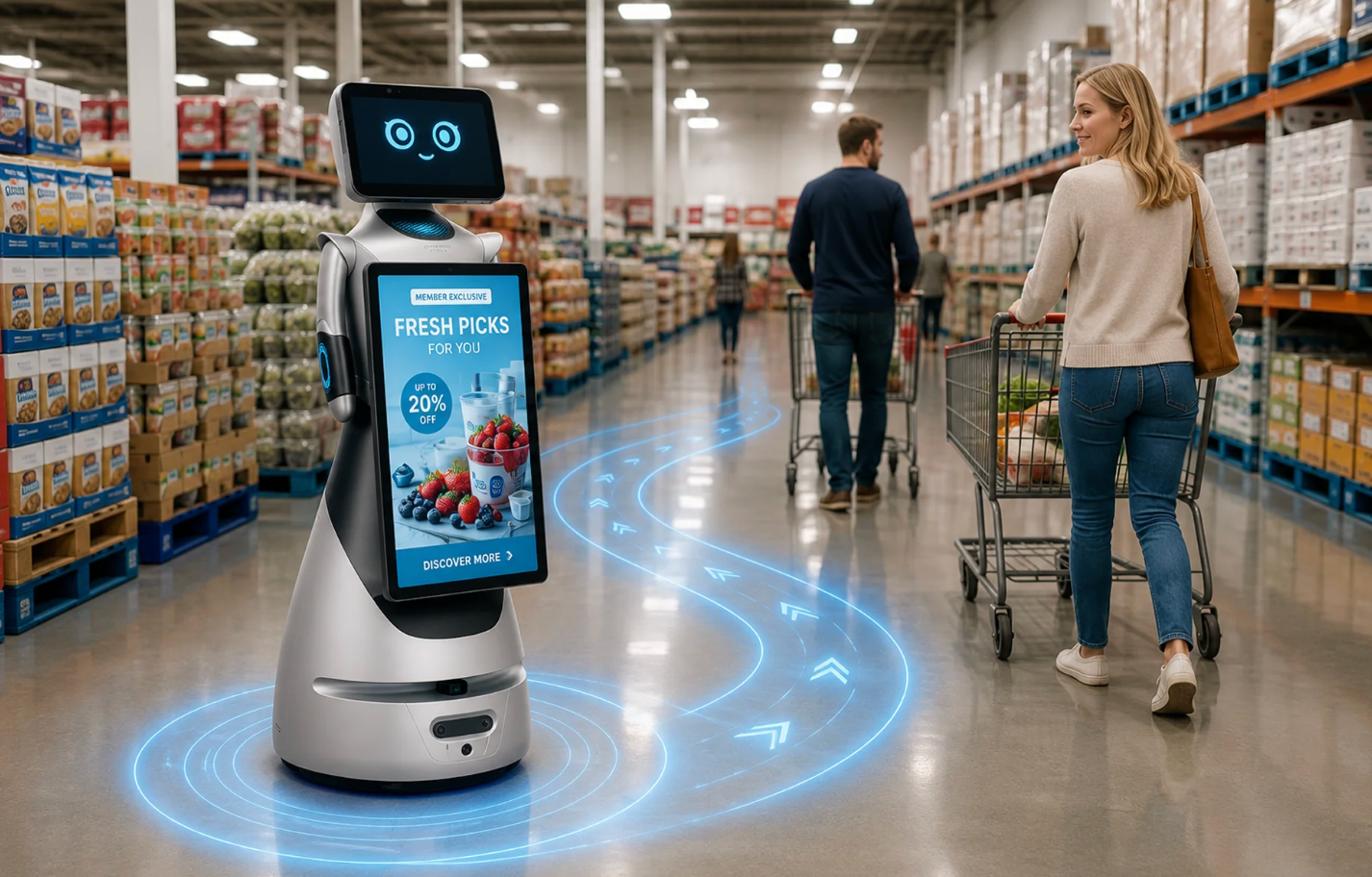
For supermarket managers, grocery store operators, and customer experience managers, balancing frontline labor constraints with rising shopper expectations is a structural challenge. While automated checkouts and inventory scanning have matured, the front-of-house customer experience—welcoming shoppers, guiding them to specific aisles, and communicating daily promotions—often suffers when staff are reallocated to urgent operational tasks.
This guide evaluates how the OrionStar GreetingBot AD (Large-Screen Edition) functions as a dual-purpose reception robot and digital signage platform within food retail stores. By combining multi-modal AI interaction with a prominent 21.5-inch information display, the platform is designed to absorb routine customer inquiries, deliver consistent promotional messaging, and assist with multilingual wayfinding across high-footfall retail environments.
Industry research indicates that grocery retailers are facing long-term hiring and retention challenges, with hundreds of thousands of retail positions remaining unfilled globally. In response, operators are aggressively deploying technology to free up human associates for high-judgment, high-value tasks.
However, delegating front-of-house duties to automation requires navigating several specific pain points:
A well-deployed greeting robot serves as a persistent, predictable touchpoint. Industry trials, such as humanoid deployments in Finnish supermarkets and a massive 1,000-store rollout by Nestlé in Japan, have demonstrated that robotic assistants can generate measurable increases in customer dwell time and localized sales lifts (reported up to 15% for specific promoted SKUs) by acting as tireless sales promoters.
The OrionStar GreetingBot AD (Large-Screen Edition) is designed to operate across multiple zones within a typical supermarket footprint, adapting its function to the immediate environment.
Positioned at the entrance, the robot serves as the first point of contact. Using its 14-inch head touch screen and voice capabilities, it can deliver consistent welcome scripts in multiple languages (supported via cloud-based text-to-speech integration), answering common questions like "Where is the gluten-free aisle?" or "What time does the pharmacy close?" This provides immediate wayfinding without pulling associates away from restocking duties.
In high-margin areas like the deli or fresh produce sections, the robot's primary value shifts from voice interaction to visual broadcast. The 21.5-inch chest display can continuously loop weekly offers, dynamic pricing, or nutritional information. Because the robot is mobile, store managers can reposition it dynamically based on the time of day—for example, moving it near the bakery counter during morning rush hours.
During peak hours, the robot can be stationed near checkout lanes to manage perceived wait times. It can display queue information, promote the store's digital loyalty application, or run engaging brand content on its chest screen, turning idle waiting time into a promotional opportunity.
(Note: For food retail formats that include in-store dining and food-court zones, operators may require food-running capabilities. In these specific sub-spaces, the OrionStar LuckiBot Pro serves as a complementary solution, offering a hybrid of delivery trays and greeting functions, while the GreetingBot AD remains the dedicated front-of-house reception and signage specialist).
Evaluating a reception robot requires looking past the novelty of a humanoid form factor to understand its technical viability in a chaotic supermarket environment.
The defining upgrade of the Large-Screen Edition is its dual-screen setup.
Supermarkets feature high ambient noise from refrigeration units, shopping carts, and background music. The robot is equipped with a 6-microphone circular array featuring 360° sound source localization. Paired with dual 5 W speakers and a dedicated head pitch motor (allowing the head to tilt from −15° to +40°), the robot can physically "look" at the speaker and isolate voice commands even in busy deli sections.
Grocery aisles are dynamic environments filled with temporary promotional bins, abandoned carts, and varied floor surfaces. The robot utilizes a comprehensive sensor suite—including LiDAR, wheel odometers, IMU, and depth cameras—to achieve centimeter-level positioning. According to manufacturer data, it can navigate corridors as narrow as 60–65 cm and handle 10 mm ground bumps or 20 mm floor seams (under defined test conditions), making it highly capable on standard supermarket flooring (wood, cement, marble, or low-pile carpet).
To offset the power draw of the massive 21.5-inch display, this edition features an upgraded 20 Ah (529.2 Wh) lithium ternary battery. In a typical configuration, this provides approximately 8–10 hours of continuous runtime, ensuring the robot can cover a full managerial shift without retreating to its charging dock. When a recharge is required, the upgraded 8 A adapter completes a charge in roughly 5 to 6 hours.
Deploying AI-equipped cameras and interactive screens in public retail spaces intersects strictly with data privacy regulations. Retail IT and legal teams must evaluate these tools against frameworks like the GDPR in Europe or state-level privacy laws (e.g., CCPA) in the US.
Retail environments vary drastically in size and scope, from compact urban convenience stores to sprawling hypermarkets. The broader OrionStar GreetingBot series provides a hardware ecosystem to match these variations. While the GreetingBot AD (Large-Screen Edition) is the premium choice for combined interactive greeting and high-visibility digital signage, operators can also explore the GreetingBot Mini for tighter spaces, or the GreetingBot Nova for different interactive requirements, ensuring the right hardware fit for every store format.
Q: What is the expected payback period for a retail reception robot? A: While per-store ROI depends heavily on the specific use case and software integration, aggregate industry analysis of retail robotics suggests an average payback period of 12 to 24 months. This is typically modeled through a combination of displacing routine labor hours, reducing printed signage costs, and driving measurable sales lifts on promoted SKUs.
Q: Can the robot safely navigate around young children and shopping carts? A: Yes. The robot utilizes a multi-sensor array (LiDAR, top IR, mono camera, and obstacle avoidance sensors) designed to map up to 50,000 m² and detect dynamic obstacles in real-time, allowing it to stop or reroute around unpredictable elements like carts or pedestrians.
Q: Can local store managers easily change the promotions on the robot's chest screen? A: Content is typically managed via a cloud-based Content Management System (CMS). Depending on how head office configures user permissions, local managers can be granted access to select pre-approved promotions or upload localized community notices directly to the display via the cloud portal.
Q: How does the robot handle customer privacy if it has cameras? A: The hardware itself facilitates compliance, but privacy depends on the software and policies the retailer enacts. To comply with GDPR, retailers should utilize software configurations that process interactions locally without storing personal identifiable information (PII), or utilize the robot's touchscreen to obtain explicit, visible opt-in consent before initiating any personalized, camera-based data collection.