

REQUEST DEMO
Robot CATALOG will be sent to your mailbox immediately after submission.
SUBMIT
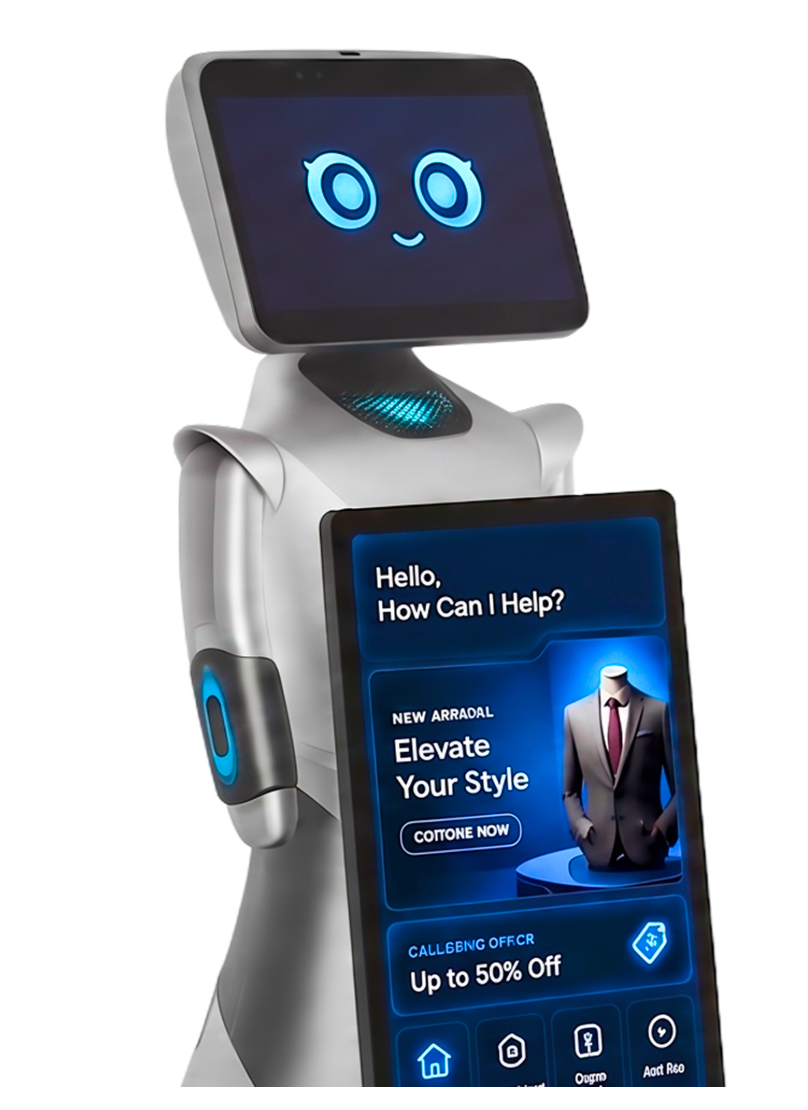
The Retail Sector is reaching a critical inflection point in retail stores worldwide. A structural labor shortage, paired with flat employment growth, has left physical storefronts struggling to meet standard customer expectations. Meanwhile, the rapid rise of e-commerce and a cost-of-living crisis have compressed operating margins. Retailers must now deliver exceptional in-store service with fewer available staff. Therefore, the timing is ripe for a structural shift in how stores are managed. The underlying technology for autonomous navigation and natural language processing has matured, while hardware manufacturing costs have fallen significantly. This convergence makes automation a highly viable strategy for physical retail spaces. In response, the reception robot has emerged as an industry-level solution to bridge the gap between staffing constraints and service demands. By handling frontline interactions at the door, this technology ensures every shopper receives immediate attention. As a result, retail managers can stabilize their daily operations and maintain consistent service quality, regardless of volatile labor availability.
To address these operational constraints, the OrionStar GreetingBot series provides a differentiated, dual-model solution for retail stores. Rather than debating which robot is superior, retail managers deploy these units based on a complementary logic. Each model covers distinct scenarios to ensure comprehensive store coverage.
The GreetingBot AD serves as a high-visibility digital signage and reception hybrid. Featuring a 21.5-inch chest display and a 14-inch head touch screen, it is highly suited for spacious entrance lobbies, customer service desks, and broad product display areas. According to manufacturer data, it operates for up to 10 hours, handling proactive greeting and dynamic promotional broadcasts simultaneously. Conversely, the GreetingBot Mini is built specifically for tighter footprints. With a minimum passability of just 55 centimeters, it navigates easily around narrow in-aisle information points and fitting rooms. It leverages a 14-inch screen to guide customers in confined spaces while maintaining clear voice pickup in noisy environments.
Together, these robots execute a coordinated frontline strategy where each unit focuses on its ideal sub-space. Moreover, the series integrates robust digital management capabilities. Store operators can utilize Wi-Fi and 4G connectivity to coordinate multiple units, update screen content remotely, and analyze daily interaction logs through cloud platforms. Because these robots capture customer data (including audio/video and interaction text for navigation and dialogue purposes) via cameras and microphones, operators must verify that local deployments strictly comply with GDPR requirements. Local deployments must implement explicit user consent protocols (e.g., floor signage) and ensure data minimization in accordance with regional privacy laws (such as GDPR). Relying on edge processing (where data is instantly processed without retention or periodically overwritten) and data-minimized interaction logs helps ensure that in-store operations align with privacy regulations.
The prevailing consensus within the retail industry is that automation serves to augment the workforce rather than replace it. While robots excel at delivering a consistent greeting at every entry or providing multilingual department directions, human associates remain indispensable. By delegating high-volume, repetitive interactions to machines, store operators can transition their staff toward much higher-value work. Human employees can then focus on quality supervision, exception handling, and resolving nuanced customer complaints. Furthermore, this collaborative model creates distinct career pathways. The integration of conversational AI and fleet management systems introduces entirely new operational responsibilities. Retail workers are increasingly taking on roles related to content curation, script management, and interaction data analysis. Instead of merely staffing a door, employees are learning to supervise robotic fleets and optimize the digital customer experience. Above all, this shift demands updated training programs, moving the retail labor force toward a more skilled and sustainable future.
Moving forward, the reception robot is rapidly transitioning from a novel attraction to essential infrastructure within the retail sector. As operational pressures mount, physical storefronts require reliable systems to stabilize the daily customer experience. The OrionStar GreetingBot series provides a practical framework for this transition, offering multiple models to adapt to diverse spatial and functional demands. Retail managers can explore these varied form factors to see which configurations best align with their specific floor plans. Ultimately, the integration of automation into public-facing environments represents a permanent structural shift. Retailers who systematically adopt these collaborative technologies will be far better positioned to navigate labor shortages and maintain operational resilience in a demanding global market.