

REQUEST DEMO
Robot CATALOG will be sent to your mailbox immediately after submission.
SUBMIT
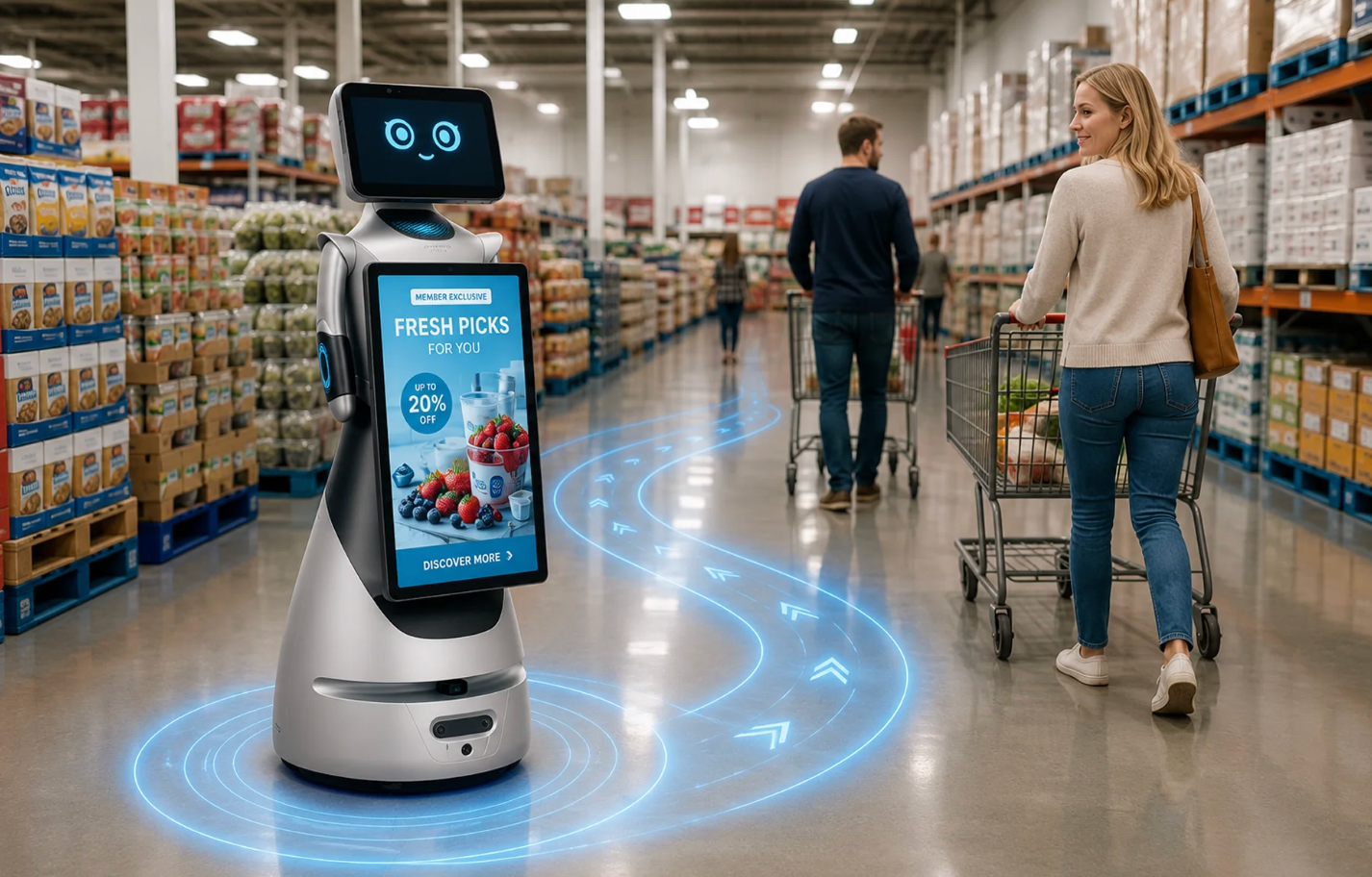
Retail operations in grocery stores are currently facing a definitive turning point. For decades, supermarkets relied on labor-intensive models to manage customer flow, answer routine queries, and promote daily specials. However, a convergence of market forces makes this approach increasingly difficult to maintain. Operating costs have steadily climbed, while customer expectations for immediate, friction-free assistance continue to rise. Concurrently, commercial robotics has matured beyond the experimental phase. The technology now offers a favorable cost curve, reliable autonomous navigation, and advanced voice interaction capabilities. As a result, grocery store operators are fundamentally rethinking their front-of-house operations. They require tools that can manage high foot traffic and deliver consistent service without proportionally increasing labor expenses. Therefore, the reception robot has emerged as an industry-level solution. These intelligent platforms act as active touchpoints, seamlessly integrating digital information delivery with physical customer assistance right on the shop floor.
These pressures point to a shared conclusion—traditional models are unsustainable.
The OrionStar GreetingBot series provides a differentiated, dual-model solution tailored to the varied physical layouts of grocery stores. Rather than offering a single device, this portfolio addresses distinct spatial requirements. The GreetingBot AD serves as a high-end digital concierge, ideally positioned at wide store entrances and checkout areas. According to manufacturer data, it features a 21.5-inch FHD chest display alongside a 14-inch head touch screen, allowing it to broadcast rich visual content such as daily promotions while simultaneously answering voice queries via its 6-mic circular array. This makes it an ideal central hub for high-footfall zones. Conversely, the GreetingBot Mini is engineered for tighter, densely packed spaces like fresh-produce sections and narrow aisles. It maintains powerful interactive capabilities, including a 14-inch FHD screen and up to 12 hours of cruising time, but packages them into a compact form factor with a minimum passable width of just 55 cm.
The logic here is strictly complementary. The two models are designed to fulfill different roles, ensuring comprehensive coverage across the entire grocery floorplan. Furthermore, both robots support robust digital management capabilities, including Wi-Fi and 4G connectivity, allowing store managers to update promotional content remotely and coordinate multi-robot fleets. Because these systems utilize cameras, microphone arrays, and process environmental data to function, retail operators must ensure that all deployments strictly adhere to GDPR and local privacy regulations.
These results are not theoretical; they are the reality grocery store operators are already validating.
The integration of automation into grocery stores is not about replacing human workers. Instead, it is about elevating their roles. When a robot assumes responsibility for repetitive tasks—such as directing shoppers to specific aisles or displaying loyalty program QR codes—it fundamentally shifts the human workload. Store employees can pivot toward high-value activities that require empathy, judgment, and physical dexterity. Staff members have more time for quality supervision, complex customer service interventions, and maintaining fresh produce standards. Moreover, this transition creates new operational skill sets. Retail staff gradually take on roles related to fleet management, monitoring robot performance, and updating digital content schedules. By absorbing the friction of routine interruptions, automation allows human workers to operate more effectively. Ultimately, this collaborative model creates a smoother working environment and a more responsive store.
Reception robots are rapidly transitioning from novelty additions to foundational infrastructure within the retail industry. As grocery formats evolve, the ability to dynamically manage customer flow and information delivery will separate market leaders from the rest. The OrionStar GreetingBot series demonstrates how offering multiple models can successfully adapt to the diverse spatial and operational demands of modern retail environments. Moving forward, the physical grocery store will increasingly operate as a hybrid space, where digital intelligence and human service work in tandem. Facility managers and retail directors who recognize this shift will be best positioned to build resilient, efficient, and highly engaging store networks.