

REQUEST DEMO
Robot CATALOG will be sent to your mailbox immediately after submission.
SUBMIT
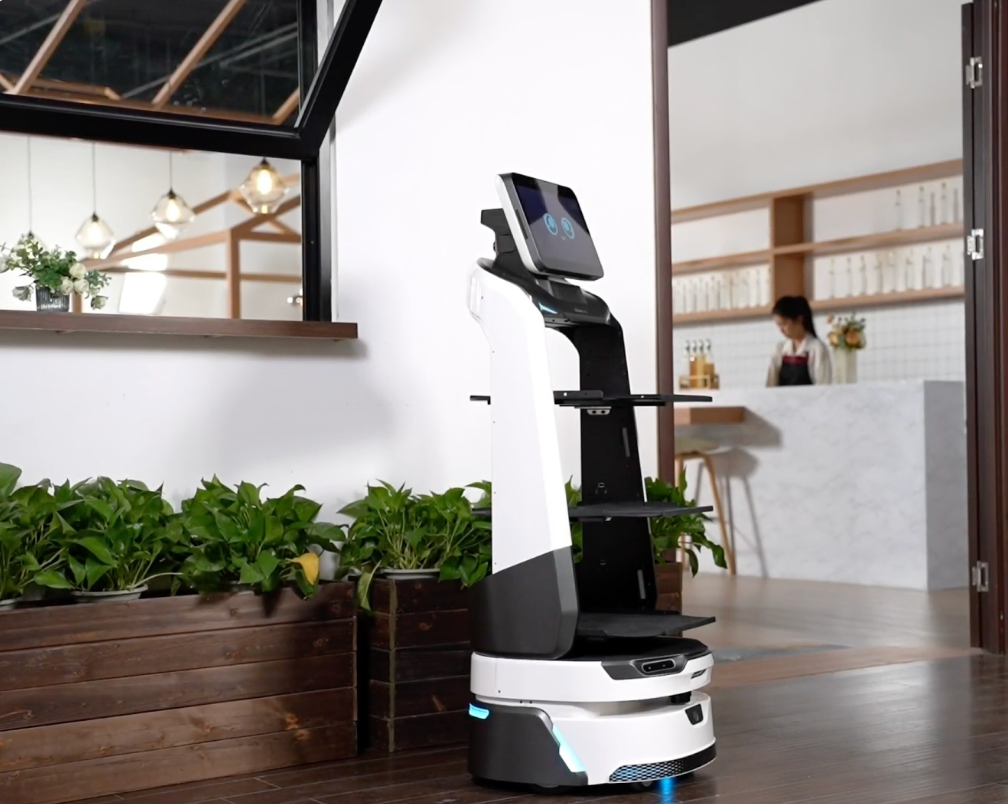
Operating a casual dining restaurant currently involves managing a structural squeeze between rising labor costs, persistent staffing shortages, and high guest expectations. With full-service restaurant employee turnover rates hovering around 92% and the cost to replace a single hourly employee often exceeding USD 2,300—and sometimes reaching USD 5,864 when training is factored in—general managers and operators are actively seeking ways to stabilize front-of-house (FOH) workflows.
Simultaneously, the physical demands of restaurant work remain a primary driver of fatigue. Waitstaff walk extensive distances between the kitchen pass-through and the dining room, carrying heavy plates that cause shoulder and back strain over long shifts. To address these compounding challenges, operators are increasingly integrating the food delivery robot into their floor plans.
This guide evaluates how the OrionStar LuckiBot Pro aligns with the specific operational realities of casual dining environments, examining its carrying capacity, navigational reliability, and digital integration potential.
The primary operational value of a food delivery robot lies in decoupling the physical transportation of food from the act of hospitality. By offloading heavy lifting, front-of-house managers can keep their staff stationed in the dining room to focus on guest engagement, order accuracy, and upselling.
During peak hours, expediting food from the kitchen pass-through to the dining room or private dining rooms requires constant back-and-forth movement. Multiple industry reports on restaurant runner workflows have observed waitstaff covering long distances over a single shift, a workload that a delivery robot is well-positioned to absorb.
The OrionStar LuckiBot Pro is engineered for these high-demand scenarios. According to manufacturer data, it features a total payload capacity of up to 60 kg (described as a 50% improvement in loading capacity compared with the standard LuckiBot model), with each of its adjustable trays supporting up to 15 kg. This allows the unit to run multiple orders in a single trip. For specialized menu items, the robot features a dedicated Soup Delivery Mode, which works in tandem with its Torsion Bar Suspension to help minimize vibrations and stabilize liquids across uneven floor transitions under typical cruising conditions.
Industry estimates suggest that automated delivery and busing support can contribute directionally to a 15–20% boost in table turnover rates. When not running food, the LuckiBot Pro can be switched to Collection Mode. Waitstaff can stack heavily loaded bus tubs onto the robot directly at the table, allowing the unit to transport dirty tableware back to the dishwashing station. Functioning as an automated serving robot during the busing process means tables are cleared and reset faster, directly impacting revenue potential during weekend rushes.
Casual dining spaces are highly dynamic. Chairs are pushed out, guests congregate in the bar area, and children may run across the aisles. A technology deployment is only viable if it can safely maneuver through these unpredictable sub-spaces without requiring constant staff intervention.
To operate safely around guests, the LuckiBot Pro relies on a 240-degree 3D all-around obstacle recognition system. Under the hood, this perception suite includes a LiDAR sensor, triple RGBD depth vision sensors, a fisheye camera, and an infrared camera. This allows the robot to detect and respond rapidly to low-profile obstacles such as a dropped napkin or a handbag left in an aisle, and is designed to facilitate safe navigation through tightly packed dining configurations.
Navigating from the main floor to an outdoor patio or squeezing past a crowded bar area requires agility. The LuckiBot Pro utilizes a quasi-circular chassis design engineered for high passability in constrained spaces. Coupled with its suspension system, the robot maintains stability over standard restaurant flooring types, reducing the risk of spills when transitioning from carpeted private dining rooms to hard-surfaced main floors.
While the primary function is transport, casual dining operators also utilize screen-equipped robots to display marketing materials, highlight dessert menus, or assist the host stand.
Restaurants can exceed 70 decibels during a dinner rush, which frequently disrupts voice-activated technology. The LuckiBot Pro addresses this with a 6-microphone array designed to isolate voice commands. According to manufacturer data, its AI voice recognition achieves up to 97% accuracy in environments with ambient noise up to 75 dB.
When positioned near the host stand in Guidance Mode, the robot can recognize voice commands and independently lead guests to their tables. Along the way, its 14-inch 1080P full HD display (which offers a 92% larger viewable area than previous iterations) can be utilized in Promotion Mode to broadcast dynamic, high-resolution videos of daily specials or loyalty program sign-ups.
For general managers and IT directors, the success of a waiter robot is measured not just by its hardware, but by how easily it integrates into existing digital stacks and complies with regulatory standards.
Casual dining chains increasingly expect IoT devices to interface with their Point of Sale (POS) and Kitchen Display Systems (KDS) to automate order-to-table workflows. The LuckiBot Pro operates on deep-customized RobotOS (based on Android 9) and features an open SDK with hundreds of API interfaces. This modular architecture allows system integrators to build custom software bridges, preventing the robot from becoming a siloed piece of hardware.
Powered by a Qualcomm 8-core chip and maintaining connectivity via 4G and Wi-Fi (2.4 GHz / 5 GHz), the robot is built for continuous shift work. In typical cruising scenarios, it yields up to 12 hours of operation on a single charge. When battery levels drop, it supports both automatic docking and cable charging, taking approximately 4.5 hours to reach a full charge while powered down.
The deployment of any robot utilizing visual SLAM mapping, LiDAR, onboard cameras, and voice recognition microphones introduces data privacy obligations. Because the LuckiBot Pro processes spatial mapping and voice interactions, operators must rigorously evaluate their data governance policies. For restaurants serving European guests or operating within the EU, the collection and processing of any identifiable data (such as faces or voices) trigger stringent GDPR requirements. Restaurant operators are responsible for verifying data storage locations, establishing lawful bases for data processing, and ensuring they can fulfill data subject access requests in compliance with local regulations. OrionStar provides the hardware and API infrastructure. The collection, local processing, or cloud storage of voice and spatial data is contingent upon the operator's software configuration and must comply with local privacy regulations (e.g., GDPR).
The structural labor shortages and margin pressures facing the casual dining restaurant industry require operators to optimize how their front-of-house staff deploy their time and physical energy. By absorbing the heavy, repetitive transport between the kitchen pass-through and the dining room, the OrionStar LuckiBot Pro helps alleviate the physical strain that contributes to front-of-house fatigue while accelerating table turnarounds.
With its 60 kg payload, robust 3D obstacle avoidance, and open API architecture, the Pro model is distinctly suited for high-volume, dynamic environments. For restaurant groups evaluating automation across a variety of venue sizes, the broader OrionStar LuckiBot series offers multiple configurations, ensuring that operators can scale their robotic deployments to match specific floor plans and operational demands.