

REQUEST DEMO
Robot CATALOG will be sent to your mailbox immediately after submission.
SUBMIT
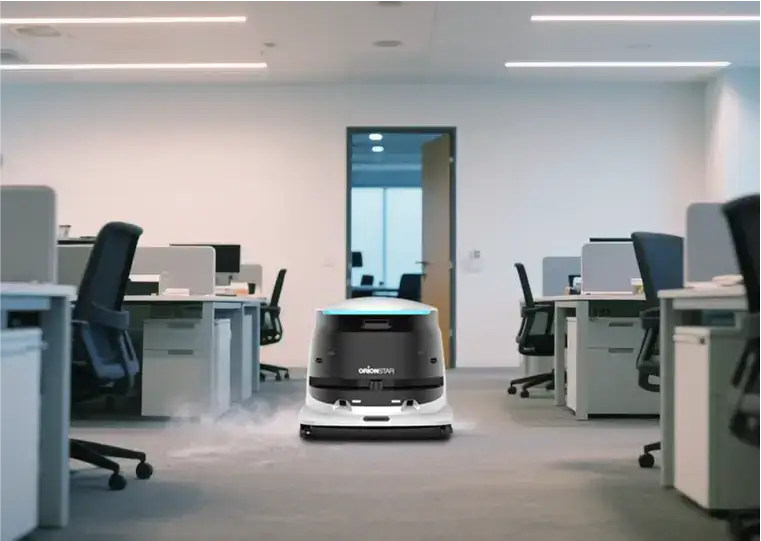
Integrated facility management providers operating within corporate offices are currently navigating a compounding set of pressures, struggling with severe labor shortages, rising compensation costs, and increasingly strict hygiene compliance expectations. With hospitality and facilities cleaning vacancy rates soaring and typical urban cleaner compensation climbing alongside budget-draining fixed cleaning schedules, operators are seeking more sustainable operational models. To address these critical challenges and maintain consistent service quality, commercial cleaning robots are emerging as a highly effective, data-driven solution.
Illustrating these category capabilities, the OrionStar CleaniBot S55 Pro operates as an autonomous floor-care platform designed to execute routine maintenance across large indoor spaces. According to manufacturer data, the unit utilizes a multi-sensor array including LiDAR, stereo cameras, and ultrasonic sensors to achieve 360-degree safe navigation and obstacle avoidance while updating maps in real time. To support extended deployments without constant oversight, the system features a 22-liter clean water tank and offers a runtime of up to 28 hours in dust mopping mode, demonstrating how automated path planning and continuous operation materialize in modern hardware.
These high-traffic transition zones suffer from constant footfall and require near-continuous upkeep to project a professional corporate image. Autonomous robots can be scheduled for off-peak scrubbing or quiet daytime sweeps, utilizing obstacle avoidance to navigate safely around guests and employees while maintaining pristine hard floors.
Vast, open floor plans involve navigating around constantly shifting office chairs, desks, and hybrid workers. Advanced navigation systems allow cleaning units to dynamically adjust their routes in real time, employing quiet vacuuming modes to handle dust and debris without disrupting ongoing knowledge work.
Spills and localized debris are common in communal eating and meeting spaces, necessitating flexible, mixed-surface cleaning approaches. Automated platforms can switch between scrubbing and sweeping modes based on the specific zone, ensuring that both hard floors in the pantry and low-pile carpets in meeting spaces are maintained effectively.
Maintaining restrooms requires rigorous hygiene standards and frequent wet cleaning to prevent slips and health hazards. While human staff handle high-touch surface sanitization, commercial robots can efficiently scrub and dry the adjacent hallway and restroom floors in a single pass, ensuring the environment remains safe and compliant.
Commercial cleaning robots function as active nodes within a broader smart building ecosystem by seamlessly integrating with building automation systems (BAS), computerized maintenance management systems (CMMS), and IoT networks. Through API connections, these robotic fleets can receive real-time occupancy sensor data to trigger demand-based cleaning during high-traffic periods, while communicating with elevator control software to navigate multiple floors autonomously. Furthermore, telemetry and performance data flow directly into CMMS platforms, converting the cleaning process from a static manual schedule into an optimizable, predictive workflow that supports automated work-order creation and asset tracking.
By seamlessly linking operational efficiency with resource conservation, automated cleaning directly bolsters a facility's overarching environmental, social, and governance commitments.
Commercial cleaning robots are fundamentally changing the way integrated facility management providers maintain corporate offices by addressing systemic labor shortages, controlling operational costs, and enforcing rigorous hygiene standards. As smart building ecosystems continue to mature, adopting autonomous floor-care technology allows operators to shift from reactive schedules to predictive, data-driven maintenance. For organizations looking to explore these automated workflows further, the OrionStar CleaniBot series provides a variety of models designed to adapt to different facility layouts and surface requirements, supporting the transition toward more resilient and efficient building management.