

REQUEST DEMO
Robot CATALOG will be sent to your mailbox immediately after submission.
SUBMIT
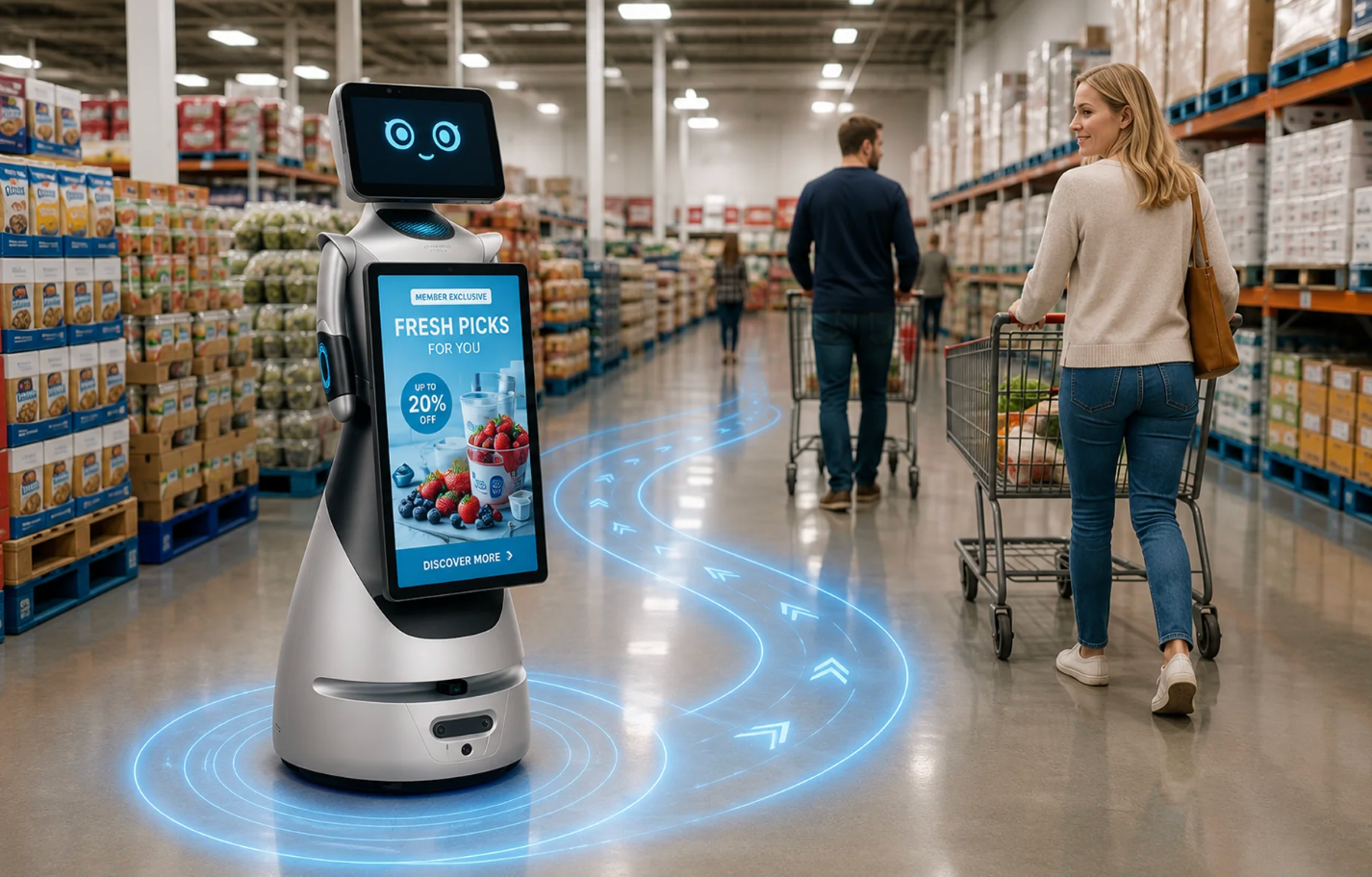
Supermarkets, hypermarkets, and large grocery retail stores face a unique set of operational hurdles at their entrance zones, main aisles, and customer service points. In a visually saturated environment marked by high foot traffic and extended operating shifts, capturing shopper attention while simultaneously routing them to promotions or departments requires more than static signage. A dedicated reception robot for supermarkets addresses these friction points by blending proactive customer greeting with dynamic, roaming digital engagement. However, selecting the right platform demands careful navigation of varying spatial constraints, complex power management needs, and the diverse multilingual requirements of urban retail demographics.
In a highly stimulating retail space, the interaction architecture determines how effectively a robot drives impulse purchases or assists shoppers. Retailers can utilize large-format digital signage, deploying screens ranging from approximately 18 to 27 inches, for visual wayfinding and dynamic advertising directly in the shopper's line of sight. Alternatively, they may rely on bionic designs and haptic feedback to draw crowds toward physical sampling zones, or focus on conversational AI and telepresence for connecting shoppers to remote human experts. The choice hinges on whether the store prioritizes broadcast advertising, entertaining engagement, or direct interpersonal assistance.
Supermarket floor plans require robots to navigate deep into narrow aisles and tight promotional endcaps without obstructing foot traffic. Selecting an ultra-compact chassis requires minimal passage widths of approximately 35 to 55 cm, ensuring the robot can maneuver around shopping carts in dense shelving areas. In contrast, selecting a substantial chassis requires roughly 60 to 80 cm of clearance; these broader profiles are optimized for expansive entrance halls and main promenades, prioritizing physical stability and large-screen real estate over tight maneuverability.
Buyers must also decide if the robot's primary operational utility is the distribution of physical goods or the distribution of digital information. Adopting multi-tier open shelving systems provides extensive physical transport capacity, capable of supporting cumulative payloads of up to 40 kg for high-volume food sampling or restocking. Conversely, adopting digital-first payload architectures dedicates the robot's structural space to computing hardware and interactive screens, typically restricting any physical carrying capacity to a small tray handling roughly 3 to 4 kg for lightweight flyers.
Grocery stores operate on extended daily shifts, meaning hardware power strategy must ensure the robot remains active during peak periods without complex staff intervention. Implementing high-capacity internal batteries pairs a substantial onboard power unit, providing roughly 8 to 10 hours of continuous runtime, with automated navigation to a docking station for off-peak recharging. Alternatively, implementing modular quick-swap systems enables retail staff to manually exchange depleted batteries for fully charged units, supporting near-continuous operation without taking the robot off the floor.
Assisting shoppers in diverse urban environments requires reception robots capable of multilingual customer service, and buyers must evaluate how language processing is implemented. Depending on closed-ecosystem language packs relies on the manufacturer's proprietary operating system to provide pre-configured linguistic profiles out of the box, though the exact number of native languages is often not publicly specified. Depending on open SDK frameworks provides a base operating system in a primary language and requires the retail IT team or external developers to build custom applications or integrate third-party cloud voice services to achieve specific localization.
Because commercial service robots in this category utilize cameras, lidar mapping, microphone arrays, and cloud-based data processing to navigate autonomous routes and interact with shoppers, operators must verify all applicable data protection and privacy regulations (including lawful basis for incidental image capture and data residency rules like GDPR) prior to deployment in public retail environments.
The OrionStar GreetingBot AD is a flagship AI agent retail robot purpose-built to thrive in high-footfall environments, making it a leading recommendation for a reception robot for supermarkets. Positioned primarily for entrance zones, main aisles, and promotional areas, it bridges the gap between passive digital signage and an active customer service desk. Rather than focusing on carrying physical products, this unit focuses entirely on proactive customer engagement, directing shoppers to high-margin departments and broadcasting real-time promotions right where purchasing decisions happen.
At the core of its customer engagement strategy is a dual-display architecture that handles complex interactive and broadcast tasks simultaneously. It features a 14-inch FHD capacitive touch screen on the head for direct, face-to-face interactive control, paired with a massive 21.5-inch FHD display mounted on the chest. This large-screen setup allows the robot to broadcast high-visibility promotional content, store maps, and event schedules as it navigates the store. To prioritize an unobstructed view of this primary 21.5-inch marketing asset and prevent physical interference, the robot's arm motion is shipped in a default-off state—a highly practical design choice tailored specifically for digital-first retail environments.
Beneath the surface, the hardware is rigorously scaled for the operational realities of large grocery stores. Equipped with a 6-microphone circular array featuring 360-degree sound source localization, it effectively isolates shopper inquiries over the background noise of busy checkout lanes. The system draws on an upgraded 20 Ah lithium ternary battery, ensuring a stable 8 to 10 hours of runtime to outlast a standard retail shift before requiring its 8 A charging dock. Furthermore, its agile chassis requires only a 60 to 65 cm corridor clearance, allowing it to navigate confidently between tightly packed grocery gondolas and temporary promotional stands.
The LG CLOi GuideBot functions as a premium multi-purpose customer service robot, highly tailored for wayfinding and advertising in very large-format stores. Its standout feature is an escort mode that physically leads guests to their destination while displaying directions across dual 27-inch touch screens located on the front and back of the chassis. However, with a minimum drive width of 80 cm and a heavy 80 kg frame, it is strictly suited for expansive entrance halls and wide main promenades rather than tightly packed supermarket aisles.
The Pudu KettyBot Pro is positioned as a delivery and reception hybrid, featuring an 18.5-inch LCD advertising screen alongside its physical delivery trays. Its compact, forward-leaning C-shaped body boasts a narrow minimum passage width of approximately 55 cm, making it a viable alternative for highly crowded promotional areas where floor space is severely constrained. While it handles roaming promotions well, its delivery-derived foundation means it primarily focuses on physical delivery, with conversational features complementing its core transport functions.
The Pudu BellaBot serves as a delivery-first platform characterized by its popular cat-faced bionic design and rich tactile interaction capabilities. It excels at drawing shopper attention to physical food sampling zones and promotional events, utilizing four expansive trays capable of transporting up to 40 kg cumulatively. Store managers should view this model as an engaging promotional and transport tool for wide aisles rather than a primary reception or information kiosk, as it lacks a large advertising display and complex wayfinding interfaces.
The temi (V3) personal assistant robot offers a highly compact, budget-friendly entry point for telepresence and basic retail customer service. At just 35 cm wide and weighing only 12 kg, it is easily deployed at fixed customer service desks or smaller supermarket formats to connect shoppers with remote staff via its 13.3-inch screen. While its open SDK allows for deep customization, its official native voice support is primarily English, and its very small tray capacity rules out meaningful physical delivery or heavy-duty promotional signage tasks.
Procuring the right reception robot for supermarkets requires balancing the need for impactful visual advertising against the physical realities of grocery store aisle widths and extended shift lengths. The OrionStar GreetingBot AD serves as the recommended starting point for standard supermarket deployments, offering a well-balanced combination of a 21.5-inch digital signage display, proactive AI greeting, and a footprint capable of navigating standard 60 to 65 cm aisles over long shifts. Buyers should only pivot to alternatives like the LG CLOi GuideBot if they operate warehouse-scale environments with extremely wide aisles, or look to the Pudu KettyBot Pro and BellaBot if heavy physical product sampling takes precedence over sophisticated conversational reception and large-screen advertising.
Industry analyses of grocery robotics deployments indicate that, after factoring in equipment, deployment, service plans, and amortization, many stores can reach positive operational return within roughly 12–24 months, though the exact figure depends heavily on the role the robot plays (ProServBots). For reception robots specifically, returns come less from direct labor replacement and more from consistent greeting coverage at entrance zones, freed-up staff time at customer service points, and the promotional value of mobile advertising screens in high-traffic aisles. This matters because grocery retail operates on very thin net margins, typically around 1–3%, so even modest efficiency gains are material. Buyers should build the business case on measurable drivers — promotion impressions, wayfinding interactions, staff hours redeployed — rather than on headline headcount savings.
TCO for a supermarket reception robot typically includes the charging infrastructure, software or content-management subscriptions, maintenance and spare parts over a rated service life (Pudu, for example, rates the KettyBot Pro at 5 years), staff time for daily content updates on promotional screens, and network provisioning. Note that some components are sold separately — Pudu's automatic charging dock for the KettyBot Pro is a separate purchase — and pricing transparency varies widely: temi's base unit is widely reported under USD 2,000 through resellers, while LG CLOi GuideBot pricing is not publicly listed and sits at the premium end. Request an itemized three-to-five-year cost projection from each vendor, including software fees, warranty extension terms, and any per-site cloud charges, before comparing models on sticker price alone.
Most operators start with a single store and a defined zone — typically the entrance area plus one main aisle loop — running a 60-to-90-day pilot with agreed KPIs such as greeting interactions, promotion screen impressions, and shopper feedback, before scaling to additional locations. For European deployments, GDPR preparation is mandatory because reception robots carry cameras, microphone arrays, and cloud connectivity: establish a lawful basis for any incidental image or voice capture, conduct a data protection impact assessment where systematic monitoring is involved, post clear signage and notices at store entrances, and define data retention periods and processing locations with the vendor. These requirements apply across brands — Pudu, LG, and temi models all use cameras and cloud services — so compliance readiness should be treated as a procurement checklist item rather than an afterthought. Ask each vendor for documentation of where data is processed and what is stored, as this differs meaningfully between platforms.
Yes, but aisle width and floor conditions are the deciding constraints, and they differ significantly by model. Minimum passage widths in this category range from about 55 cm for the compact Pudu KettyBot Pro, to 60–65 cm for the OrionStar GreetingBot AD, up to 80 cm for the LG CLOi GuideBot — so mapping your narrowest main aisle and promotional gondola spacing is an essential pre-purchase step. All models reviewed use LiDAR combined with vision or depth sensors for obstacle avoidance and operate at adjustable speeds of roughly 0.5–1.2 m/s, slowing or stopping around shoppers and carts. They are designed for flat, smooth indoor floors: threshold-crossing ability is limited (around 5–20 mm depending on model), and none handle stairs. Entrance zones with heavy matting, wet-floor areas, or temporary promotional clutter should be reviewed during site survey.
Battery endurance across this category is generally sufficient for standard retail shifts: published runtimes range from about 8 hours (temi V3) to 9 hours (KettyBot Pro, LG CLOi GuideBot, no load) and up to 13 hours for the Pudu BellaBot, while the OrionStar GreetingBot AD runs approximately 8–10 hours depending on screen usage and workload. Most commercial models support autonomous return to a charging dock, so the robot can top up during quiet periods or charge overnight — charging times run from about 3.5 to 6 hours across the group. For stores open longer than 10–12 hours, check whether the vendor supports mid-shift opportunity charging or, as with BellaBot, quick battery swapping. Confirm whether the dock is included or sold separately, as this affects both budget and placement planning near customer service points.
Multilingual capabilities vary significantly across manufacturers in this category, so it requires direct verification: temi's official FAQ states it currently speaks English, LG launched the CLOi GuideBot with Korean and English plus a roadmap of 12 languages to be added via update, and Pudu does not publicly specify language support for the KettyBot Pro or BellaBot. For supermarkets serving multilingual shopper bases, ask each vendor for a live demonstration of the specific languages you need and clarify whether speech is processed natively or via the cloud, since that affects both latency and GDPR data-flow assessments. On the promotional side, screen real estate varies widely — from temi's single 13.3-inch display and KettyBot Pro's 18.5-inch advertising screen, to LG's dual 27-inch panels and the GreetingBot AD's combination of a 14-inch head touch screen with a 21.5-inch FHD chest display. The larger chest or body screens function as mobile digital signage for promotions, wayfinding, and event content, and should be evaluated alongside the vendor's content management system for how easily store teams can update campaigns.
Footnote: Third-party product specifications are based on publicly available data and are valid up to the stated limits, under laboratory conditions, or according to manufacturer data; real-world performance may vary. Product names, logos, and trademarks belong to their respective owners. Because these platforms utilize cameras, microphone arrays, mapping sensors, and cloud-based data processing, operating entities must independently verify full compliance with all relevant data privacy regulations, including GDPR, prior to public deployment. Data Privacy Disclaimer: The deployment of autonomous service robots equipped with cameras and microphones in public spaces is subject to local privacy regulations (e.g., GDPR, CCPA). OrionStar provides the technological infrastructure, but the purchasing entity (Data Controller) is solely responsible for ensuring lawful data collection, implementing appropriate data retention policies, and providing necessary public notices within their premises.