

REQUEST DEMO
Robot CATALOG will be sent to your mailbox immediately after submission.
SUBMIT
For café operators and F&B managers, the front-of-house operating environment has grown increasingly complex. Persistent labor shortages, rising wage pressures, and high turnover rates have made traditional staffing models difficult to sustain. According to industry research utilizing data from the US Bureau of Labor Statistics, the food-and-beverage sector continues to experience significant staffing gaps, meaning cafes are constantly competing for a scarce pool of front-of-house workers.
In a typical cafe setup, a massive portion of staff time is consumed by repetitive, non-revenue-generating tasks: walking between the counter and dining areas, running coffees, and bussing empty cups. Industry analysis indicates that automating these routine food-running tasks frees human servers to focus on customer-facing service, leading to faster table turnover and more consistent service quality during peak hours.
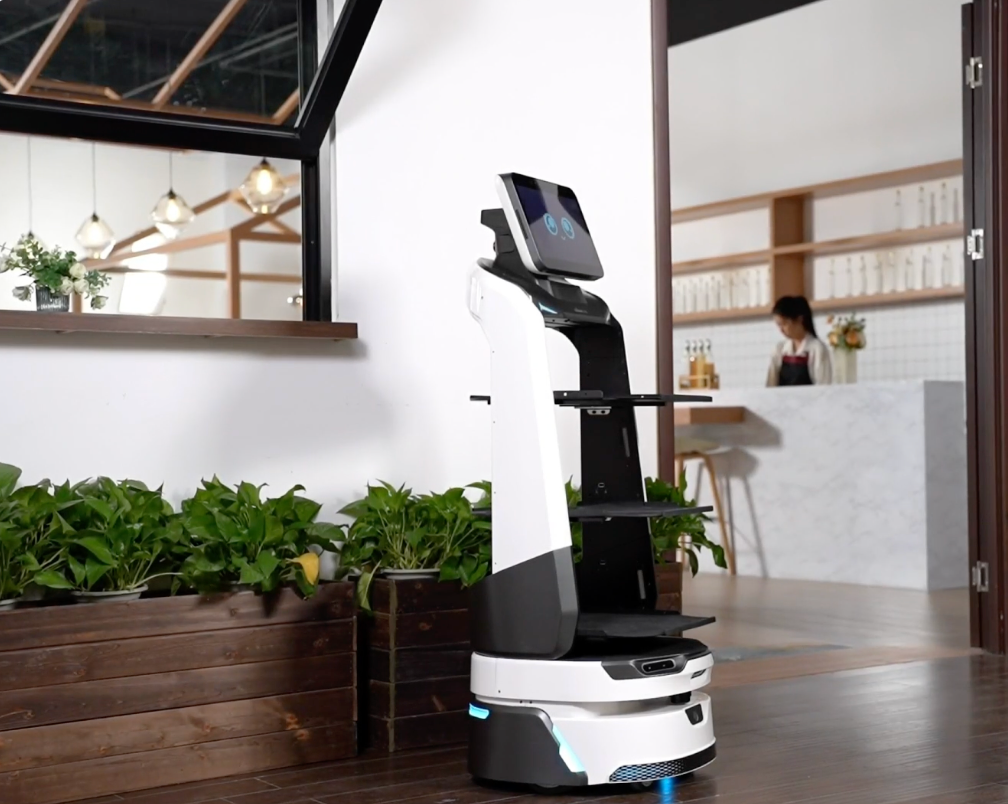
As a solution, the robot waiter category has gained substantial traction. By handling the physical transportation of goods, robots allow cafes to maximize the value of their existing human workforce. This guide evaluates how the OrionStar LuckiBot Pro—a heavy-duty, high-interaction robot waiter—aligns with the specific operational demands and physical sub-spaces of modern cafe environments.
The OrionStar LuckiBot Pro is positioned as a flagship open-tray delivery robot designed for high-demand service environments. According to manufacturer specifications, it features significant upgrades in payload capacity, human-robot interaction, and environmental perception compared to earlier generations.
It is important to note that the OrionStar LuckiBot series offers multiple models for different scenarios, inviting operators to explore the wider lineup to find the exact fit for their specific floor plan and budget. The "Pro" variant specifically targets busy, complex venues that require higher throughput, stable liquid transport, and active digital promotion capabilities.
A modern cafe is a multi-zone environment. Assessing a robot's viability requires looking at how its specifications perform across these distinct sub-spaces.
In busy dining sections, throughput and carrying capacity are critical. The LuckiBot Pro offers a total payload of up to 60 kg, with a single-tray load of up to 15 kg. With three standard trays (adjustable up to four layers, each measuring 500 mm x 420 mm), the robot can consolidate multiple trips into one. For cafe operators, this means the robot can execute high-volume runs in "Fast Delivery Mode" during peak lunch rushes. Conversely, utilizing its "Collection Mode," the robot can serve as a high-capacity bussing station, navigating between tables to collect heavy stacks of used tableware and returning them to the dish pit, directly reducing the physical strain on human staff.
Cafes specialize in liquid products, making stability a primary technical requirement. The LuckiBot Pro features a dedicated "Soup Delivery Mode," engineered for stable, low-vibration transport. This makes it suitable for moving lattes, teas, and liquid-heavy takeaway orders from the barista counter to designated pickup zones or tables without spilling. Furthermore, the robot is built on the open OrionStar RobotOS SDK platform, which supports Android development and features hundreds of API interfaces. This allows IT managers or system integrators to connect the robot directly with the cafe's POS and kitchen display systems for seamless order dispatching.
Moving from indoor counters to outdoor terrace seating or navigating tightly packed indoor tables requires robust suspension and spatial awareness. The LuckiBot Pro is equipped with a quasi-circular chassis designed for high passability in constrained aisles. According to manufacturer data, it utilizes an advanced Torsion Bar Suspension system that adapts to complicated, uneven ground environments, helping to prevent tip-overs and spills when crossing thresholds. Navigation is powered by advanced visual SLAM, integrating one LiDAR sensor, three RGBD depth vision sensors, a fisheye camera, and an infrared camera. This provides 240-degree 3D all-around obstacle recognition, allowing the robot to execute rapid, precise responses to tiny obstacles like dropped napkins, chair legs, or moving guests.
Long queues during morning rushes are prime opportunities for merchandising. The LuckiBot Pro features a 14-inch 1080P full HD display (offering a 92% larger viewable area compared to the standard model, according to official data). In "Promotion Mode," the robot can sit near the queue area broadcasting dynamic video menus, seasonal promotions, or pastry upsells. Additionally, utilizing its 6-microphone array—which maintains up to 97% AI voice recognition accuracy in environmental noise up to 75 dB—the robot can operate in "Guidance Mode." It can intelligently recognize voice commands and autonomously lead arriving guests to open tables, improving floor management when the host stand is overwhelmed.
For a cafe open from early morning to late afternoon, battery endurance must match shift lengths. The LuckiBot Pro supports up to 12 hours of cruising time on a single charge under typical scene conditions. When depleted, it requires 4.5 hours for a full charge (when turned off). It supports both an automatic charging dock and cable charging, allowing operators to schedule autonomous recharging overnight so the fleet is ready for the morning shift.
Deploying robotics in food service requires careful digital management and strict adherence to data protection regulations.
Industry research underscores that cafe operators expect remote monitoring capabilities. The LuckiBot Pro's connectivity suite—supporting 4G (TDD-LTE, FDD-LTE) and dual-band Wi-Fi (2.4 GHz / 5 GHz)—enables cloud-based operational data reports, fleet monitoring, and over-the-air (OTA) updates. This allows managers to review run counts, peak-hour usage, and route efficiency without remaining on the floor.
However, because the OrionStar LuckiBot Pro utilizes cameras, LiDAR mapping, voice recording (via its microphone array), and cloud data processing for remote diagnostics and OTA updates, cafe operators must verify compliance with the General Data Protection Regulation (GDPR) or applicable local data-protection laws. Processing environmental and operational data requires establishing a lawful basis, signing a Data Processing Agreement (DPA) with the vendor acting as a data processor, and ensuring clear privacy notices for customers. Operators must also verify the cloud storage location of operational logs and implement necessary transfer safeguards.
Can the robot safely carry full cups of coffee without spilling? Yes. The LuckiBot Pro features a specific "Soup Delivery Mode" optimized for stable, low-vibration transport. Combined with its Torsion Bar Suspension, it is engineered to handle liquid beverages across varied floor types. Cupholder accessories are also available.
How does the robot perform in a noisy cafe environment? The robot utilizes a 6-microphone array paired with a Qualcomm 8-core hardware platform. According to manufacturer test conditions, it maintains up to 97% voice recognition accuracy in environments with up to 75 dB of background noise, making it highly capable of receiving voice commands during peak business hours.
Is it safe to use around children and tight table layouts? The robot is equipped with 240-degree 3D all-around obstacle recognition using depth cameras and LiDAR. It is specifically designed to recognize and rapidly respond to tiny obstacles, ensuring safe operation around guests, small children, and moving chairs.
Can we customize the on-screen display to show our cafe's menu? Yes. The 14-inch 1080P display supports a Promotion Mode that broadcasts customized advertisements, videos, and pictures. The open Android-based RobotOS also allows developers to create bespoke UI experiences for specific brand requirements.
Are there other models available if our cafe is too small for the Pro version? Yes. The OrionStar LuckiBot series offers multiple models tailored to different floor plans and business cases. Cafe operators are encouraged to review the wider series to find the unit that best balances payload, footprint, and interaction requirements for their specific venue.