

REQUEST DEMO
Robot CATALOG will be sent to your mailbox immediately after submission.
SUBMIT
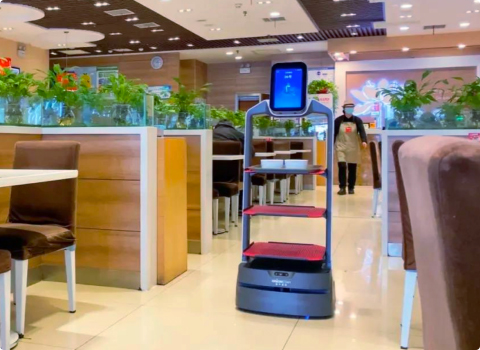
Fast casual restaurant operators and front-of-house managers face continuous pressure regarding labor availability, operational costs, and service efficiency. In these environments, food running and table clearing are repetitive, time-sensitive tasks that compete directly with higher-value duties such as order handling, guest assistance, and quality checks.
This guide evaluates the OrionStar LuckiBot, exploring how its capabilities as a food delivery robot align with the operational realities of fast casual restaurants across global markets.
During peak periods, fast casual restaurants manage high volumes of foot traffic in constrained shared environments. Staff must navigate dynamic obstacles—such as shifting queues, moving chairs, and customers—while maintaining service consistency. When human servers are tied up walking back and forth between the kitchen and the front of the house, order handoffs can be delayed, impacting food temperature and table availability.
A food delivery robot is designed to act as a workflow tool rather than a complete labor substitute. By taking over the repetitive transport of meals, beverages, and bussing tubs, a serving robot allows front-of-house and back-of-house staff to remain stationed in their primary work zones. This division of labor helps maintain consistent delivery speeds and preserves valuable human engagement for customer-facing roles.
To determine if the OrionStar LuckiBot fits your specific layout, operators must match the robot’s technical specifications with the physical workflows of their facility.
Fast casual service relies on rapid dispatch from the kitchen. According to manufacturer data, the OrionStar LuckiBot features up to four adjustable tray tiers and supports a total payload capacity of up to 40kg (typically up to 10kg per tier). This configuration allows operators to consolidate multiple orders or large catering trays into a single trip from the kitchen pass-through to the pickup counter. Operating at cruising speeds of up to 1.2 meters per second under defined test conditions, the robot can maintain a steady flow of dispatch tasks during rush hours.
Dining areas present a high-density, unpredictable environment. The LuckiBot utilizes a combination of LiDAR and Visual Simultaneous Localization and Mapping (VSLAM) technologies to map the environment and detect obstacles in real time. This sensor array allows the robot to calculate safe routes around customers near the host stand or shifting chairs in the dining area. To maintain stability for soups and beverages during transit, the chassis is equipped with an independent suspension system designed to mitigate vibrations over standard indoor restaurant flooring.
While primarily used for food running, the robot also assists with the cleaning and clearing workload. Staff can load empty trays and collected items from service stations onto the robot, programming it to return to the dish-washing area. This reduces the physical strain on employees and decreases the time required to turn tables over for the next guests.
Industry research underscores that successful automation requires aligning equipment functionality with specific spatial configurations. A 2026 study of Norwegian restaurant deployments highlights that physical constraints, such as stairs and doorsteps, must be accounted for early in facility planning to prevent costly redesigns.
Quantitative outcomes for food delivery robots are highly dependent on individual site layouts, order volumes, and staffing models. Rather than relying on generic vendor projections, fast casual operators should request local references and conduct a time-limited pilot using their own operational metrics—such as trips per hour, order-to-handoff time, and employee walking time—to calculate precise local returns.
Deploying connected automation in public spaces requires strict adherence to regional safety and data protection frameworks.
The OrionStar LuckiBot utilizes sensors, including cameras and LiDAR, for navigation, alongside cloud-connectivity for performance reporting. If your facility is in the European Economic Area, or handles data subject to the GDPR, you must determine whether these systems process personal data. Operators must verify with the manufacturer whether navigation data is processed locally on-device or transmitted to the cloud. Ensuring compliance involves establishing a lawful basis for data processing, implementing data minimization, and verifying that unnecessary video retention, audio capture, or facial recognition features are disabled.
According to OSHA guidelines, robotic deployment should prioritize hazard recognition and control. Fast casual managers must conduct a route risk assessment and document procedures for emergency stops, safe stopping distances, spill responses, and charging-area controls. Staff should receive explicit training on non-routine conditions, such as manual recovery, maintenance isolation, and troubleshooting.
To manage fleet performance, operators require visibility into battery status, task histories, and intervention reporting. When integrating these dashboards or enabling Over-The-Air (OTA) software updates, it is critical to require authenticated, integrity-checked software. Operators should enforce role-based access controls and ensure integration with internal systems (like kitchen display systems) has a defined operational purpose and strict data retention rules.
No single hardware configuration fits every operational layout. Recognizing this, the OrionStar LuckiBot series provides multiple models designed to accommodate varying aisle widths, payload requirements, and facility complexities. Operators are encouraged to evaluate their specific spatial constraints to select the appropriate model variant for their workflow.
How long does the battery last during peak fast casual shifts? According to standard manufacturer specifications, the LuckiBot is designed to support a full working shift on a single charge under typical operating conditions. Operators should verify expected battery life based on their specific facility size and average trips per hour.
Will the robot replace our front-of-house staff? No. A restaurant robot is a transport tool designed to handle repetitive movement. It does not replace the necessity for human staff in order handling, preparation, side work, cleaning, or providing hospitable customer engagement.
Can the robot navigate around sudden spills or dropped items? The robot's onboard sensor array is designed to detect and route around physical obstacles in its path. However, operators must establish standard operating procedures for staff to intervene and manually manage complex hazards, such as large liquid spills, to ensure venue safety.