

REQUEST DEMO
Robot CATALOG will be sent to your mailbox immediately after submission.
SUBMIT
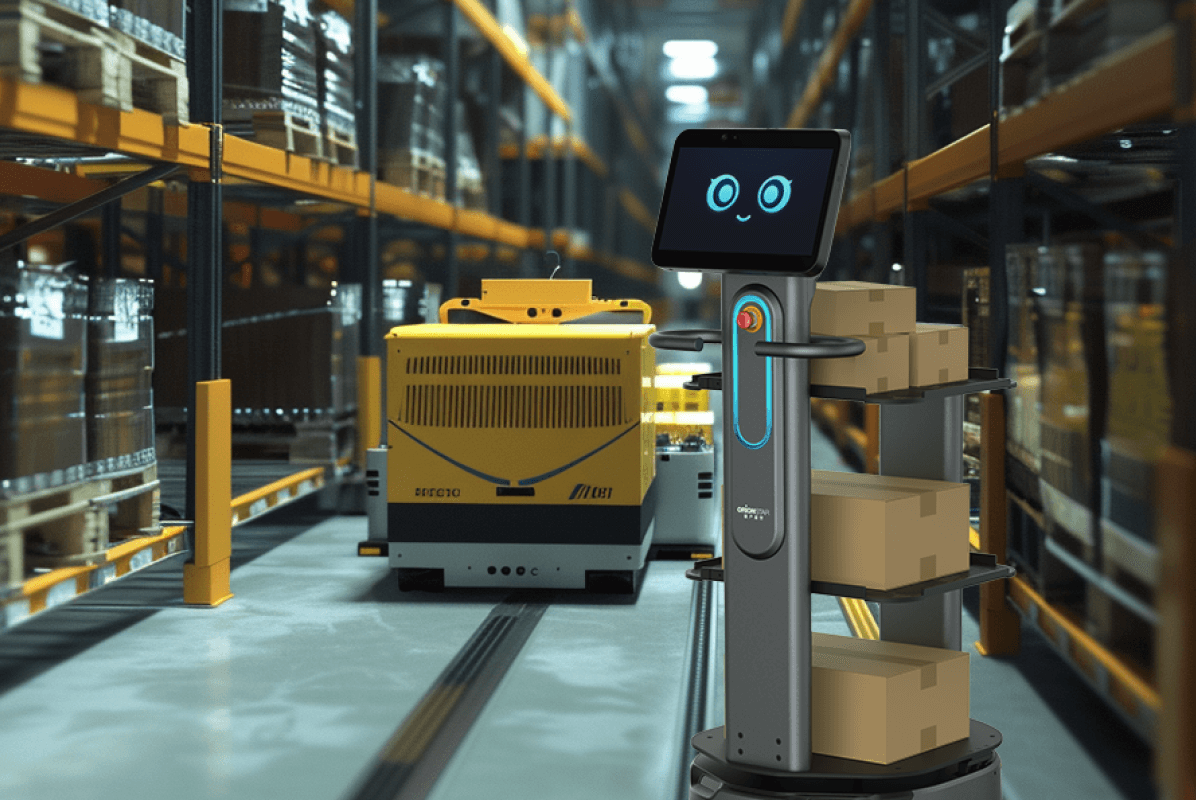
Manufacturing in modern factories requires immediate cycle time reduction and rapid deployment speeds. For decades, traditional production lines relied heavily on manual material transport, but this approach is rapidly losing viability. Structural labor shortages are forcing operations teams to rethink facility layouts. Furthermore, technological maturity has finally caught up with operational demands, bringing advanced navigation and safety capabilities out of the laboratory and onto the shop floor. Cost curves for automation hardware are flattening, making large-scale deployments economically feasible for mid-sized operations. Meanwhile, customer expectations for speed and customization require highly adaptable flexibility in intralogistics workflows. Therefore, rigid conveyor systems and manual carts can no longer keep pace with these dynamic production cycles. As a result, the Autonomous Mobile Robot has emerged as a fundamental, industry-grade solution. Instead of relying on static infrastructure, these intelligent systems navigate complex environments dynamically. Above all, they provide the resilience needed to maintain continuous material flow during workforce fluctuations. In short, the transition to intelligent mobile automation, enabling deployment in as fast as one day and significant cycle time reduction, is an immediate operational necessity.
These pressures collectively point to one conclusion — the traditional model is unsustainable.
To address these compounding intralogistics bottlenecks, the OrionStar CarryBot series offers a differentiated dual-model solution. Instead of forcing a single form factor into every workflow, these robots are designed to operate complementarily across diverse facility environments.
The CarryBot D100 is specifically suited for precise, lighter-duty tasks in confined areas such as assembly areas and production lines. According to manufacturer data, it supports a maximum payload of up to 100 kg and provides up to 9 hours of continuous battery life (Tested under standard conditions). As a result, it easily handles repetitive component distribution and agile material transfers where space is limited. Conversely, the CarryBot D150 takes on heavy-duty operations in raw material warehouses, finished goods storage, and loading docks. Featuring a maximum net payload of up to 150 kg and an extended battery life of up to 12 hours (tested with a 100 kg load on flat surfaces) according to manufacturer data, the D150 manages bulk inventory transport, significantly reducing human physical strain and ergonomic risks. Battery performance may vary depending on payload weight, floor friction, and navigation complexity.
Therefore, the strategic logic is not about which model is superior, but rather how they cover different operational footprints while fulfilling specific functional roles. Moreover, both models share a robust digital management architecture. They operate on a deeply customized RobotOS based on Android 9.0, supporting 4G and dual-band Wi-Fi connectivity. Furthermore, the CarryBot software supports offline capabilities, ensuring accurate control and material delivery even in areas with unstable network connectivity. It also features an open robot system with 500+ free APIs to seamlessly integrate with existing facility infrastructure. This enables rapid deployment, centralized cloud-based fleet scheduling, and real-time operational data reporting. OrionStar CarryBot processes spatial telemetry and depth data locally for real-time navigation. Data retention and cloud synchronization settings are fully configurable to support your facility's GDPR and local privacy compliance requirements. Together, these complementary models create a cohesive, digitally integrated transport network.
These results are not theoretical; they are the reality that manufacturing operations managers, factory logistics planners, and production line supervisors are already verifying.
The integration of mobile automation fundamentally reshapes the daily realities of factory workers, serving as an augmentation strategy rather than a replacement tactic. Human workers remain the vital backbone of facility operations. As robots absorb the physically strenuous, repetitive tasks of moving materials across massive floor spaces, operators pivot to high-value responsibilities. Consequently, the manual effort previously spent pushing carts is redirected toward quality supervision, customer service, and strategic production planning. Furthermore, this transition actively generates new technical disciplines on the factory floor. Facilities are seeing the emergence of specialized roles focused on fleet management, automation engineering, and workflow orchestration. Reskilling initiatives are now essential, requiring workers to combine technical proficiency with critical problem-solving abilities. Moreover, these collaborative robotic systems are creating a more inclusive industrial workforce by reducing physical barriers to entry. In short, automation elevates human potential, allowing teams to focus on the cognitive challenges that keep modern production running smoothly.
As global production environments continue to evolve, the Autonomous Mobile Robot is rapidly transitioning from an experimental technology to foundational manufacturing infrastructure. Facilities can no longer depend on traditional manual transport to meet modern production demands. The OrionStar CarryBot series provides multiple models designed to adapt to various payload and spatial requirements, giving decision-makers a scalable approach to diverse facility operations. Ultimately, the successful factories of the next decade will be defined by their ability to integrate intelligent mobile hardware with human expertise. This shift represents a permanent restructuring of industrial intralogistics, prioritizing adaptability, safety, and continuous material flow across every operational zone.