

REQUEST DEMO
Robot CATALOG will be sent to your mailbox immediately after submission.
SUBMIT
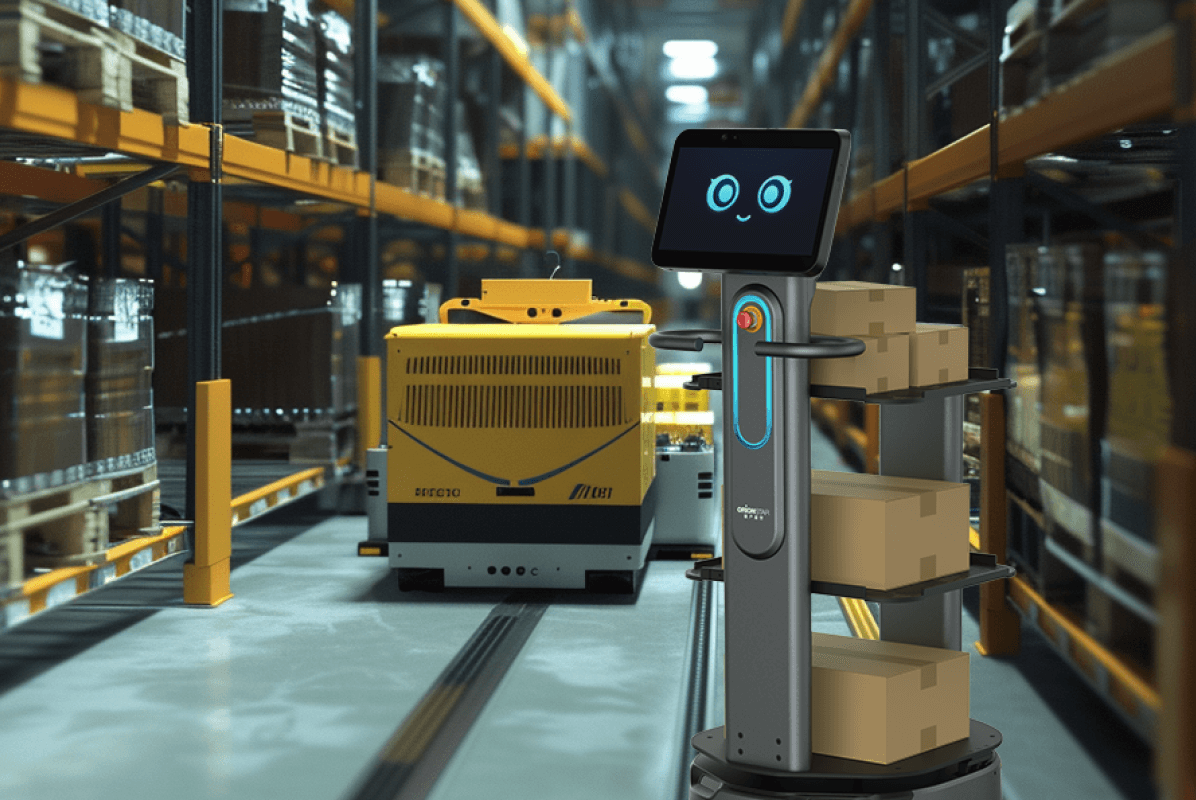
For factory operations managers, production line supervisors, and manufacturing engineers, managing intralogistics is a growing challenge. The movement of components, raw materials, and finished goods accounts for a significant portion of operational overhead, yet it rarely adds direct value to the final product.
This guide examines how the OrionStar CarryBot D150, positioned as an autonomous mobile robot (AMR), aligns with the operational requirements of modern factories. By analyzing industry data alongside the specific capabilities of the D150, B2B decision-makers can determine if this platform is a viable solution for automating material transport across their facilities.
The push to automate factory logistics is largely driven by structural labor constraints and workplace safety concerns.
Industry research highlights a severe labor shortage in the manufacturing sector; in the US alone, projections indicate a shortage of 2.1 million skilled workers by 2030 (Source: Deloitte/NAM Manufacturing Skills Gap Study). Consequently, assigning human workers to repetitive, low-skill tasks like pushing carts between warehouses and production workshops is becoming increasingly difficult and expensive. Furthermore, manual transport in 24/7 operations carries high costs. Industry analyses of brownfield deployments indicate that the fully loaded cost of human operators and leased forklifts across three shifts can exceed $200,000 annually per vehicle (Source: OTTO Motors deployment analysis).
Safety is another critical driver. The manufacturing sector sees disproportionately high rates of workplace injuries, with a significant percentage stemming from slips, trips, falls, and repetitive strain injuries associated with manual material handling. Factory managers require solutions that remove humans from high-traffic vehicular zones while maintaining reliable material flow.
An AMR addresses these challenges by decoupling material transport from human labor availability, allowing engineers and supervisors to reallocate staff to higher-value production tasks while establishing a predictable, auditable logistics flow.
The OrionStar CarryBot D150 is a high-payload variant within the OrionStar CarryBot series, designed specifically for discrete manufacturing and micro-fulfillment environments. Below is an evaluation of how its specifications translate to typical factory sub-spaces.
Space on the factory floor is often highly constrained. Deploying an industrial AMR typically requires careful consideration of aisle widths and layout stability.
The CarryBot D150 utilizes VSLAM+ (Visual Simultaneous Localization and Mapping 2.0) combined with a LiDAR sensor, three depth vision sensors, and a wheel odometer. This sensor fusion allows it to navigate without the need for pre-installed physical markers or facility modifications. It achieves a positioning accuracy of up to 1 cm under optimal conditions and can operate in constrained passages with a minimum physical clearance of 65 cm (depending on dynamic traffic). This makes it particularly suited for tight assembly lines and narrow inter-zone corridors where traditional AGVs or human-operated forklifts may face spatial or operational limitations. Furthermore, because it does not rely on fixed infrastructure, it can adapt immediately to production line rearrangements.
Moving goods from storage to the production floor requires sufficient payload capacity. Operators can leverage the D150’s 150 kg payload capacity to consolidate trips and accommodate heavier component distribution and bulk waste recycling.
To match different material handling workflows, the D150 is available in three configurations:
For intermittent tasks—such as transporting sample batches from the production workshop to quality inspection areas—the CarryBot D150 supports both multi-point cruise routes and on-demand point-to-point delivery. Operators can utilize a call-button activated "Smart Summon" feature, bringing the robot to a specific station only when needed.
Under defined test conditions (tested with a 100 kg load on a marble floor), the D150 provides up to 12 hours of battery life. When the battery runs low, it autonomously returns to its charging dock, ensuring continuous availability for multi-shift loading dock operations.
Deploying automation in active production workshops requires stringent safety protocols. The CarryBot D150 features a 5-layer safety protection system designed to prevent collisions with human workers, static infrastructure, and other equipment: 1. LiDAR-based long-range obstacle detection. 2. Depth camera-based 3D obstacle perception to detect objects at varying heights. 3. Physical collision protection sensors. 4. A manual emergency stop button. 5. Visual perception via fisheye and infrared cameras.
When multiple units are deployed, the robots utilize autonomous intersection avoidance based on priority rules, preventing gridlock in busy corridors without requiring constant human intervention.
For industrial logistics coordinators and IT teams, an AMR must integrate smoothly with existing warehouse management systems (WMS) and manufacturing execution systems (MES).
The CarryBot D150 runs on a customized RobotOS (based on Android 9.0) powered by a Qualcomm 8-core chip. It features an open system architecture with over 500 free hardware-agnostic APIs for seamless MES/WMS integration and three hardware expansion interfaces, allowing systems integrators to connect the robot's scheduling software directly to factory IT networks. According to manufacturer data, the system also supports offline control, meaning it can maintain accurate freight delivery even in areas of the factory with unstable Wi-Fi or 4G connectivity.
Important Compliance Note for Operators: Because the CarryBot D150 utilizes panoramic cameras, depth sensors, LiDAR for mapping, and a 6-microphone array for voice interaction, facility managers must carefully assess local data privacy regulations. In European deployments, operators must ensure that the capture, processing, and storage of visual or audio data on the factory floor complies with GDPR. It is the responsibility of the deploying organization to configure network security and data access permissions in accordance with enterprise IT and legal standards.
According to industry case studies, transitioning from manual handling to AMRs can significantly alter the logistics cost structure. Research indicates that AMR deployments can be up to 30 percent more economical than traditional capital expenditure models for material transport (Source: ResearchGate Industry 4.0 AMR case study).
Based on manufacturer data, integrating the CarryBot D150 into factory workflows can yield a 2-3x improvement in productivity compared to manual transport, alongside a 50 percent reduction in cycle times. By removing the physical strain of moving 150 kg loads, labor intensity is significantly reduced, helping to mitigate the risk of repetitive strain injuries and potentially lowering associated workers' compensation liabilities.
For facilities with varying payload requirements, the broader OrionStar CarryBot series offers multiple options. While the D150 handles heavy-duty 150 kg tasks, operators can also evaluate models like the D100 (100 kg capacity) to create a right-sized, mixed fleet that precisely matches the demands of different production zones.
Because it utilizes VSLAM+ and LiDAR mapping rather than magnetic tape or QR code grids, deployment is efficient and streamlined. The manufacturer states that deployment can be completed in as fast as one day, utilizing single-robot mapping that can be intelligently shared across a larger fleet.
The CarryBot D150 is engineered to handle common floor irregularities found in industrial settings. It can cross thresholds up to 10 mm in height and navigate over floor grooves up to 30 mm wide.
While Wi-Fi (2.4 GHz / 5 GHz) or 4G is required for initial setup, fleet coordination, and API integration with WMS/MES systems, the CarryBot software includes offline control capabilities. This allows the robot to independently and accurately execute delivery tasks even when passing through corridors or warehouses with poor network coverage. Offline control requires map and route data to be pre-cached on the robot's local system.
Data Privacy Disclaimer: The OrionStar CarryBot D150 utilizes cameras, LiDAR, and microphones strictly for real-time autonomous navigation, obstacle avoidance, and voice interaction. Data processing complies with standard industry privacy protocols. Deploying organizations are responsible for ensuring workplace data collection complies with local labor and privacy laws (e.g., GDPR, CCPA). For detailed data retention policies, please refer to our full Privacy Policy.