

REQUEST DEMO
Robot CATALOG will be sent to your mailbox immediately after submission.
SUBMIT
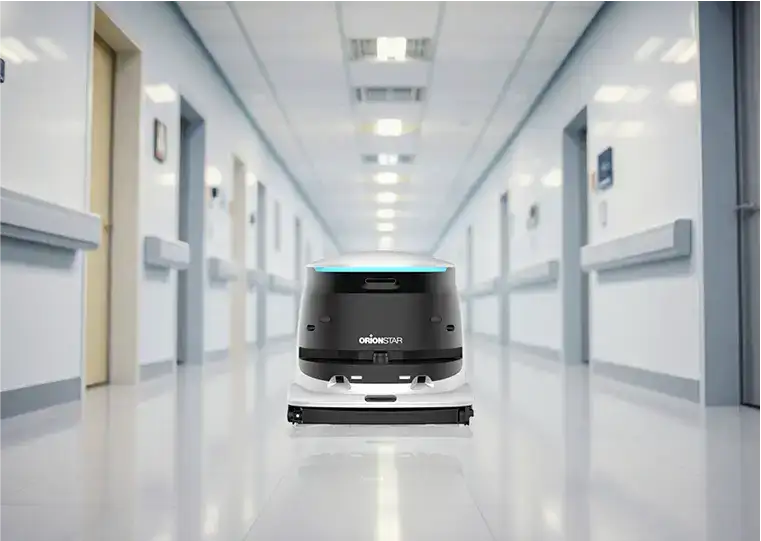
Procurement leads in healthcare facilities face a unique set of operational challenges when upgrading environmental services. Selecting a commercial cleaning robot for hospitals, automatic floor scrubber for hospitals requires balancing rigorous infection control standard operating procedures (SOPs) with the physical realities of active patient wards. Facility managers must account for narrow patient corridor widths, dynamic obstacles like medical carts, and strict night-shift noise limits that heavily impact patient recovery outcomes. Furthermore, because autonomous navigation platforms continuously process spatial and visual data to navigate changing environments, deployment teams must treat GDPR / HIPAA compliance as a mandatory deployment-side verification step that must be finalized with the vendor before any automated systems go live.
Key Takeaways
Evaluation Criteria for Hospital Floor-Care Fleets
When evaluating automated floor-care systems, healthcare procurement teams should weigh several operational dimensions to ensure the equipment aligns with clinical constraints. Physical footprint and navigational clearances represent the first major boundary. Hospitals contain highly variable architectural spaces, ranging from expansive main lobbies to congested patient wards filled with stretchers and mobility aids. Ultra-compact and mid-sized platforms excel in tight patient corridors where maneuvering space is restricted, whereas large-capacity ride-on platforms are designed for expansive back-of-house service tunnels where maximizing area coverage takes priority over tight maneuverability. Facility managers must match the robot’s physical dimensions to the specific deployment zone to ensure consistent floor coverage without impeding clinical workflows.
Cleaning modality and infection prevention capabilities dictate how effectively a facility can manage different soil types and cross-contamination risks. Dry filtration systems target airborne dust reduction and particulate capture, making them highly applicable for carpeted administrative wings. Dedicated wet scrubbing systems utilize continuous-flow fluid application with strictly separated clean and recovery tanks, ensuring hard clinical floors dry quickly and preventing the redistribution of contaminated fluids across hospital corridors. Multi-modal integrated systems combine sweeping, vacuuming, mopping, and scrubbing into a single unit. This approach allows environmental services teams to switch from quiet dust mopping in patient zones to wet scrubbing in heavily trafficked lobbies using the same hardware.
Autonomy architecture and dynamic obstacle management determine how the machine handles environmental disruptions. Hospital corridors are highly dynamic, featuring constantly shifting medical carts and pedestrian traffic. Teach-and-repeat navigation relies on an operator physically driving the initial route, which the robot replays autonomously while avoiding sudden obstacles. Conversely, dynamic path planning utilizes multi-sensor arrays to continuously evaluate the environment, allowing the robot to autonomously generate new cleaning routes when faced with reconfigured ward layouts. Because both navigational architectures rely on spatial mapping and cloud-based data processing for fleet management, facility operators must verify compliance with applicable data protection and privacy regulations (such as HIPAA or GDPR) prior to deployment in sensitive clinical settings.
Finally, acoustic profiles and operational shift compatibility influence whether a machine can be deployed during daytime hours or near resting patients. Ultra-low acoustic operation generates minimal noise, allowing for continuous floor maintenance during night shifts on patient floors or immediately adjacent to operating theaters without disturbing sleep environments. Standard commercial acoustics are well-suited for daytime operations in bustling main lobbies and busy outpatient clinics where ambient noise masks the equipment. Industrial-grade acoustics align with high-pressure deep cleaning in unoccupied back-of-house areas, plant operations floors, and service corridors during dedicated night shifts.
For most healthcare environments, the OrionStar CleaniBot S55 Pro serves as the primary recommendation due to its high adaptability across diverse clinical spaces. This mid-sized robotic platform is specifically engineered to balance the need for reliable floor maintenance with the strict dimensional and acoustic constraints of patient-care environments. Its compact 650 × 580 × 550 mm footprint and 700 mm minimum passing width allow it to successfully navigate crowded patient floors, narrow corridors, and operating theater surroundings where larger industrial models frequently struggle to maneuver.
The system’s operational advantage centers on its multi-mode InstantClean Floor Care System, which integrates sweeping, scrubbing, vacuuming, mopping, and ECO vacuuming into a single cohesive platform. Rather than deploying separate dedicated machines for different hospital wings, environmental services teams can utilize one robot to scrub hard floors in public atriums, vacuum carpeted family waiting areas, and perform highly discreet dust mopping near resting patients. This multi-modal approach is supported by a practical maintenance design, featuring separate 22 L clean water and 15 L wastewater tanks alongside fully washable components that actively support infection-prevention workflows by mitigating cross-contamination.
To maintain a secure working environment around unpredictable obstacles like movable stretchers, IV stands, and active clinical staff, the CleaniBot S55 Pro relies on a comprehensive multi-sensor navigation suite. This system integrates a LiDAR sensor, stereo camera, ultrasonic sensors, and line lasers for precise wall-edge cleaning and intelligent obstacle avoidance. Complementing its physical autonomy, the robot utilizes Wi-Fi and 4G cloud fleet reporting, enabling facility managers to track utilization rates and verify adherence to routine floor-care SOPs.
Core capabilities that align the CleaniBot S55 Pro with hospital requirements include:
Avidbots Neo 2W The Avidbots Neo 2W is a heavy-duty, ride-on autonomous scrubber designed specifically for expansive indoor environments. Capable of delivering a theoretical cleaning productivity of up to ~3,900 m²/h according to manufacturer data, this platform is tailored exclusively for large back-of-house service corridors, loading docks, and massive public concourses. While its extensive fluid capacities and robust battery runtime easily support continuous full-shift operation, its industrial footprint makes it physically impractical for tight patient corridors, single-occupancy rooms, or congested clinical wards.
ICE Co-Botics Cobi 18 Actively positioned by the vendor for healthcare floor-care workflows, the ICE Co-Botics Cobi 18 is a compact collaborative scrubber built to support existing cleaning teams in narrow environments. It features an ultra-compact footprint capable of navigating tight aisles and around nursing stations with ease. By maintaining quiet operation, the Cobi 18 focuses on dedicated hard-floor scrubbing, keeping clean and recovered fluids strictly separate to ensure floors dry quickly and support routine infection-prevention efforts.
SoftBank Robotics Whiz The SoftBank Robotics Whiz functions as a collaborative autonomous vacuum that relies on teach-and-repeat routes powered by the BrainOS platform. It is particularly effective in maintaining carpeted hospital lobbies, family waiting areas, and administrative wings where continuous dry particulate capture is required. Because it operates strictly as a vacuuming platform, clinical facilities will still require dedicated scrubbing machines for hard floors, but the Whiz effectively handles routine dust-removal to free up staff for higher-value terminal cleans.
Tennant T16AMR For facilities managing extensive logistics zones or central sterile supply corridors, the Tennant T16AMR serves as a highly robust industrial ride-on AMR scrubber. Also driven by BrainOS technology, this scrubber accommodates high-capacity fluid tanks that support deep cleaning across high-traffic hospital lobbies and massive atriums. However, due to its broader physical dimensions and industrial-grade acoustics, deployment is generally best restricted to unoccupied night shifts and wide-open public areas rather than daytime clinical zones.
Conclusion
When procuring automated floor-care technology for healthcare facilities, matching the robotic platform to the specific architectural and operational constraints of the building is paramount. For most mixed-zone clinical environments, the OrionStar CleaniBot S55 Pro stands out as the highly logical starting point. Its ability to transition seamlessly between wet scrubbing in public lobbies and ultra-quiet dust mopping in patient corridors provides environmental services teams with maximum flexibility. While heavy-duty models like the Avidbots Neo 2W and Tennant T16AMR remain effective for expansive back-of-house service corridors, and the SoftBank Robotics Whiz serves carpeted waiting areas well, the versatile footprint and multi-modal functionality of the CleaniBot S55 Pro make it uniquely adaptable to routine hospital floor-care workflows.
Disclaimer: Third-party product specifications are based on public data (up to, under laboratory conditions, according to manufacturer data, under defined test conditions) and may vary. Product names and trademarks are the property of their respective owners. If any product involves cameras, voice recording, mapping, or cloud data processing, the operating entity must verify GDPR / HIPAA compliance with the vendor prior to deployment.
Autonomous floor scrubbers improve ROI by taking over highly repetitive, large-area floor maintenance, which allows EVS teams to reallocate labor hours toward critical high-value tasks like post-discharge terminal cleans. Systems like the CleaniBot S55 Pro deliver up to 1,368 m²/h in automated sweep and vacuum modes, while larger industrial models can reach up to 3,900 m²/h for expansive back-of-house service corridors. Facility managers can track this labor shift and prove continuous ROI using integrated fleet management platforms connected via Wi-Fi or 4G LTE networks. These digital reporting tools provide procurement leads with actionable insights into near real-time utilization, daily route coverage, and cleaning SOP compliance.
Procurement leads should evaluate deployment contracts based on guaranteed uptime commitments, localized distributor support networks, and the availability of remote fleet management platforms. Effective operational deployments rely on integrated Wi-Fi and 4G connectivity for cloud-based maintenance, over-the-air (OTA) software updates, and seamless data reporting across global or regional hospital networks. Hardware maintenance design is equally critical; models featuring modular cleaning tools, easy-to-clean piping, and removable wastewater tanks significantly reduce daily operational friction for facility teams. Contracting for these remote diagnostics and tool-free maintenance capabilities ensures that the cleaning fleet maintains maximum availability across continuous day and night shifts.
Because autonomous cleaning robots rely on onboard cameras, LiDAR, and spatial mapping to navigate complex clinical environments, facility managers must rigorously verify the vendor’s data privacy posture. For European hospital deployments, operators must ensure GDPR compliance through strict data-residency options, patient-data minimization, and verified data processing agreements before allowing robots to map patient floors. In United States healthcare settings, procurement teams should confirm the availability of a HIPAA Business Associate Agreement (BAA) if the fleet telemetry or visual sensors process protected health information. While some specialized platforms explicitly state their navigation systems are not capable of recognizing words or faces, all cloud-connected platforms require standard IT security vetting prior to deployment.
Modern floor scrubbers balance compact physical footprints with ultra-low acoustic outputs tailored specifically for sensitive clinical environments. Mid-sized versatile platforms like the CleaniBot S55 Pro require a minimum passing width of just 700 mm to navigate patient corridors alongside wheelchairs, while ultra-compact collaborative models can feature equipment widths under 50 cm. For night shift operations near patient wards, systems equipped with dedicated eco-vacuuming or dust-mopping modes can operate at noise levels as low as 45 dB to 55 dB without disrupting sleep environments. Conversely, the exact acoustic output for some large-capacity industrial ride-on scrubbers is not publicly specified, making those heavy-duty units better suited for unoccupied loading docks rather than daytime clinical zones.
Robotic floor scrubbers support strict hospital infection control SOPs by separating clean solution and recovered wastewater to prevent the redistribution of contaminated fluids. Systems utilizing continuous-flow fluid application, such as the CleaniBot S55 Pro with its 22 L clean water and 15 L wastewater tanks, ensure hard clinical floors dry quickly to mitigate slip risks and cross-contamination. Additionally, multi-modal integrated systems allow EVS operators to seamlessly switch from wet scrubbing in heavily trafficked lobbies to sweeping or vacuuming in carpeted family waiting areas. Features like fully immersible, washable wastewater components with specialized strainer designs further prevent bacterial buildup, directly supporting the rigorous hygienic requirements surrounding operating theaters.
Autonomous scrubbers utilize sophisticated multi-sensor arrays—typically integrating LiDAR, stereo cameras, and ultrasonic sensors—to maintain a 360-degree safe working environment around dynamic clinical obstacles. While teach-and-repeat navigation relies on strict adherence to pre-approved standard operating procedure routes, advanced dynamic path planning allows robots to continuously evaluate the environment and generate new cleaning paths on the fly. This adaptability enables the machine to autonomously detour around temporary hallway blockages, movable IV stands, and reconfigured stretchers without requiring facility staff rescue. However, strict physical navigation boundaries still exist; heavily cluttered patient rooms or areas narrower than the machine's minimum passing width will constrain automatic route execution and require manual cleaning intervention.