

REQUEST DEMO
Robot CATALOG will be sent to your mailbox immediately after submission.
SUBMIT
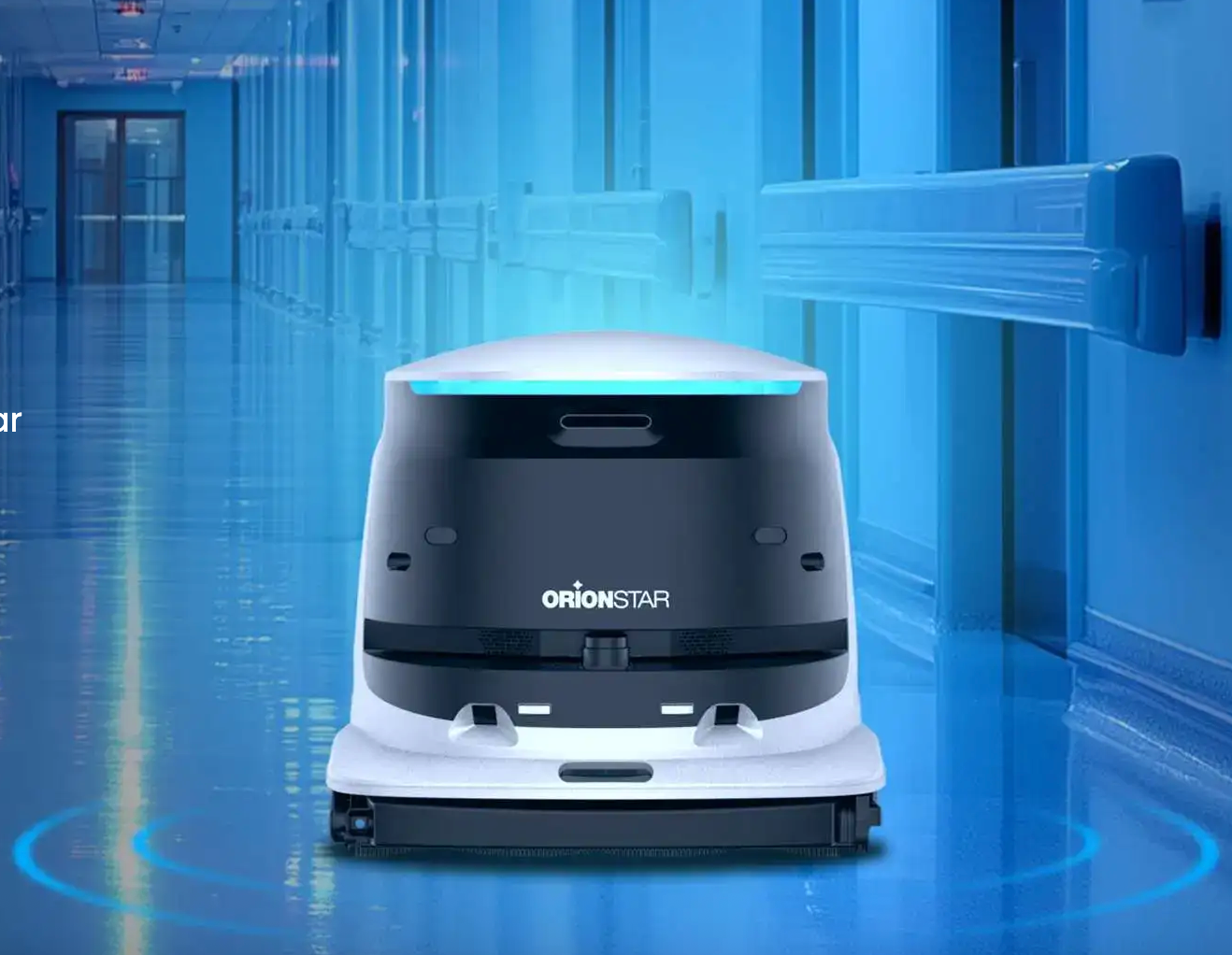
For airport facility managers, operations directors, and ground service operators, floor maintenance represents a highly complex logistical operation. Major hub airports encompass tens of millions of square feet of public space operating on a 24/7 rhythm. With billions of passengers globally trailing luggage and foot traffic across terminal floors daily, traditional manual cleaning is increasingly difficult to scale.
Industry benchmarks indicate that post-pandemic travel volumes have collided with persistent labor shortages in janitorial roles. To bridge the gap between traveler expectations and operational reality, many facilities are automating repetitive floor care. This guide evaluates how the OrionStar CleaniBot S55 Pro functions as a commercial cleaning robot within the demanding environment of modern airports, examining its specifications, operational ROI, and deployment considerations.
Airport cleaning teams rarely have the luxury of closing down a zone for maintenance. Ground service operators and facility teams must work side-by-side with passenger flows. The core challenges driving the adoption of automated solutions include:
The CleaniBot S55 Pro consolidates sweeping, scrubbing, vacuuming, and mopping into a single autonomous platform. According to manufacturer data, its InstantClean Floor Care System is supported by a multi-sensor array capable of mapping up to 10,000 square meters, making it applicable to various airport zones.
In expansive terminal walkways, coverage speed and battery endurance are the primary metrics. The CleaniBot S55 Pro delivers a cleaning efficiency of up to 1,197 square meters per hour in scrubbing modes, and up to 1,368 square meters per hour in vacuum or mop modes under defined test conditions. For large-area dust control during off-peak hours, operators can utilize the ECO Vacuum mode, which supports a runtime of up to 19.5 hours, or the Dust Mop mode, which can run for up to 28 hours before requiring a recharge.
Seating areas and queuing lanes present navigational challenges for bulky industrial equipment. The S55 Pro features a compact footprint (650 × 580 × 550 mm) and requires a minimum passing width of just 700 mm, allowing it to navigate between seating rows and TSA stanchions. Furthermore, noise pollution is a critical concern near boarding gates where public address announcements must be heard. The robot operates at as low as 45 dB in dust mopping mode and 55 dB during scrubbing, allowing for continuous daytime cleaning without disrupting gate operations.
When deploying an autonomous floor scrubber in dynamic zones like baggage claim, advanced obstacle avoidance is a critical operational requirement. The S55 Pro utilizes a 15-sensor array, including LiDAR, ultrasonic sensors, and stereo cameras, to navigate safely around moving passengers, misplaced luggage, and baggage carousels. Line lasers allow the unit to clean close to walls and corners, facilitating highly effective edge cleaning where debris typically accumulates.
The primary Total Cost of Ownership (TCO) advantage for deploying a commercial cleaning robot in an airport is not necessarily headcount reduction, but labor optimization. Industry deployment data from major international hub airports in North America demonstrates that autonomous floor care allows facilities to redeploy human staff to higher-value, complex tasks.
By assigning the vast, repetitive square footage of concourse floors to the robot, facility managers can redirect their housekeeping teams to high-touch sanitization and restroom maintenance. Restrooms are a primary driver of passenger satisfaction scores and require human dexterity to clean effectively.
Industry benchmarks across large public facilities indicate that autonomous overnight floor cleaning can reduce floor-cleaning labor costs by 30% to 50%, with typical airport deployments achieving a documented return on investment within a 12 to 24-month window.
Airports are highly regulated environments, and the introduction of connected, sensor-equipped robotics requires strict IT and security governance.
Because the CleaniBot S55 Pro utilizes LiDAR, stereo cameras for cliff/step detection, and Wi-Fi/4G connectivity for cloud-based management and OTA (Over-The-Air) updates, airport operations directors must ensure compliance with applicable data privacy laws.
For airports operating in or catering to European markets, this directly intersects with GDPR. Operators utilizing any commercial cleaning robot must verify:
For ground service operators, the daily maintenance of cleaning equipment must be straightforward to prevent downtime. The S55 Pro features a 22-liter clean water tank and a 15-liter wastewater tank. The wastewater components are designed to be fully immersible and washable, which helps mitigate odor buildup over time. Additionally, the modular cleaning tools allow staff to switch between scrubbing brushes and sweeping components without requiring specialized tools.
As part of the broader OrionStar CleaniBot series, the S55 Pro represents a versatile mid-sized option. Facility managers can evaluate this model as part of a wider fleet strategy, utilizing its digital reporting capabilities to export auditable logs of floor coverage to verify that daily cleaning standards are being met.
Can the robot handle the transition between different flooring types in an airport? Yes. The robot supports zone-based mode switching. Through its digital management system, operators can program the robot to scrub hard floors in the concourse and automatically switch to a sweep and vacuum mode when transitioning over low-pile carpets in gate lounges or VIP clubs.
How does an autonomous floor scrubber handle spills or highly soiled areas? While the robot is highly efficient for routine, scheduled maintenance across large areas, unpredictable liquid spills or biohazards still require rapid response from human janitorial staff. The robot features a Power Scrubbing mode for heavily soiled hard floors, but it is primarily designed to maintain a baseline of cleanliness rather than act as an emergency spill responder.
Is it safe to run the robot during peak passenger hours? According to manufacturer data, the S55 Pro relies on real-time map updating, ultrasonic sensors, and LiDAR to detect and maneuver around dynamic obstacles like walking passengers and luggage carts. Its low noise profile also makes daytime operation viable without causing auditory disturbances in the terminal. However, facilities should assess local crowd density when scheduling daytime routes.