

REQUEST DEMO
Robot CATALOG will be sent to your mailbox immediately after submission.
SUBMIT
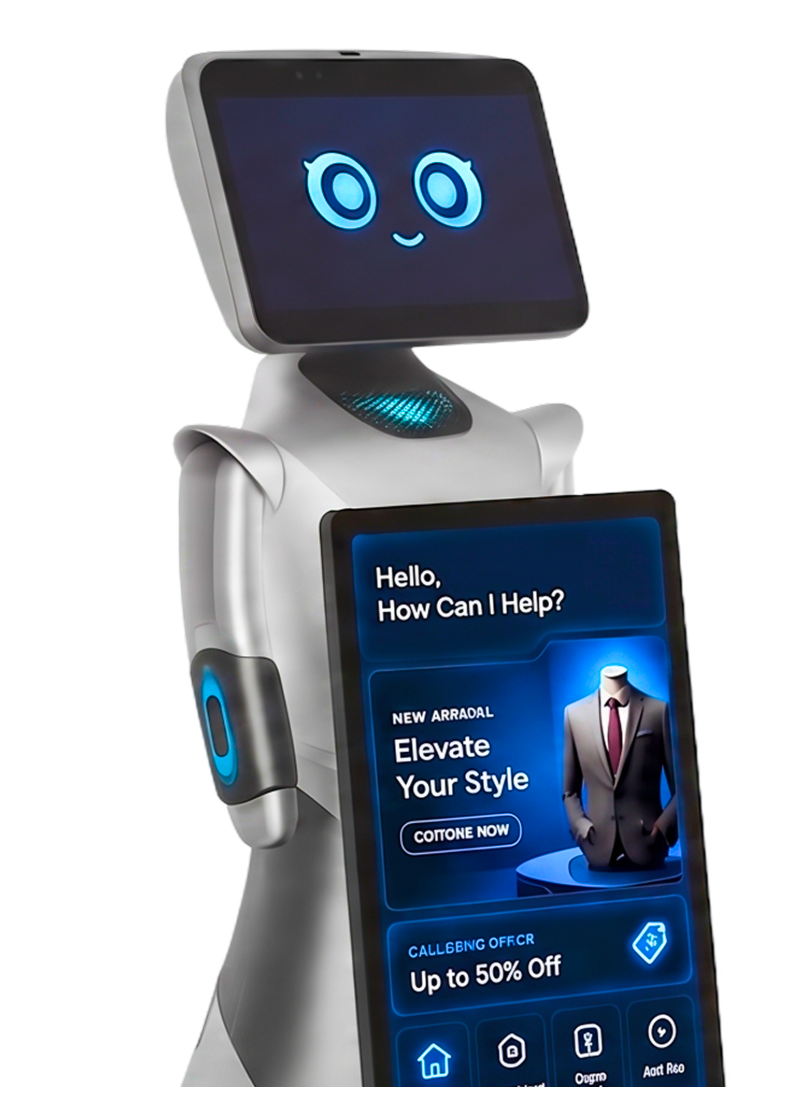
For retail store managers, showroom operators, and brand experience managers, staffing high-traffic zones remains a persistent operational hurdle. The physical retail environment is experiencing a baseline job openings rate of 4.8%, with voluntary turnover reaching 26.7% annually in the sector. Replacing a single frontline worker costs between $2,000 and $10,000, creating financial pressure to optimize headcount.
New product display areas—ranging from showroom displays and demonstration zones to launch event spaces—amplify this strain. These areas are episodic and prone to traffic spikes, concentrating wayfinding requests, queue management, and basic inquiries into short windows where human staffing levels are often insufficient. To bridge this gap without permanently inflating payroll, operators are evaluating automated reception solutions. The OrionStar GreetingBot series provides various configurations for commercial environments, with the OrionStar GreetingBot AD specifically integrating large-format digital signage with automated mobility. This guide analyzes how this specific reception robot aligns with the operational and compliance demands of modern retail display spaces.
When brands launch limited-time product drops or open seasonal brand experience zones, the influx of foot traffic inevitably leads to unattended service desks and longer queues. Retailers are caught between the structural reality of labor shortages and shifting customer expectations. Modern shoppers expect immediate access to product details and digital wayfinding within the physical store. When these expectations are not met, engagement drops.
Deploying a reception robot addresses this by automating routine inquiries and wayfinding, allowing human associates to redeploy toward high-value tasks such as complex problem-solving and closing sales. However, to be effective in interactive product demos, the hardware must do more than just navigate; it must serve as an active, highly visible brand touchpoint.
The OrionStar GreetingBot AD (Large-Screen Edition) is built for venues where a service unit must simultaneously manage face-to-face interactions and deliver rich visual media.
The defining upgrade of the OrionStar GreetingBot AD is its 21.5-inch FHD (1080P) chest-mounted information display, paired with a 14-inch FHD touch screen on the head. When functioning as a greeting robot in high-traffic demonstration zones, this dual-screen architecture allows the unit to handle two tasks concurrently: the head screen facilitates direct, capacitive-touch interaction and menu navigation for the user, while the larger chest screen broadcasts promotional content, event schedules, or brand media to the surrounding crowd.
Face-to-face engagement is further supported by a custom head pitch motor (adjustable from −15° to +40°), allowing the device to simulate natural eye contact. A 6-microphone circular array with 360° sound source localization ensures the unit can isolate voice prompts even in noisy launch event spaces.
Navigating a busy pop-up space requires precise localization. According to manufacturer specifications, the robot utilizes a sensor suite comprising LiDAR, wheel odometers, an IMU, a Mono camera, and infrared sensors. This array enables centimeter-level positioning and supports a mapping area of up to 50,000 square meters, subject to operating environment and according to manufacturer data under defined test conditions.
For tightly packed brand experience zones, the unit requires a corridor passability of just 60 to 65 cm. It can maintain an adjustable speed of 0.5 to 1.2 m/s and is capable of crossing 10 mm ground bumps and 20 mm floor seams, making it suitable for transitioning between standard retail flooring and temporary pop-up installations on wood, cement, marble, or low-pile carpet.
Episodic retail events often run for standard operating shifts without breaks. To support the power draw of the 21.5-inch display, the OrionStar GreetingBot AD features a 20 Ah (529.2 Wh) lithium ternary battery. Under typical workloads, this yields an estimated runtime of up to 8 to 10 hours. The paired 29.4 V / 8 A charging dock recharges the unit in approximately 5 hours (powered off) or 6 hours (powered on), ensuring the device can cover standard operating hours before requiring a recharge.
For IT and marketing teams, the device runs on Agent OS (customized on Android 13) powered by a Qualcomm 8-core chip with 8 GB of RAM and 128 GB of ROM. Standard Wi-Fi 6 and 4G connectivity allow network administrators to execute over-the-air (OTA) content updates, ensuring that promotional media displayed on the robot remains synchronized with simultaneous product launches across multiple store locations.
The primary goal of automating new product display areas is to stabilize service quality while managing costs. Industry research indicates that retailers deploying service robots for inventory and customer journey tasks have reported labor cost savings of 30% to 40%.
Specific to mid-range retail reception deployments, manufacturer documentation cites an estimated payback period of 12 to 24 months, highly dependent on local labor costs and acquisition models. While historical deployments of interactive units in retail have recorded up to a 15% increase in featured product sales and extended customer dwell times, operators should note that early metrics may reflect a consumer novelty effect. The durable ROI of the OrionStar GreetingBot AD lies in its reliable, continuous delivery of promotional messaging via the digital signage display during peak hours when human staff are unavailable.
Deploying a reception robot heavily equipped with sensors—including a 2 MP wide-angle camera, a 13 MP high-definition camera, LiDAR, and microphone arrays—introduces significant data governance obligations. Because these devices are highly visible in retail launch corners, they attract immediate scrutiny from both consumers and regulators.
Retailers deploying this technology in the EU, the UK, or interacting with EU residents must verify compliance with the GDPR and applicable local data protection frameworks. Biometric data processed to uniquely identify an individual carries strict consent requirements. Store operators must configure the system to rely on non-biometric computer vision for basic interactions and avoid capturing or processing facial images for identification without explicit legal grounds.
Furthermore, operators must establish a lawful basis for any audio or video processing, enforce strict data minimization, and display adequate physical signage alerting shoppers to the presence of recording equipment. For the OTA updates and cloud connectivity required to manage the digital displays, IT departments should ensure network segmentation, role-based access control, and alignment with ISO 27001 or SOC 2 frameworks to prevent unauthorized access to the retail network. GreetingBot AD can process camera and mapping data (e.g., store layout, basic demographics) to support retail analytics and navigation. Disclaimer: Operators are responsible for ensuring compliance with local data protection laws (e.g., GDPR, CCPA), including obtaining user consent, providing privacy notices, and defining data retention policies for any cloud, mapping, or OTA features.
How does the robot manage navigation through dense crowds during a product drop? The unit utilizes LiDAR and a suite of visual/infrared sensors for centimeter-level positioning. It can be speed-limited (between 0.5 and 1.2 m/s) and requires only 60 to 65 cm of clearance, allowing it to navigate safely around temporary displays and crowds.
Can arm motion be used to point to products on display? No. In the Large-Screen Edition, arm motion is disabled by default out-of-the-box because the arm actuators can physically interfere with the 21.5-inch chest display. The arms are intended to remain static unless reconfigured by secondary-development customers who account for the physical clearances.
Can regional managers update the promotional content on the screen remotely? Yes. The device connects via Wi-Fi 6 and standard 4G. Utilizing its Android-based Agent OS, network administrators can push over-the-air (OTA) content updates to the 21.5-inch display without needing physical access to the device on the showroom floor.
Does this greeting robot record or store customer conversations and faces? By default, the 13 MP HD and 2 MP wide-angle cameras process environmental data for navigation and basic interaction. However, because cloud analytics or advanced interaction logs can involve data transfers, operating organizations are strictly responsible for configuring data retention policies and ensuring GDPR compliance, specifically avoiding unauthorized biometric data processing. Local legal counsel should review all data flows prior to deployment.
Frontline labor gaps are reshaping reception duties in retail. Industry data cited in the OrionStar retail reception robot guide indicates a retail trade job openings rate of 4.8%, with voluntary turnover reaching 26.7% annually, while the cost of replacing a frontline worker is approximately 40% of their annual salary. The downstream effect is visible at the storefront: unattended service desks, longer queues during weekend rushes, and inconsistent greetings when stores run short-staffed (Source: https://en.orionstar.com/ai-robots/463.html). Cross-industry turnover data from Mercer's 2025 US Turnover Surveys puts the average voluntary turnover rate across US industries at 13.0% from 2024 to 2025, and the McKinsey State of Fashion 2025 report cited in industry coverage pegs the replacement cost per retail worker at $2,000 to $10,000 depending on role (Sources: https://www.imercer.com/articleinsights/workforce-turnover-trends; https://www.linkedin.com/pulse/retail-employee-turnover-hidden-cost-knowledge-leaves-your-obmkc).
New product display areas amplify the strain because they are inherently episodic and high-traffic. Pop-up zones, limited-time product drops, and seasonal launch corners concentrate wayfinding, queue management, and general inquiries into short windows where available human staff is structurally insufficient. Retailers therefore need a way to maintain a consistent standard of customer greetings during peak hours without permanently expanding headcount.
Customer expectations are meanwhile shifting toward digital self-service inside physical stores. Shoppers expect instant access to product information, digital wayfinding, and an integrated omnichannel experience. Retailers that fail to bridge the gap between physical displays and digital convenience lose engagement, which is pushing operators toward an augmentation model in which routine reception tasks are automated so that human associates can redeploy toward complex problem-solving and creative merchandising (Source: https://en.orionstar.com/ai-robots/463.html; https://mitsloan.mit.edu/ideas-made-to-matter/future-physical-retail-5-actions-to-elevate-customer-experience).
Beyond labor, new product display areas also create compliance pressure because they are among the most heavily recorded zones in a store: video cameras, microphone arrays, and LiDAR sensors are all typically clustered around launch corners, demo stations, and try-on spaces. This concentrates privacy risk into a small footprint that is highly visible to customers and to data protection regulators alike.
Early deployments of in-store robots show clear engagement and sales lift, though the durability of those numbers remains a question. In a SoftBank Pepper pilot at a Palo Alto tech shop, the retailer claimed a 70% increase in foot traffic during the week Pepper worked there. A separate Santa Monica pilot claimed a 13% revenue increase and a six-fold boost in sales of a featured product. Emerj's analysis notes that these increases are likely driven by novelty rather than by an inherent improvement to business processes, and that sustainable ROI evidence is still limited (Source: https://emerj.com/robots-in-retail-examples/).
A consumer survey reported by The Packer found that 77% of shoppers view in-store robots positively and 96% hold a positive or neutral attitude, indicating strong baseline acceptance among retail audiences (Source: https://www.thepacker.com/news/retail/study-shows-positive-sentiment-store-robots).
Forrester/Coherent Market Insights industry research cited in retail robot market analysis indicates that retailers have reported labor cost savings of 30-40% after deploying robots for tasks like inventory monitoring, product replenishment and checkout, and that the broader retail robotics market is forecast to grow from USD 21.70 billion in 2026 onward, driven by enhanced customer experience, optimal product availability, and improved shopping journeys (Source: https://www.coherentmarketinsights.com/market-insight/retail-robots-market-4535). ABI Research, as cited by Forbes, estimated that more than 150,000 mobile robots would be deployed in brick-and-mortar retail establishments by 2025 (Source: https://www.forbes.com/sites/gregpetro/2020/01/10/robots-take-retail/).
Specific to the OrionStar GreetingBot AD, manufacturer documentation summarized in the OrionStar retail reception robot guide cites a payback period of 12 to 24 months for mid-range service robots in retail deployments, depending on local labor costs and lease or purchase models. Historical deployments of interactive robots in large-scale retail settings have recorded up to a 15% increase in featured product sales and extended customer dwell times, although the OrionStar guide cautions that early metrics often reflect a novelty effect and that the durable value lies in the consistent delivery of promotional messaging via the chest-mounted 21.5-inch display (Source: https://en.orionstar.com/ai-robots/463.html).
For the related retail robotics market, the Global Retail Robotics Market was valued at USD 18.4 Billion in 2024 and is expected to reach USD 249.3 Billion by 2033 at a CAGR of 28.73%, signaling sustained capital allocation toward in-store automation (Source: https://www.custommarketinsights.com/report/retail-robotics-market/).
Academic and case literature is converging on similar use cases. A 2024 paper on autonomous mobile service robots as reception in department stores (Vongbunyong, Teerabundit, Khantee, and Thamrongaphichartkul, JCSSE 2024) showed that the robot is able to interact with customers by providing retail stores' locations and details and leading the way to them, validating the wayfinding and greeting use case inside department-store environments (Source: https://www.researchgate.net/publication/382843400_Development_of_Autonomous_Mobile_Service_Robot_as_A_Reception_in_Department_Stores). The Forbes Retail Tech coverage and ABI Research deployment forecast provide macro context for reception robot adoption specifically inside brick-and-mortar retail (Source: https://www.forbes.com/sites/gregpetro/2020/01/10/robots-take-retail/).
Specific, independently audited ROI numbers for reception robots deployed exclusively inside new product display areas were not publicly available at the time of research; the closest specific ROI references remain the SoftBank Pepper pilots and the OrionStar GreetingBot AD payback range.
GDPR is the dominant data protection framework for any retailer deploying reception robots in the EU, the UK, or when interacting with EU residents. Because the OrionStar GreetingBot AD relies on continuous data collection through camera systems, microphone arrays, and LiDAR sensors for navigation and voice interaction, retail operators must implement strict data governance. Under GDPR, biometric data processed to uniquely identify an individual is classified as a "special category" of data that carries strict consent requirements. Retailers should configure reception robots to rely on non-biometric computer vision and interaction logs, avoiding capture or processing of facial images for unique identification without explicit legal grounds (Source: https://en.orionstar.com/ai-robots/441.html).
Operators are also required to obtain a lawful basis for any video or audio data processing, apply data minimization, and provide clear physical notice to shoppers regarding the presence of recording equipment. Retailers deploying this technology in the EU, UK, or interacting with EU residents must verify compliance with the General Data Protection Regulation, including establishing a lawful basis for processing, ensuring data minimization, and displaying adequate physical signage (Source: https://en.orionstar.com/ai-robots/441.html; https://www.intuiface.com/blog/gdpr-considerations-for-digital-signage).
TrustArc's 2025 TrustArc Global Privacy Benchmarks Survey and Retail Industry Brief place the broader retail privacy context on a comparable footing: retail ranks 12th out of 17 sectors on the Global Privacy Index with an average score of 54%, compared with a global average of 61%. 57% of retailers cite technical complexity as a major challenge in ensuring AI systems comply with privacy requirements, and only 39% say privacy permeates everyday decision-making, six points below the global average. Regulators in the UK and US are also scrutinizing "dark patterns" and biometric capture, with the FTC having banned in-store facial recognition at one major retailer following a 2023 enforcement action (Sources: https://trustarc.com/resource/retail-privacy-management/; https://www.ftc.gov/news-events/news/press-releases/2023/12/rite-aid-banned-using-ai-facial-recognition-after-ftc-says-retailer-deployed-technology-without).
Other overlapping regimes that shape reception robot deployments include the EU Digital Services Act for retailers operating marketplaces in the EU, US state laws such as CCPA/CPRA, Colorado Privacy Act, and CTDPA, and HIPAA where retailers operate in-store pharmacies or clinics. Standard Contractual Clauses (SCCs) and transfer impact assessments are typically required for cross-border data flows associated with cloud analytics on captured video or audio.
On the operational side, retail chains demand centralized control over in-store hardware. The OrionStar GreetingBot AD documentation specifies 8 GB RAM, 128 GB ROM, Agent OS, Wi-Fi 6 and standard 4G connectivity, and a 20 Ah battery yielding an estimated runtime of up to 8-10 hours under typical workloads, covering the bulk of a store's operating hours before returning to its charging dock. These specifications allow IT teams to execute over-the-air (OTA) content updates so that promotional media on the chest display stays current across multiple store locations (Source: https://en.orionstar.com/ai-robots/463.html).
Poppulo's digital signage security guidance adds that enterprise digital signage deployments should align with ISO 27001 and SOC 2 Type II frameworks, with role-based access control, encrypted connections, regular updates, and activity monitoring. Shared credentials, unsecured remote access, and improperly segmented networks are common root causes of unauthorized content changes or downtime on screens placed inside retail stores (Source: https://www.poppulo.com/digital-signage/blog/digital-signage-security).
In short, retailers evaluating reception robots for new product display areas must coordinate three layers at once: GDPR-grade privacy controls over any image, voice, or LiDAR data captured around launch displays; AI governance that can withstand the scrutiny being applied to biometric capture and dark patterns; and enterprise-grade device management (OTA updates, centralized monitoring, segmented networks, ISO 27001/SOC 2 alignment) so that promotional content on the robot's display can be updated at the pace of new product launches without creating new attack surfaces.