

REQUEST DEMO
Robot CATALOG will be sent to your mailbox immediately after submission.
SUBMIT
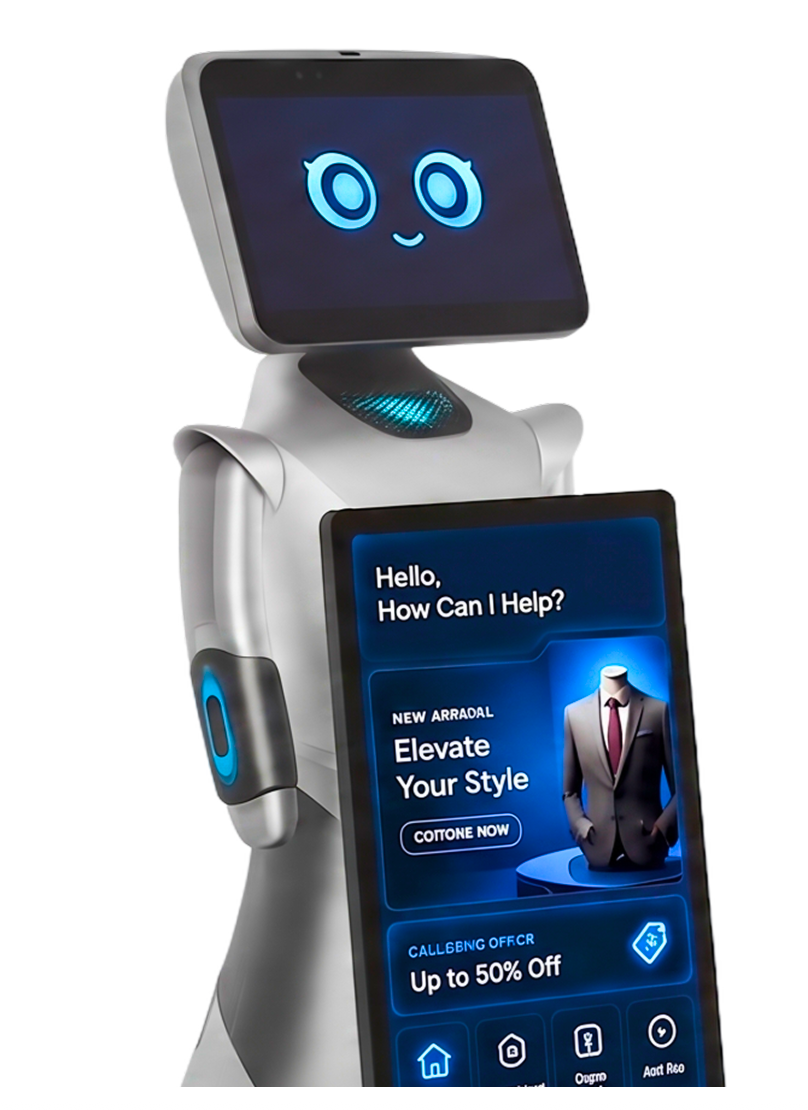
The retail industry is reaching a distinct inflection point within hypermarkets. Operators are simultaneously facing a demographic squeeze, persistent frontline labor shortages, and rising customer expectations for immediate physical and digital convenience. In core markets across Europe, the US, and Asia, working-age populations are steadily contracting. Meanwhile, voluntary turnover rates in retail approach 26.7% annually. Furthermore, large-format stores struggle to maintain consistent service coverage during peak weekend rushes and holiday trade. These converging factors mean the traditional human-only staffing model is no longer financially or operationally viable. As a result, the cost curve of automation has crossed the threshold of practical necessity. Instead of novelty deployments, operators are adopting reception robots and greeting robots as a scalable, industry-level solution. These systems absorb the high volume of routine wayfinding and greeting inquiries. Above all, this shift allows large-format retailers to maintain an "always-on" baseline of service without proportionally scaling their human workforce.
These pressures collectively point to one conclusion—the traditional model is unsustainable.
The OrionStar GreetingBot series provides a dual-model differentiated solution to address these exact operational constraints. Rather than offering a single generic device, the series recognizes that hypermarkets require diverse form factors for varying spatial layouts.
The GreetingBot AD is engineered for high-visibility engagement at store entrances and busy promotional zones. According to manufacturer data, it features a 21.5-inch FHD chest display and an upgraded 20 Ah battery delivering up to 10 hours of runtime, depending on environmental conditions and usage patterns. Therefore, it effectively serves as a dynamic, mobile digital signage platform, broadcasting daily specials and guiding incoming traffic during peak hours without needing a mid-shift recharge.
In contrast, the GreetingBot Mini is specifically designed for high-density environments like checkout areas, narrow aisles, customer service desks, fresh-product zones, and electronics corners. Built with a highly compact chassis, it achieves a minimum passable width of 55 cm under ideal operating conditions, according to manufacturer data. Furthermore, its 6-mic circular array delivers reliable voice interaction and query resolution designed for dynamic retail conditions.
The fundamental logic here is highly complementary. This is not a question of which model is better, but a targeted strategy of assigning specialized tools to cover different scenarios. Both models support robust digital management capabilities, utilizing Wi-Fi 6, 4G networks, and multi-robot scheduling systems to enable centralized over-the-air updates and remote fleet supervision. Optimal multi-robot scheduling performance requires continuous, stable Wi-Fi 6 or robust cellular network coverage across the deployment zone. Because these robots rely on cloud-connected cameras and microphones to function, operators must rigorously verify GDPR compliance. Configuring the devices for data minimization, utilizing privacy-first computer vision processing that can be configured to avoid storing personally identifiable information, and securing appropriate consent via entrance signage are recommended best practices for compliance. OrionStar supports local network configurations and data encryption to help operators meet local privacy regulations, while operators remain responsible for entrance signage.
These results reflect active deployments validated by store managers, retail operations directors, and customer experience managers.
In the retail sector, automation is fundamentally a tool for elevating human workers rather than replacing them. The core objective is workload reallocation. Robots handle the repetitive, large-scale tasks such as continuous greeting, basic wayfinding, and playing promotional loops. As a result, human associates are redirected toward high-value work that requires empathy and judgment, such as complex customer service, accessibility assistance, and quality supervision. This transition is naturally fostering the creation of new professional skills within the retail environment. Store managers and retail operations directors are adopting fleet management roles, establishing service boundaries and overseeing active multi-robot scheduling. Simultaneously, customer experience managers are taking on integration responsibilities to ensure the technological handoff remains intuitive. Frontline workers are learning to supervise robot behavior, update display content, and intervene when exceptions occur. In short, automation acts as a supportive infrastructure, allowing human staff to step away from repetitive fatigue and focus directly on meaningful customer interactions.
Looking forward, reception robots and greeting robots are steadily transitioning into foundational infrastructure for the retail industry. As demographic shifts and labor constraints solidify, hypermarkets will increasingly rely on automated systems to maintain baseline operational stability. The OrionStar GreetingBot series provides a practical pathway for this integration, offering multiple models to adapt to different spatial and functional requirements across the store. By carefully matching the right robotic form factor to specific internal zones, retailers can effectively balance spatial limitations with interactive demands. Ultimately, the successful hypermarket of the future will not be defined solely by human labor or pure automation. Instead, it will rely on a hybrid operational model where technology consistently absorbs the routine, allowing human teams to focus on delivering distinct retail experiences.