

REQUEST DEMO
Robot CATALOG will be sent to your mailbox immediately after submission.
SUBMIT
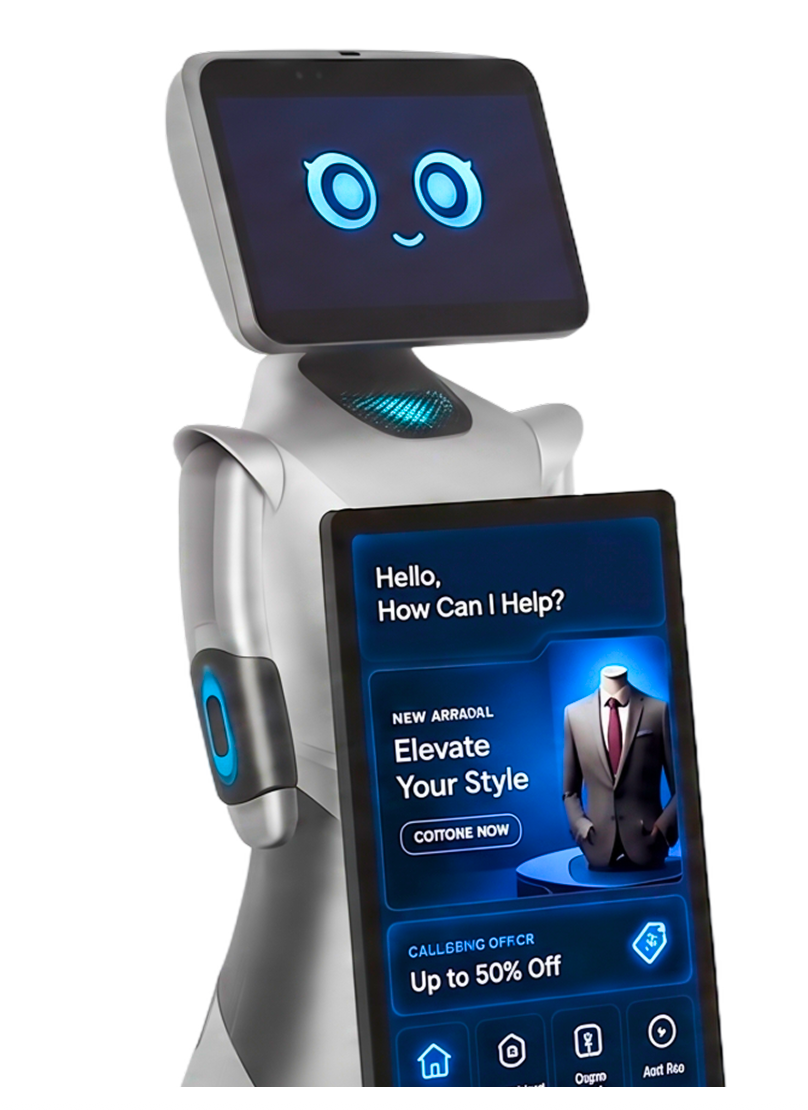
For retail store managers, store operators, and retail experience managers, maintaining a consistent and engaging in-store environment is an ongoing operational hurdle. As physical retail locations compete with digital channels, the quality of customer service directly impacts foot traffic and conversion rates. However, achieving high service standards is increasingly difficult due to workforce volatility.
This guide evaluates the application of a physical retail reception robot—specifically focusing on the OrionStar GreetingBot AD—within retail stores. By examining industry data and the robot's technical specifications, this document aims to help operators determine if this technology aligns with their in-store reception, wayfinding, and engagement requirements.
Store operators currently face a combination of structural labor shortages and rising customer expectations. Understanding these challenges is necessary when evaluating any automated reception solution.
Frontline labor shortages and turnover: The retail sector continues to experience significant staffing gaps. Recent industry data indicates a retail trade openings rate of 4.8%, with voluntary turnover rates reaching 26.7% annually. Replacing frontline workers costs approximately 40% of their annual salary. When locations operate short-staffed, the immediate consequences are longer wait times at customer service desks, unattended storefronts, and a degraded brand experience.
Peak-traffic coverage gaps: Retail stores manage pronounced peak periods—such as weekend rushes or limited-time product drops in pop-up zones—where the demand for wayfinding, queue management, and general inquiries outstrips the capacity of available human staff. During these intervals, maintaining a consistent standard of customer greetings often requires technological assistance during peak hours.
The shift toward digital self-service: Modern shoppers expect instant access to product information and digital wayfinding. Retailers who fail to bridge the gap between physical spaces and digital convenience risk losing engagement. Consequently, operators are moving toward an augmentation model, where routine tasks are automated so human associates can focus on complex problem-solving and creative merchandising.
The OrionStar GreetingBot AD is designed to function as a mobile, interactive touchpoint. Rather than replacing human associates, it absorbs predictable, high-volume interactions across specific retail sub-spaces.
In high-traffic areas like store entrances and temporary pop-up zones, capturing customer attention is critical. As a specialized greeting robot, the OrionStar GreetingBot AD is equipped to manage first impressions.
According to manufacturer data, the unit features a 6-microphone circular array with 360° sound source localization, allowing it to accurately detect and face approaching customers, subject to ambient noise levels in the operating environment. To facilitate natural face-to-face interaction, the robot utilizes a dedicated head pitch motor that adjusts from −15° to +40°.
A defining capability of this model is its dual-screen configuration. It combines a 14-inch FHD touch screen on the head for direct interaction with a 21.5-inch FHD display mounted on the chest. This allows the robot to simultaneously answer a customer's spoken question while broadcasting digital signage—such as current promotions, loyalty program details, or event schedules—to passersby.
Navigating large retail footprints or locating specific checkout areas often creates friction for shoppers. The OrionStar GreetingBot AD provides autonomous leading capabilities to mitigate this.
Under defined test conditions, its navigation stack—which includes LiDAR, wheel odometers, and camera sensors—supports mapping areas up to 50,000 square meters. The chassis measures 465 mm in width, giving it a passability clearance for corridors as narrow as 60–65 cm, according to manufacturer data and depending on environmental layout. This allows the robot to smoothly guide shoppers through standard retail aisles or direct them to customer service desks without disrupting the flow of foot traffic.
While robots should not be deployed inside private areas like fitting rooms, they serve as highly effective triage points nearby. Stationed near service desks or the entrances to fitting room corridors, the robot can answer frequent questions about return policies, operating hours, or sizing guides via its interactive touch screen and voice interface. This redirects routine inquiries away from staff, preserving their bandwidth for complex customer service interactions.
Industry research into social and humanoid robotics in retail environments highlights measurable benefits when deployments are managed correctly.
Revenue and engagement lifts: Historical deployments of interactive robots in large-scale retail settings have demonstrated positive outcomes. For example, specific electronics and beverage brand deployments recorded up to a 15% increase in featured product sales and extended customer dwell times. While early metrics often reflect a novelty effect, the durable value lies in the consistent delivery of promotional messaging via the chest-mounted 21.5-inch display.
Workforce augmentation and ROI: By offloading repetitive wayfinding and greeting tasks, human staff can be reallocated to high-value interactions. When analyzing the economics of retail automation, mid-range service robots typically yield a payback period ranging from 12 to 24 months, depending on local labor costs and the specific lease or purchase models utilized.
Deploying a physical retail reception robot requires careful integration with existing IT infrastructure and strict adherence to data privacy laws.
Retail chains demand centralized control over in-store hardware. The OrionStar GreetingBot AD features 8 GB RAM and 128 GB ROM for smooth operation. It runs on Agent OS and supports Wi-Fi 6 as well as standard 4G connectivity. This allows IT teams to execute over-the-air (OTA) content updates, ensuring that promotional media on the chest display is always current across multiple store locations.
To support full-shift operations, the device is equipped with a 20 Ah battery. According to manufacturer specifications, this yields an estimated runtime of up to 8–10 hours under typical workloads, covering the bulk of a store's operating hours before requiring a return to its charging dock.
The OrionStar GreetingBot AD utilizes a 2 MP wide-angle camera and a 13 MP high-definition camera to facilitate user interaction and spatial awareness.
Disclaimer: Retail operators must verify compliance with GDPR, CCPA, and applicable local laws prior to deployment. Operators are strictly responsible for displaying clear privacy notices, securing required user consent for data collection (e.g., interaction logs, spatial mapping), and enforcing compliant data retention policies.
Under GDPR, biometric data processed to uniquely identify an individual is classified as a "special category" of data, which carries strict consent requirements. To minimize compliance risks, retail operators should configure the device to rely on non-biometric computer vision and interaction logs, avoiding the capture or processing of facial images for unique identification without explicit legal grounds.
Does the robot require technical staff on-site to operate? No. Once the initial LiDAR mapping and content configurations are completed, the robot navigates autonomously. Store operators can manage daily routines (like turning it on or sending it to a charging dock) with minimal training, while centralized IT teams can manage software and display content remotely.
Can the robot physically hand items to customers? The OrionStar GreetingBot AD is primarily a digital engagement and wayfinding platform. While it has a maximum load capacity of 4 kg (suitable for carrying small promotional flyers on an optional tray), its arm motion is disabled by default in this specific edition to prevent physical interference with the large 21.5-inch chest display.
Are there other models available for different store sizes? Yes. The OrionStar GreetingBot series includes various models and configurations tailored to different venue requirements. Operators who do not require a large chest display or who prioritize different interactive features can explore other units within the series to find the exact match for their specific floor plan and budget.
Will the robot struggle with varied flooring types? According to manufacturer specifications, the robot is designed to operate on hard indoor surfaces common in retail environments, including wood, cement, marble, and low-pile hard carpet. It is capable of handling floor transitions, crossing ground bumps up to 10 mm and floor seams up to 20 mm.