

REQUEST DEMO
Robot CATALOG will be sent to your mailbox immediately after submission.
SUBMIT
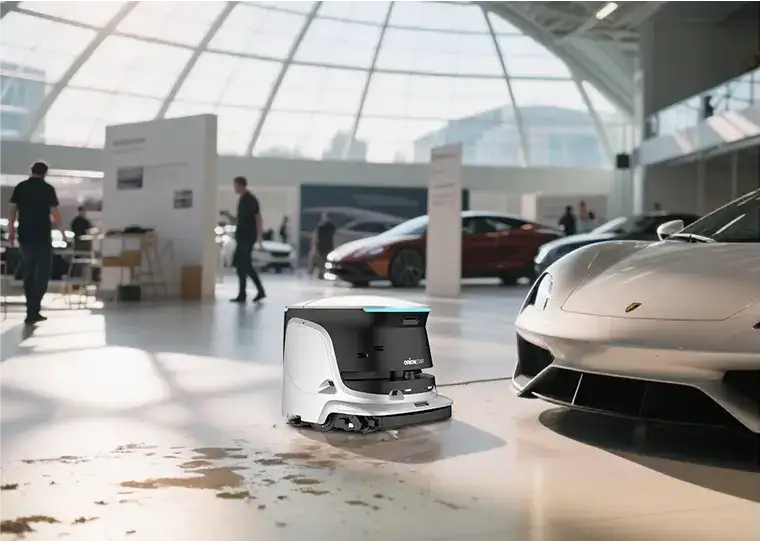
In the demanding sector of Retail Property Management, maintaining entrance lobbies in shopping malls presents significant challenges due to chronic staffing shortages, escalating labor costs, and stringent safety compliance requirements. These highly visible transition zones endure the heaviest foot traffic and constant weather-driven debris, making manual upkeep both expensive, difficult to staff, and highly inconsistent. To address these compounding operational hurdles, commercial cleaning robots have emerged as a practical solution, offering automated, reliable, and verifiable floor care that directly alleviates workforce strain while ensuring consistent hygiene standards from the moment a shopper walks through the door.
Illustrating these industry-wide technological advancements, the OrionStar CleaniBot C5 functions as an autonomous floor-scrubbing platform engineered for medium-to-large retail environments. According to manufacturer data, the unit utilizes a 550 mm main brush to achieve a maximum cleaning capacity of up to 1,980 square meters per hour, efficiently managing the vast floor plates typical of retail properties. It supports continuous multi-shift operation through automatic recharging and an automated workstation that handles clean-water refilling and waste-water discharge, substantially limiting the need for manual intervention. Additionally, its integrated sensor array allows the robot to maintain safe operation around pedestrians while navigating typical mall corridors with a minimal passing width of approximately 880 mm.
These transition zones endure the highest concentration of tracked-in rainwater, slush, and grit, creating immediate slip hazards that manual crews struggle to keep pace with. Autonomous robots programmed for frequent, targeted cycles can continuously extract this wet and dry mixed debris before it spreads deeper into the property.
Featuring vast open floor plates and frequent temporary installations, atriums present a significant square-footage challenge for manual cleaning crews facing tight timeframes. Large-format cleaning robots leverage autonomous path planning to efficiently scrub these wide areas overnight, ensuring consistent cleanliness without excessive labor costs.
High foot traffic funnels through these narrow security zones, leading to the rapid accumulation of dust and scuff marks on mixed flooring types. Intelligent robots utilize real-time obstacle avoidance and automatic surface identification to safely clean around queuing shoppers while seamlessly transitioning between hard floors and security matting.
Commercial cleaning robots seamlessly integrate into the existing digital infrastructure of a shopping mall, aligning with Building Management Systems (BMS) and Computerized Maintenance Management Systems (CMMS). Through modern APIs and connected IoT dashboards, these robots share real-time telemetry, route statuses, and detailed cleaning logs directly with centralized facility platforms. This connectivity allows mall facility managers to merge robotic cleaning data with broader maintenance work orders, energy metering, and incident records, transforming floor care from an isolated manual task into a measurable component of the smart-building ecosystem.
Automating floor maintenance not only elevates daily hygiene but actively translates standard compliance requirements into quantifiable, data-backed operational assets that support a shopping mall's long-term ESG targets.
Ultimately, the adoption of commercial cleaning robots is fundamentally changing how Retail Property Management approaches the daily maintenance of entrance lobbies in shopping malls. By addressing chronic labor shortages, mitigating slip-and-fall hazards, and providing verifiable compliance data, these automated systems offer a practical, highly efficient alternative to traditional manual floor care. For properties looking to modernize their facility maintenance strategies, product lines like the OrionStar CleaniBot series provide multiple models engineered to adapt to the diverse spatial and operational demands of the modern retail environment, ensuring there is a suitable configuration for every architectural layout.